Learning how to write a thank you note with a child works best as a guided activity rather than a writing test. You pick the person to thank, match the method to your child’s writing level, help them say one specific thing about the gift or the kindness, then handle the envelope and delivery yourself. Fifteen minutes is usually enough.
I have three kids, and the difference between a note that takes twenty minutes of negotiation and one that takes four is almost always preparation. Nothing ruins the mood faster than a child staring at a blank card at 7pm on a Sunday while you search your phone for an address.
What the activity actually teaches is worth the effort. Writing a thank you note forces a child to name a person, name something specific, and put it in order on a page. That is real writing practice wrapped inside a social skill, and the note itself is proof you cared enough to bother.
This guide covers the whole process, from getting ready to mailing, plus age-appropriate wording, what to do about a gift nobody likes, and how to handle a child who would rather go outside.
Table of Contents
- 1What You Need Before You Start
- 2Step-by-Step: How to Write a Thank You Note with a Child
- 3Choose Who to Thank
- 4Say What the Person Did
- 5Write the Thank-You Message
- 6Add a Personal Touch
- 7Review, Sign, and Deliver
- 8Common Mistakes and How to Fix Them
- 9Frequently Asked Questions
- 10What age should kids start writing thank you notes?
- 11What do you write in a thank you note from a young child?
- 12How do I help my child write a thank you note for a gift they do not like?
- 13Should kids write a thank you note for every gift?
- 14Can a child send an email or video thank you note instead?
- 15How do I stop thank you notes from turning into a battle?
- 16Conclusion
What You Need Before You Start
Everything for this activity is probably already in a drawer. The useful part is setting it up once instead of hunting for it each time.
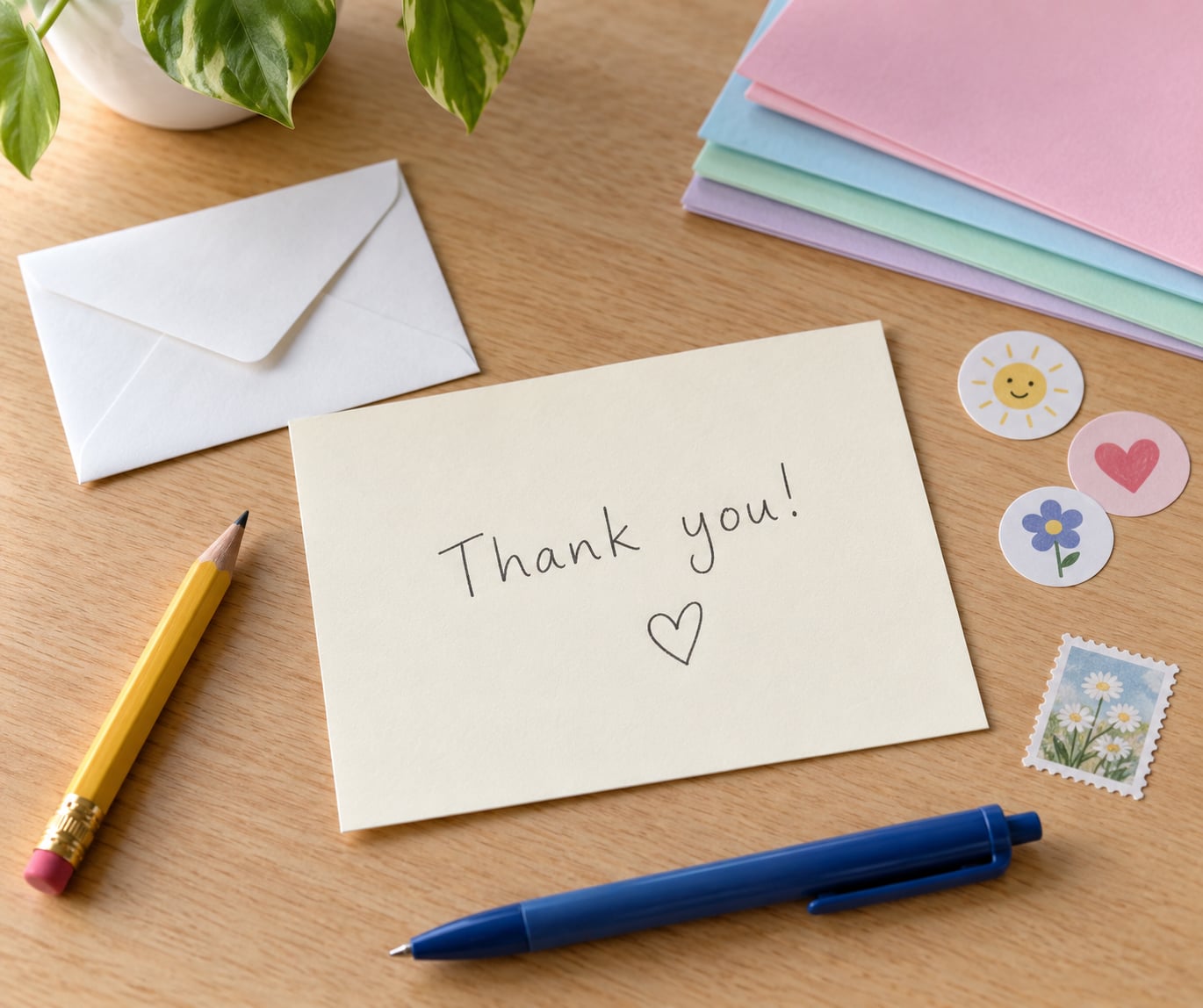
- Paper or blank cards. Folded paper works fine, and index cards cut the amount of writing a beginner has to do.
- Something to write with. A thick pencil or a crayon is kinder to small hands than a fine-tip pen. Older kids can use a marker or a colored pencil.
- An envelope that fits the card, plus a stamp. A card that has to be folded twice gets folded wrong and never gets sent.
- A quick list of who gave what. Jot the giver and the gift in your phone the day of the party or while presents are being opened. You will not remember by the time the note gets written.
- The reason for saying thanks, in one sentence you could read out loud. That is the part the child borrows.
- Ten quiet minutes. Not a scheduled lesson. A kitchen table with a snack and no screens is plenty.
A small thank you note kit makes the routine stick. Use a shoebox or a drawer with blank cards, envelopes, stamps, markers, colored pencils, stickers, and a roll of washi tape. When the box comes out, the child knows what is happening, which removes the negotiation phase entirely.
Step-by-Step: How to Write a Thank You Note with a Child
The order below runs from the moment the gift arrives to the moment the note goes in the mail. Skip a step and the note tends to feel vague or take twice as long.
Choose Who to Thank
Start by naming one person. Not the whole room, not every adult who said something nice. One note, one recipient, because a child can hold a single idea in their head but not five.
Tie the note to something concrete: a specific gift, a welcome, an act of help, or time spent together. A grandmother who drove two hours and brought a board game gets a different note than a classmate who signed a shared card, and the child can understand that difference once you say it out loud.
Match the method to the child rather than to the note. A two-year-old scribbles, stamps, and signs their name or makes a mark you describe as their signature. A four-year-old draws, dictates one sentence, and adds their name. A six- to eight-year-old fills in blanks for the opening and closing lines and writes the middle in their own words. Nine to eleven can start from a blank card with you nearby. Twelve and up can handle the whole thing including the address if you want them to.
One rule keeps the mood reasonable: no opening the new gift until the note is written. Families who try this say it works more often than not, because the alternative is a child writing about a toy they are already distracted by.
Say What the Person Did
This is the part that turns a generic note into a real one, and it is the part adults skip. A child who has only been told to say thank you will write thank you for the present and stop.
Ask three questions and write the answers down where the child can see them:
- Who gave it, and what did they give?
- What is one detail about it? A color, a character, a flavor, a size, a book title.
- When will you use it?
The third question does a lot of work. It turns a static object into a plan, and it gives a shy six-year-old something to say beyond thanks.
Then hand the child a sentence starter to complete in their own words. Keep them short:
- Thank you for the…
- I like how…
- I am going to…
- You helped me when…
For a child who says thank you really loudly but writes nothing, dictate. You write the sentence, they say it, you write it down word for word, and they sign their name at the bottom. Their words, your handwriting, at least for now.
Write the Thank-You Message
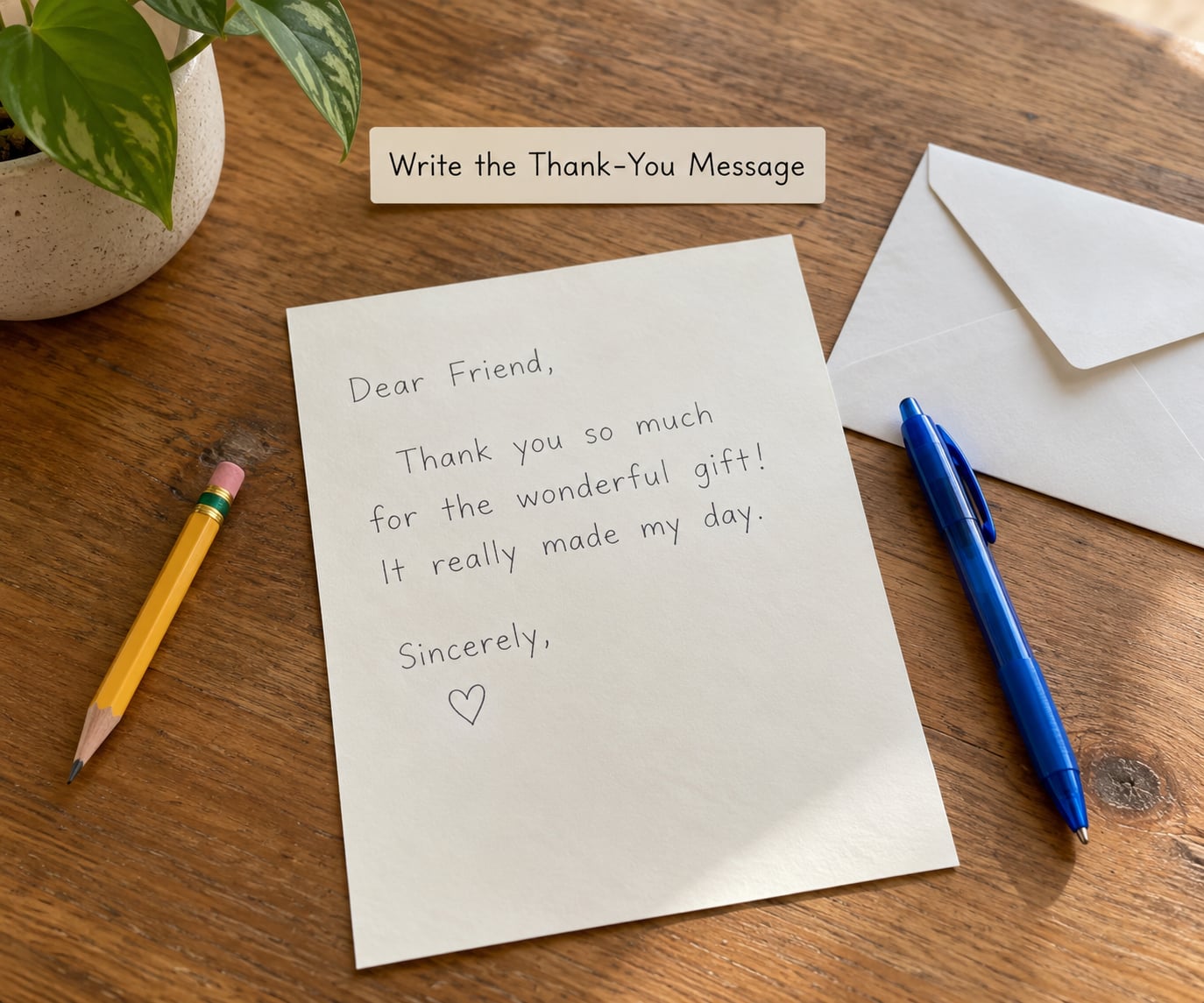
A thank you note has four working parts: a greeting, the thanks, one specific detail, and a closing. That structure works for every age once you adjust how much the child fills in.
A note a confident young writer can copy:
Dear Grandma Ruth,
Thank you for the board game. I like the one with the blue pieces and the tiny houses. I am going to play it with Dad on Sunday. I like that you came to my party.
Love, Maya
The same note with blanks for an early writer:
Dear ________,
Thank you for the ________. I like ________. I am going to ________.
Love, ________
Word choice matters more than length. Lovely, gracious, and appreciate are heavy words for a seven-year-old. Sweet, fun, my favorite, I can hardly wait, and you remembered are words a child can actually mean.
For money gifts, the note is easier than parents expect. Thank you for the money, I am saving some for a skateboard and I am going to put the rest in my star jar.
For a gift the child cannot stand, honesty beats a fake compliment. Thank you for the sweater, I like that you thought of me, I will wear it for the school picture. Then let them be a child: I wish it were a different color. A note that admits a feeling reads as more honest than one that fakes delight, and it still models good manners.
Add a Personal Touch
Personal touches are how a note stops looking like a form letter. Pick one, not five. Too many crafts and the writing itself gets lost.
- A small drawing, even a scribble, on a card the child folded themselves.
- A photo of the child holding the gift tucked inside the card.
- A detail only the two of them would know, like a joke from the party.
- A decorated envelope with stickers or washi tape, which children often prefer to writing.
- One colored sentence written in a marker on top of the pencil text.
Letting your child choose between two options keeps the sense of control without opening the whole craft drawer. Two cards, or two pens, or a drawing or a sticker.
For group gifts where you do not know exactly who gave what, note the group and the specific thing your child enjoyed. Thank you for the gift from my cousins. I have already put the puzzle together.
Review, Sign, and Deliver
Read the note back to your child before it goes in the envelope. You are checking three things: that the name at the top matches the person, that one specific detail made it in, and that there is a closing line.
Signing is not optional. A thank you note without a signature reads like an oversight, and signing your own name is a separate skill worth practicing.
Address the envelope together, even with older kids. Return address, then recipient name, then street, then city and state, then the stamp. Index cards give you a second address to practice on.
On timing, mail birthday notes within about two weeks, which keeps them connected to the event. Holiday notes go out before the new year by convention. Thank you notes for hospitality, help, or an invitation can go out within a few days, because the kindness is still fresh.
Handwritten mail still matters to grandparents, and a note arriving in real mail gets commented on for years. Email or a video message is fine when someone lives far away and writes rarely, though a physical note for a physical gift is the stronger habit. If you want both, send a card and add a photo of the child holding the gift inside.
Common Mistakes and How to Fix Them
The thank-you is too vague. Thank you for the present tells the giver nothing. Fix it by asking the three questions in the step above and requiring one detail about the gift before the note is finished.
It sounds like an adult wrote it. Parents often polish the wording until the voice disappears, and children notice. Say the child’s sentence back slightly wrong if you have to. Kids forgive messy handwriting faster than they forgive a stiff note.
You asked for too much. Four demanding sentences from a five-year-old is why this turns into a fight. Cut it to one sentence plus a signature and add difficulty in a few months.
The signature is missing. Very common, especially when a parent finishes the card at the last minute. Put a reminder to sign inside the card, and treat an unsigned note as a to-do rather than a failure.
The envelope does not fit the card. Fold the card to match the envelope rather than forcing a card into a smaller one. Half the notes that never get mailed fail for this reason.
You cannot find an address or a stamp. Take the address at the door, in your phone, while the person is still close by. It takes ten seconds and removes the most common reason a note sits on the counter for months.
Two habits fix most of the rest. Have the child write while you write, so the note is company rather than supervision, and let them pick the card and the stamp. Parents who write their own note at the same table report the same result: the child stops treating it as a chore.
Frequently Asked Questions
What age should kids start writing thank you notes?
Start as early as two, using scribbles, stamps, and a signature mark, because the goal at that age is the ritual rather than the words. Around four, add one dictated sentence and a drawing. From six to eight, fill-in-the-blank cards work well. Nine and up can usually write independently. A child who can comfortably write a paragraph can write a thank you note, so handwriting fluency matters more than age.
What do you write in a thank you note from a young child?
Keep it to three parts: thank you for the gift, one specific detail about it, and when the child will use it. A five-year-old note might read, Dear Nana, thank you for the blue truck. I like the big wheels. I am going to race it with Ben. Love, Max. The detail is what makes it land, and it is the piece most parents forget to prompt.
How do I help my child write a thank you note for a gift they do not like?
Let them say the truth and still be polite. Ask for thanks for the thought, plus one honest line: I wish it were a different color, or I do not know what to do with it yet. Children read fake praise as fake, and they remember being caught in it. Practising an honest line now is a useful adult skill too, since most grown-ups avoid them.
Should kids write a thank you note for every gift?
No, and they do not need to. A handwritten note suits a personal gift, money, or a group gift. For small classroom treats or a quick stop by, a verbal thank you at the door is enough. Sending a note for every single item trains children to write fast and mean nothing by it. Most etiquette guidance suggests a note within two weeks for a birthday and before the new year for the holidays.
Can a child send an email or video thank you note instead?
Yes, when the recipient rarely receives real mail. Email suits a distant relative who works full time, and a short video where the child says thank you and shows the gift feels genuine rather than obligatory. A handwritten card still wins for grandparents, teachers, and anyone who gave something in person, because the effort of the handwriting is part of what the note says.
How do I stop thank you notes from turning into a battle?
Lower the target before you start, write alongside your child, and let them choose the card and the stamp. A ten-minute session at the kitchen table with a snack beats a scheduled lesson every time. If resistance continues, switch to dictation and keep it to one sentence. The habit matters far more than the sentence, and a short note sent on time beats a perfect one never written.
Conclusion
Start tonight, not after the next birthday. Grab a blank card and a pencil, ask your child who to thank and what that person did, and write one honest sentence together. Ten minutes and a signed envelope is a finished thank you note, and doing it now teaches the habit before the arguing starts.