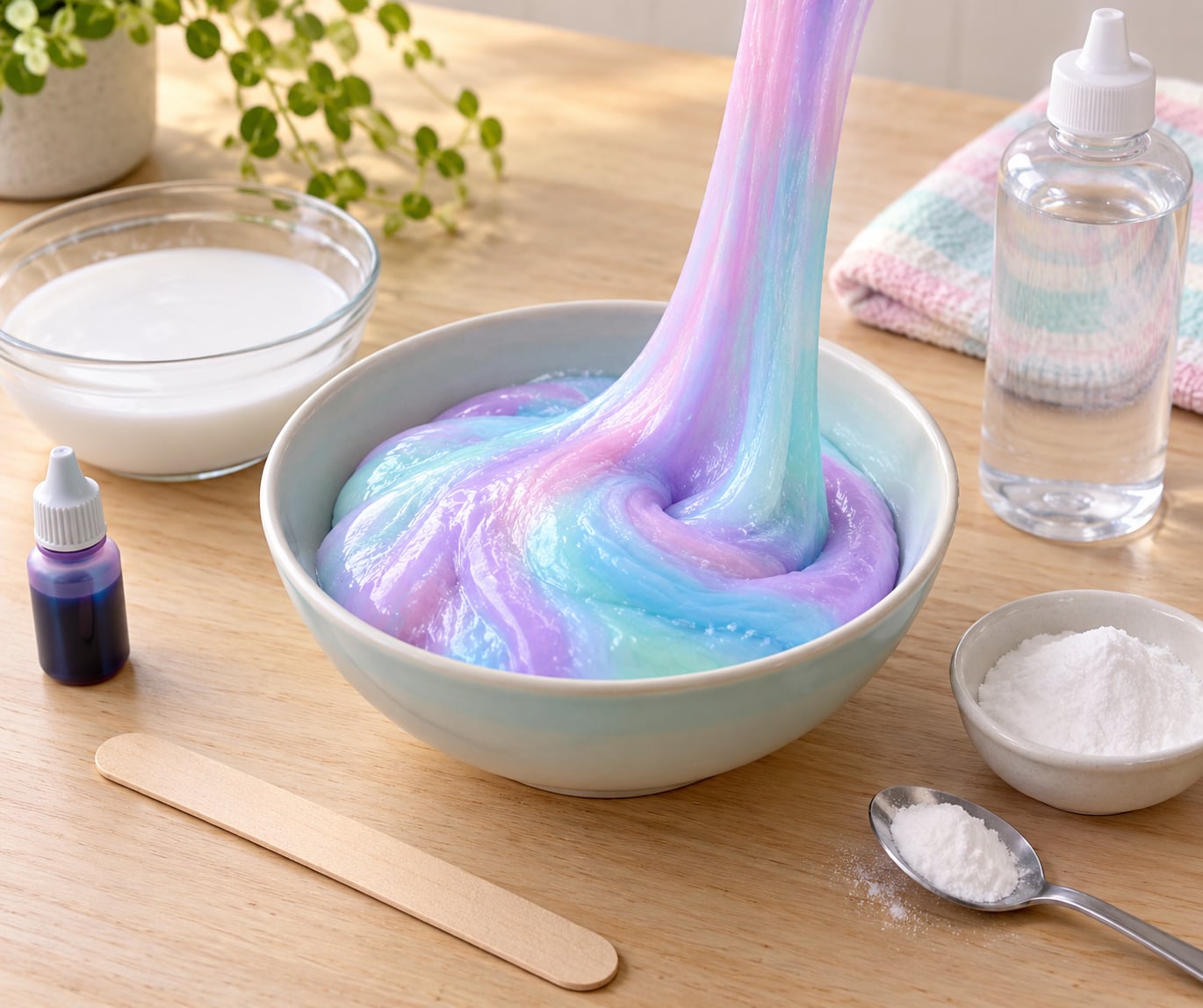
You can make slime without borax with three things you probably already own: washable school glue, baking soda, and contact lens solution. The baking soda raises the pH of the mixture, the borate in the eye solution links the glue’s polymer chains together, and about ten minutes later you have the stretchy, pull-apart slime kids ask for on repeat. No special-order activator, no laundry-starch warnings on the label.
It is worth being straight about one thing up front. Contact lens solution contains boric acid, which is what borax dissolves into in water. So this recipe is borax-free in the practical sense that no box of borax goes in the bowl, but it is not boric-acid-free. If your household needs to avoid boric acid completely, the shampoo and cornstarch method further down uses nothing but pantry and bathroom staples.
Table of Contents
- 1What You Need for How to Make Slime Without Borax
- 2Step-by-Step: How to Make Slime Without Borax
- 3How to Get the Right Slime Texture Without Borax
- 4Fun Slime Variations for Kids
- 5Safety, Storage, and Cleanup
- 6Storage and Shelf Life at a Glance
- 7Common Mistakes When Making Slime Without Borax
- 8Frequently Asked Questions
- 9Can I make slime without glue?
- 10What ingredients can replace borax in homemade slime?
- 11Why is my no-borax slime too runny?
- 12Is homemade slime safe for toddlers to play with?
- 13How long does homemade slime last?
- 14Can I add glitter or food coloring to slime?
What You Need for How to Make Slime Without Borax
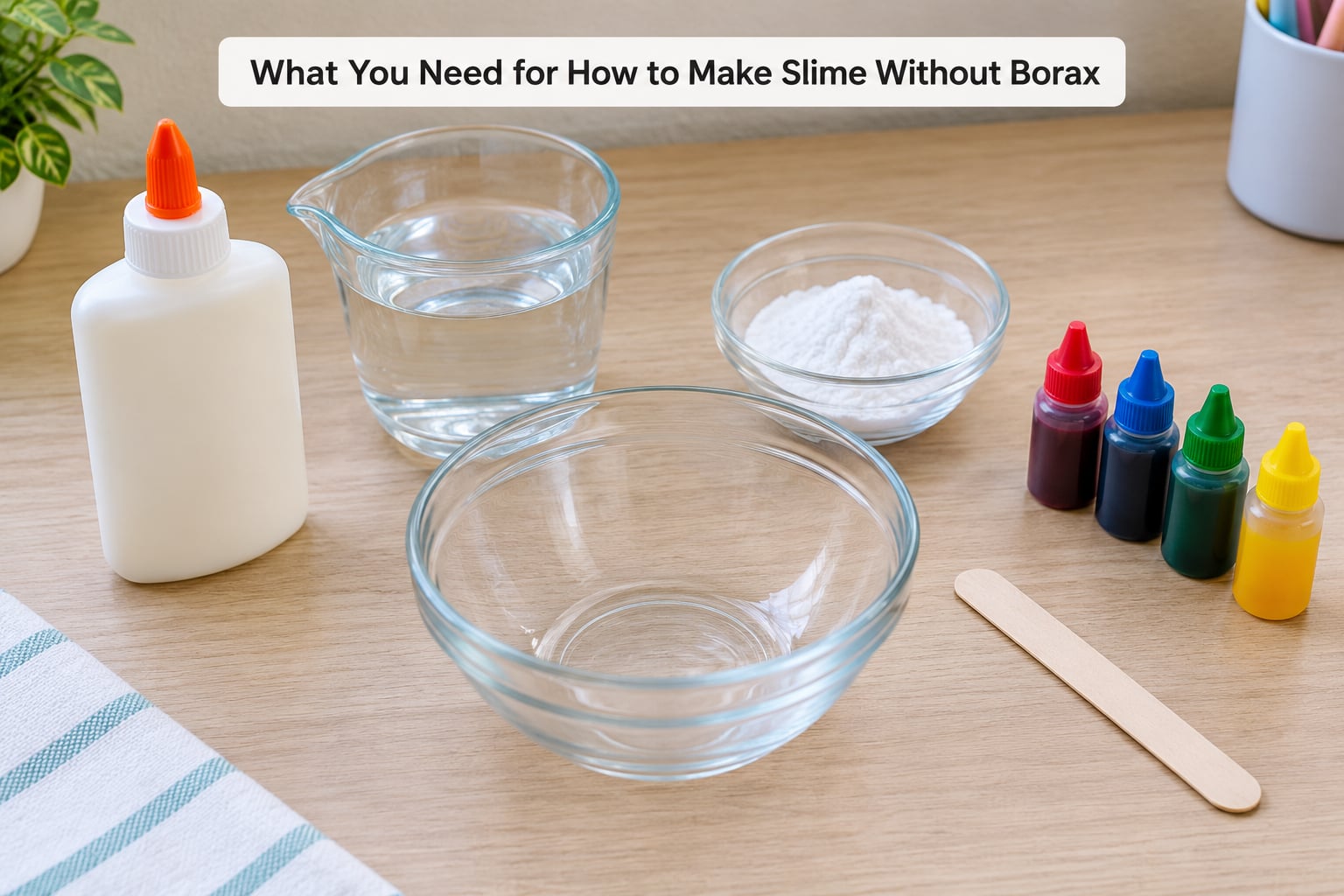
- 120 ml (half a cup) of washable PVA glue – the white school glue sold for crafts. This is the polymer that becomes slime.
- 120 ml (half a cup) of contact lens solution – the buffered multipurpose kind that lists boric acid on the label. Plain saline does not work here, which surprises a lot of people.
- 1 teaspoon of baking soda
- 60 ml (a quarter cup) of water, for thinning the glue
- Food coloring and a wooden stick or spatula – optional, but easier to mix than a fork
Two things matter more than the rest. The glue must be PVA, and the eye solution must say boric acid on the ingredients panel. Craft glue and Elmer-style glue vary a lot in polymer content, and a bottle that barely holds together will just sit in the bowl as a sticky puddle.
Skip the loose glitter if a child under about five will be handling it. Small pieces of glitter pass straight through, and you’ll be finding them in a bath for a week. Confetti, foam beads, or a couple of drops of food coloring do the same visual job with none of that.
Step-by-Step: How to Make Slime Without Borax
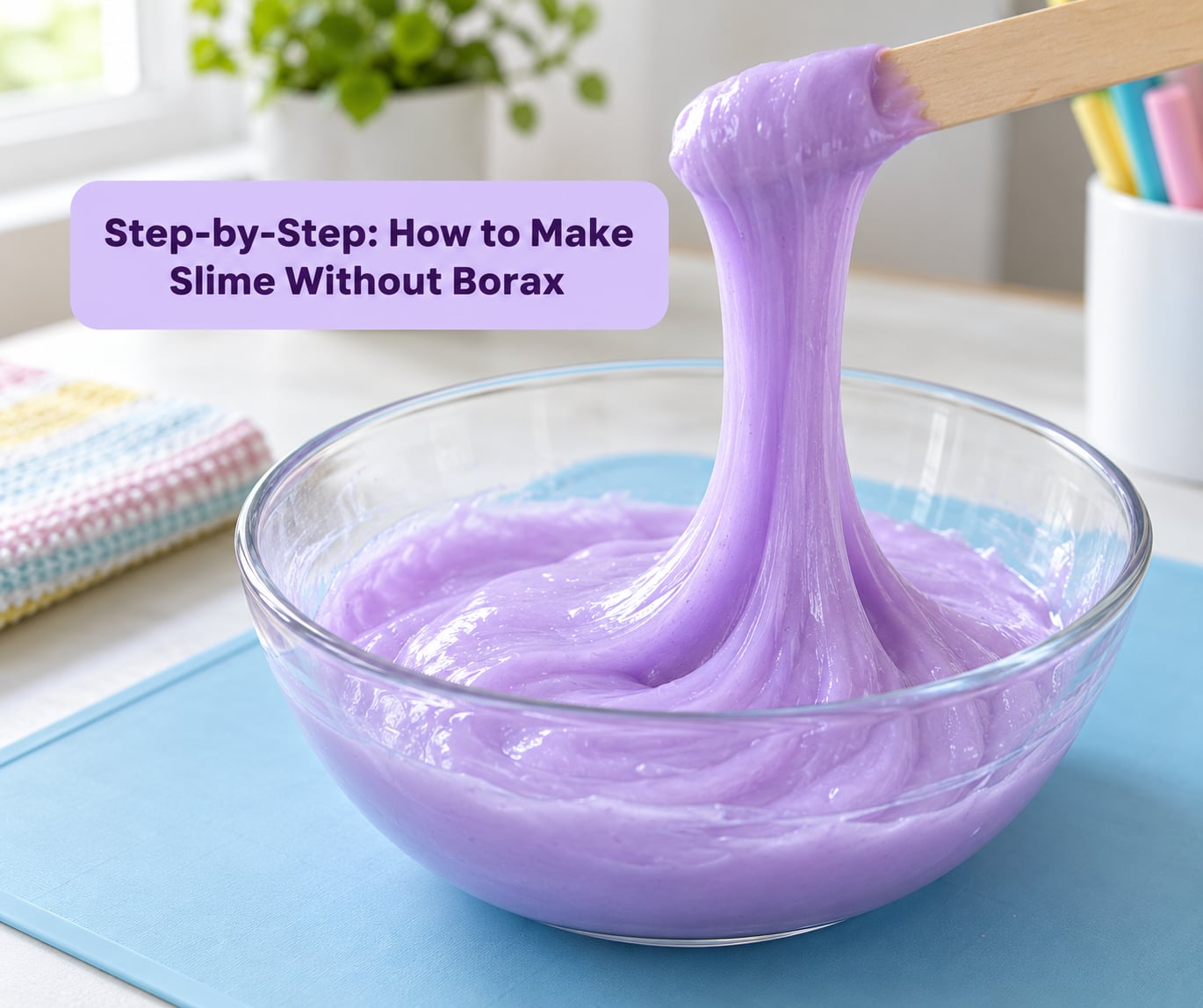
Set a washable mat or old towel under your bowl first. The mixture is forgiving about a lot of things but not about spatters of colored water.
- Pour in the glue. Empty the full half cup of PVA glue into a mixing bowl. If you want colored slime, add 4 to 6 drops of food coloring now and stir until the color is even, before any water thins it out.
- Add the water and stir. Pour in a quarter cup of water and mix for a full minute with the wooden stick, scraping the sides and the bottom. It should go from a thick paste to a smooth, pourable cream. Lumps here mean you will get lumps in the slime, so keep stirring until there is no visible grain.
- Add the baking soda. Stir one level teaspoon of baking soda through the mixture and keep going for about 30 seconds. Expect a slight foam and thickening. This is the step people rush, and rushed baking soda is exactly why some batches turn to clumpy soup.
- Add the activator slowly. Pour the contact lens solution in a thin stream while stirring, and keep stirring for another minute to two. The slime starts grabbing the stick at the end of this and stops being a liquid.
- Knead it. Tip the doughy mass onto the mat and knead with clean hands for five to ten minutes. This is the step that gets skipped most often, and it is the difference between slime that stretches for ten seconds and slime that stretches for ten minutes.
- Stretch and test it. Pull a strand slowly between two fingers, then press it into a ball and let it drop onto the mat. It should pull into a smooth ribbon, not snap off in short pieces.
Total time is roughly ten minutes, and you get about one cup of slime. Let it sit untouched for a few minutes before judging it, because it keeps tightening as the polymer network finishes setting.
How to Get the Right Slime Texture Without Borax
Texture is controlled by how much activator you use relative to the glue, and every change should be small. Half a teaspoon of activator at a time is the rule most families land on after a few goopy batches.
- Runny puddle: too little activator or too much water. Add a quarter teaspoon more baking soda and stir, or add 30 ml of plain glue back in. Add one thing at a time so you know what worked.
- Sticky fingers that pick up everything: knead longer, two more minutes, and add a small squirt of the original glue. Washing hands with soap mid-knead usually fixes it faster than adding anything.
- Rubbery and bouncy but short stretch: you have too much activator. Add 2 to 3 tablespoons of plain PVA glue and knead it in. It will look wrong for a minute and then come together.
- Grainy or clumpy: the activator went in before the baking soda fully dissolved. Sieve the batch, or add a tablespoon of water and knead hard to smooth it out.
The same ratio also gives you different textures on purpose. A little under one teaspoon of baking soda with a slow pour of eye solution gives a gooey, pourable slime. Equal measures give the classic stretchy pull-apart version. Adding a spoonful of extra baking soda toward the end firms it up into a kneadable dough that holds a shape for small hands.
Fun Slime Variations for Kids
Change one thing at a time and keep small batches, because doubling a recipe is how you end up with a bowl nobody wants to touch.
- Foam fluff slime: whip half a cup of shaving foam into the glue and water before the baking soda goes in, then add the activator as normal. The result is marshmallow-soft, holds peaks, and dries out faster than the classic version.
- Shampoo and cornstarch: mix 120 ml of thick shampoo with 120 ml of cornstarch, then knead. No glue, no baking soda, no boric acid at all. It behaves more like dough than slime, so treat it as a sensory material for hands rather than a stretchy pull-apart.
- Two-color swirl: split the finished batch into two bowls, tint one and leave one plain, then fold one into the other with a chopstick three or four times. Stop while the swirl is still visible.
- Soft-touch version: beat a teaspoon of plain lotion into the glue before activating. Slower to set and noticeably gentler on dry hands, which matters for kids with eczema.
Leave out instant coffee, powdered drink mixes, and anything labeled for consumption. They stain skin, cloth, and the bowl permanently, and a slime that dyes a child’s hands for a week stops being fun by day three.
Safety, Storage, and Cleanup
Adults should handle the mixing and kneading, and everyone washes hands with soap and water afterwards. Slime is not edible, and it should stay off mouths, eyes, and any open cut or eczema flare-up.
Read the eye solution label. Buffered contact lens solution with boric acid is the standard activator here, and the same borate chemistry is involved whether the borax comes from a box or from a bottle. If you want the boric acid gone too, use the shampoo and cornstarch version instead.
Store the slime in an airtight container in a cool spot, away from direct sun. Expect three to seven days before it dries out and goes rubbery. When that happens, a few drops of water worked back in with kneading brings most of it back.
For cleanup, let dried slime dry fully, then scrape it off rather than chasing it while wet. For slime in clothes, scrape off the dried pieces, pretreat the oily residue with dish soap, leave it for a few minutes, then wash as usual. Hair is harder: work a little oil or conditioner into the clumps, comb gently, then shampoo twice.
Storage and Shelf Life at a Glance
How long a batch lasts depends entirely on air and water, not on the recipe.
- Airtight container, cool cupboard: usually still playable at one week.
- Airtight container, warm room or car: softens within two or three days.
- Left in a bowl or on a mat: usable for a day or two before it crusts over.
- Frozen: thaw slowly in the container; the texture comes back but slightly softer.
Common Mistakes When Making Slime Without Borax
Almost every failed batch traces back to one of six things.
- The batch never thickened. Plain saline was used instead of buffered solution with boric acid. There is no recovery from that ingredient; start over with the right bottle.
- It turned to clumpy soup. Activator was added before the baking soda had dissolved, or all at once. Mix the baking soda in first, fully, and pour the activator in a thin stream.
- It is over-activated and rubbery. Pour in more glue, 2 tablespoons at a time, and knead until the stretch returns.
- Hands are permanently sticky. Knead for another five minutes. The stickiness almost always means the polymer chains have not finished linking, not that you need more water.
- Too much baking soda. It flattens the slime into a stiff, crumbly dough that snaps instead of stretching. Add glue and water together, a tablespoon of each, and knead.
- It is a colored puddle. Too much water went in early. Open the batch on a mat and leave it for an hour; the surface firms and you can knead it back together.
Two habits prevent most of these. Mix everything wet before everything dry, and add the activator slower than feels necessary. A thin stream, not a pour.
Frequently Asked Questions
Can I make slime without glue?
Yes, and the best-known glue-free version is shampoo with cornstarch. Mix about 120 ml of thick shampoo with 120 ml of cornstarch until it forms a dough, then knead for several minutes. It stretches less and pulls apart less than glue slime, so treat it as a sensory material for hands and tools rather than a stretchy pull-apart. It also dries out faster, so store it airtight and expect a few days of play.
What ingredients can replace borax in homemade slime?
The usual replacement is buffered contact lens solution, which supplies the borate needed to cross-link PVA glue once baking soda has raised the pH. Baking soda on its own only thickens the glue; it will not make true slime without a second activator. For a route with no boric acid at all, use shampoo and cornstarch, or cornstarch and dish soap. Plain saline is not a substitute, because it has no boric acid and silently fails.
Why is my no-borax slime too runny?
Three causes account for almost every runny batch: too much water, too little baking soda, or activator that was added too slowly and got diluted. Add a quarter teaspoon more baking soda and stir, or stir in 30 ml of plain PVA glue. If it is still loose, leave the bowl open on a mat for an hour and knead it back together. Note that plain saline contains no boric acid and will never activate glue, whatever the proportions.
Is homemade slime safe for toddlers to play with?
Homemade slime is not edible and is not recommended for children who still put things in their mouths. An adult should handle the mixing and kneading, and hands should be washed with soap and water after play. Keep it away from eyes, mouths, and broken skin, since the glue base and the contact lens solution can irritate all three. For a toddler who needs to taste the activity, a food-only recipe such as cornstarch and water is the safer choice.
How long does homemade slime last?
In an airtight container kept in a cool cupboard, a glue and baking soda batch usually stays playable for three to seven days, sometimes a little longer. Warmth and air are what shorten it, so a bowl left on the counter crusts over within a day or two. When a batch turns stiff and rubbery, work a few drops of water in by kneading and it usually recovers. Freezing and thawing slowly also revives a dried-out batch.
Can I add glitter or food coloring to slime?
Food coloring is safe and works best mixed into the glue before you add water, since the color disperses more evenly. Liquid food coloring or a few drops of gel color both work. Glitter works too, but loose glitter is hard to clean up and should be kept away from children under five; foam beads or confetti give a similar sparkle and are easier to catch. Avoid powdered drink mixes and coffee, which stain skin, hair, and fabric permanently.
Start with the three-ingredient batch above, get the kneading right, and only then experiment. The whole method takes ten minutes and one bowl, and once the base version works, the texture changes are just a matter of how much activator you dare add.