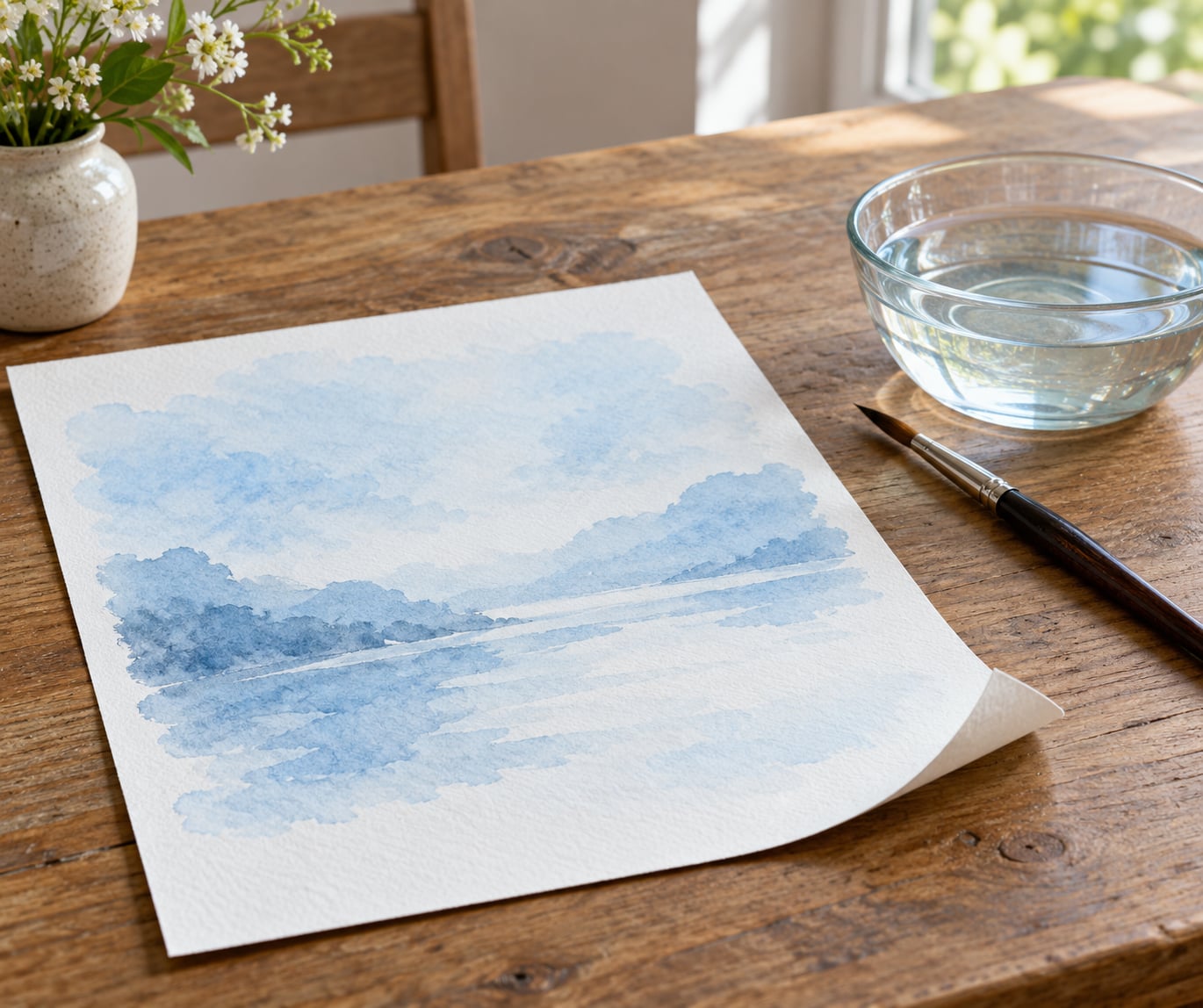
A sheet of watercolor paper buckles because water swells the cellulose fibers in one part of the sheet more than another, and the paper dries in that lopsided shape. The fix is simple, the drying time is the annoying part, and most of it can be avoided with a few habits that are easy for a child to learn.
I’ve watched my own kids lift a finished painting off the table, watch the far edge drop like a drawbridge, and hand it to me with the face of someone who thinks they broke something. Nothing is broken. Watercolor paper does this, and the sheet underneath usually comes out fine.
Table of Contents
- 1Why Does Watercolor Paper Buckle When Painted?
- 2How Water Changes the Paper
- 3What Makes Watercolor Paper Buckle More?
- 4Why Does Watercolor Paper Buckle on Different Surfaces?
- 5How to Flatten Buckled Watercolor Paper
- 6Can You Save a Very Wrinkled or Torn Painting?
- 7How to Prevent Watercolor Paper from Buckling
- 8Why does watercolor paper buckle less when you use less water?
- 9Paper, Paint and Drying Choices for Beginners
- 10Frequently Asked Questions
- 11How long does watercolor paper take to stop buckling?
- 12Can I iron a watercolor painting to flatten it?
- 13Will a heavy book flatten watercolor paper after it dries?
- 14Why is my child’s watercolor paper wrinkling instead of buckling?
- 15What paper weight is least likely to buckle for children?
- 16Conclusion
Why Does Watercolor Paper Buckle When Painted?
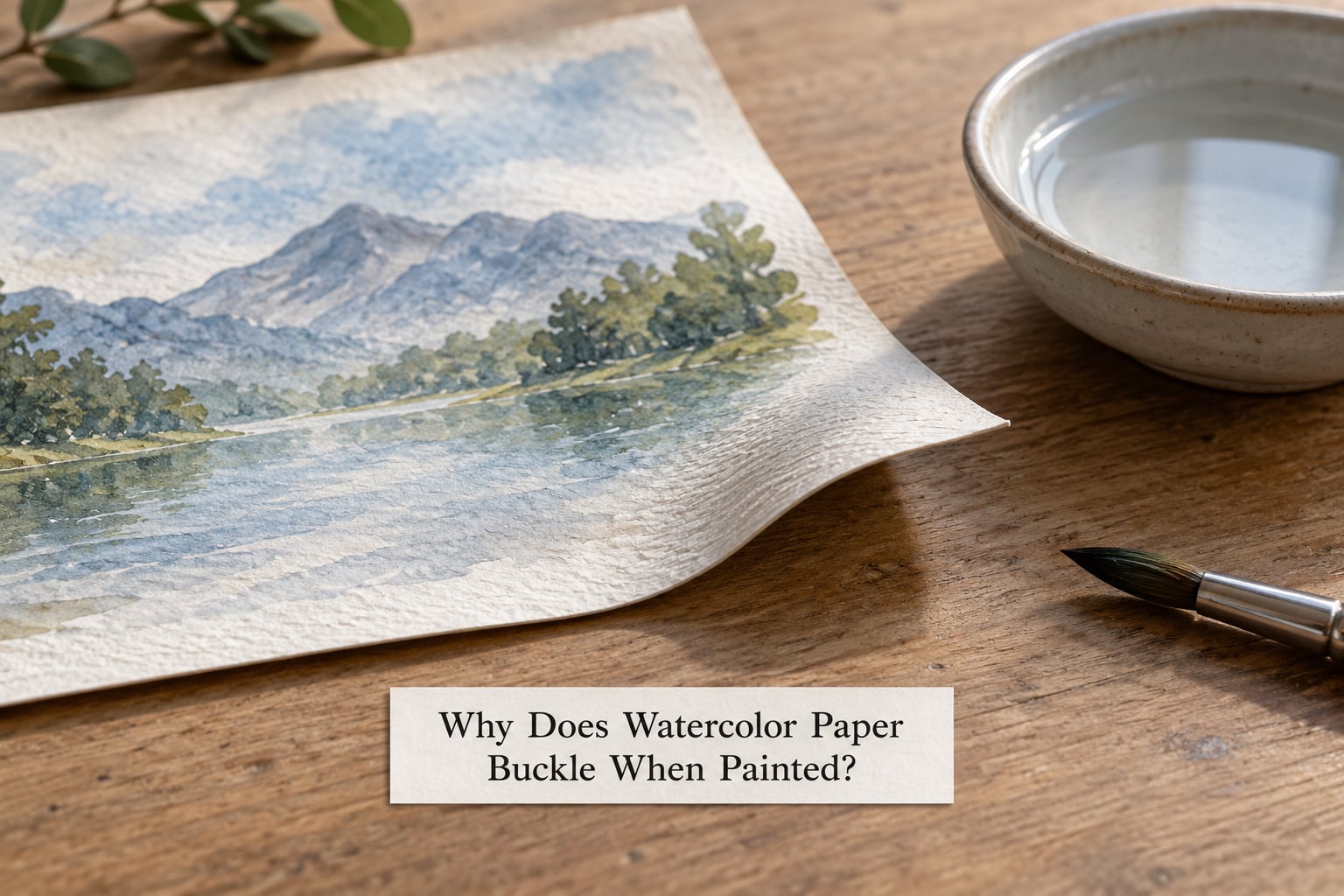
Watercolor paper buckles when wet areas expand faster than dry areas. The sheet swells where you painted, and as it dries the swollen parts shrink back at a different rate, leaving the paper arched, rippled or curled instead of flat.
Light watering and heavy watering produce very different results. How much water you put on the sheet matters more than how good your technique is.
| Water level | What happens to the sheet | How long it takes to settle |
|---|---|---|
| Damp brush, barely wet paint | Mostly flat, maybe a soft ripple along one edge | A few minutes |
| Even wash across the whole sheet | Stays flat if the edges are held or the sheet is heavy enough | 20 to 40 minutes to touch-dry |
| Puddles and standing water | Lifts and cockles badly, corners curl first | Several hours, sometimes overnight |
| Water sitting on one spot only | A permanent hump over that spot, flat everywhere else | Dries fast but stays warped |
My rule of thumb with kids is that if you could blot the brush on a paper towel and still see a mark on the towel, there is too much water on it for a flat sheet.
How Water Changes the Paper
Paper is made of millions of tiny cellulose fibers, more like a bundle of tiny straws than a solid sheet. Water soaks into that fiber network and makes it swell.
Here is what happens, in the order it happens. Water loosens the hydrogen bonds that hold the fibers to each other. Each fiber swells and gets longer and fatter. The swollen sheet physically grows in every direction at once, and because the sheet is fixed at its edges or held flat on a table, the extra length has nowhere to go, so it lifts in the middle. Then the fibers dry, contract, and set into whatever shape they were in when they dried.
Think of a paper napkin that has been dampened and pressed with a warm iron. The wrinkles that set are permanent until the fibers get wet again and get a chance to move.
Thin paper reacts more dramatically because there is less fiber mass to resist the change. A 140 gsm student sheet swells several times as much as a 300 gsm cotton sheet for the same brush load of water. Heavy cotton rag has longer fibers too, roughly 20 to 30 mm against 1 to 3 mm for wood pulp, so the fibers entangle like a net and hold the sheet together instead of letting it ripple.
Sizing matters too. The glue-like sizing in watercolor paper slows absorption. When the surface sizing gets loosened, fibers near the top loosen and move more easily, which is why a paper can start smooth and then cockle more over time.
What Makes Watercolor Paper Buckle More?
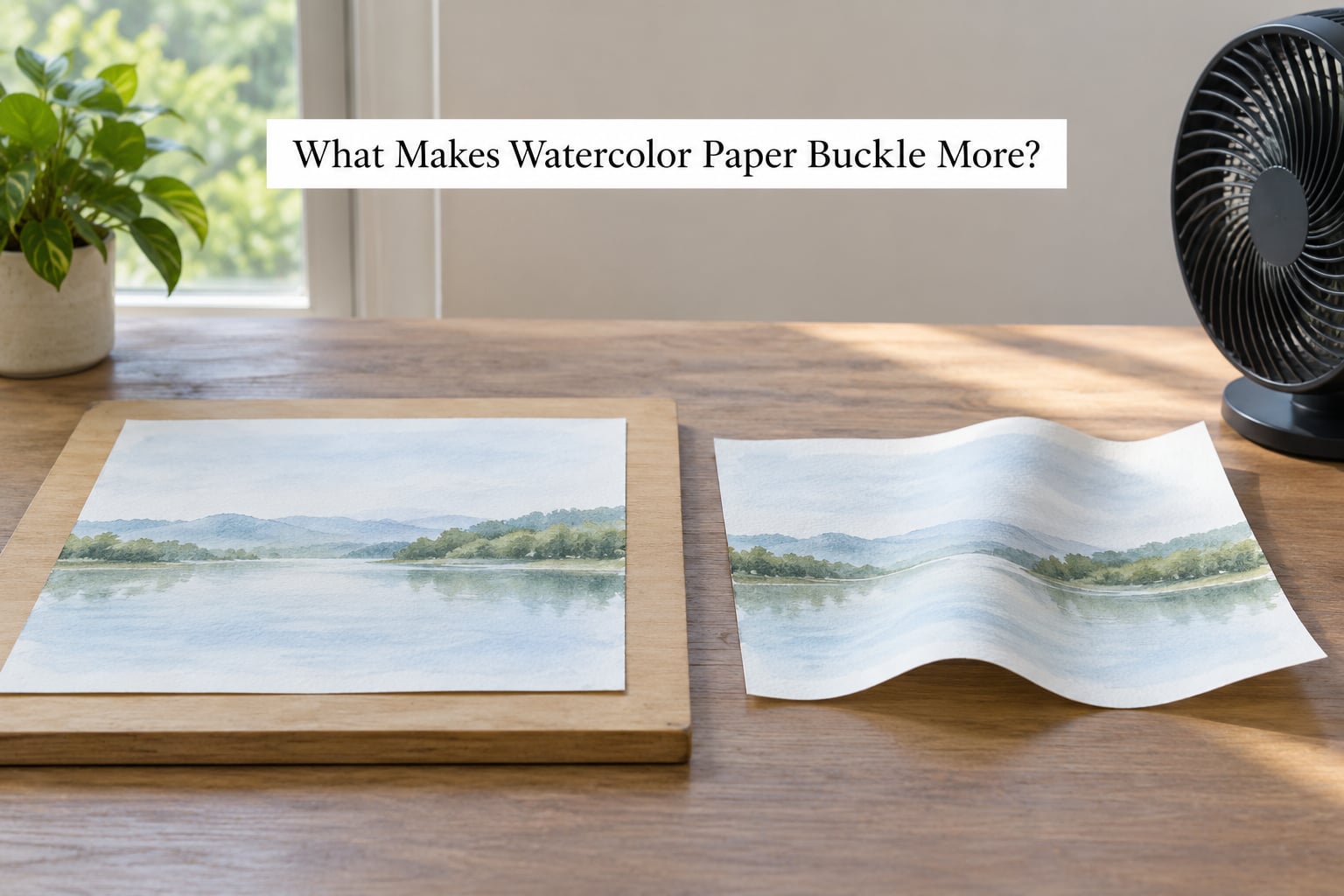
Almost every case of bad buckling traces back to one of a handful of causes. This table maps what you see to what caused it.
| What you see | Likely cause | What to change |
|---|---|---|
| The whole sheet domes upward while still wet | Too much water, no support underneath | Use less water and tape the sheet flat first |
| Edges curl while the middle stays flat | An unpainted dry border around a wet centre | Pre-wet the edges too, or tape them down |
| Small ripples across a big wash | Painting one side only, back stays dry | Run water across the back, or stretch the sheet |
| One hard hump where a puddle sat | A puddle soaked through in a single spot | Blot the puddle instead of leaving it |
| Waves in the centre of a flat area | Brush strokes went back and forth over the same spot too long | Lift off sooner and use a drier brush |
| Still slightly wavy days later | Stored while still faintly damp | Press flat under light weight for a day |
| Rough bumpy surface after drying | Fibers lifted by surface sizing loosening | Expect mild texture; cold press hides it best |
Humidity, a fan, a hair dryer on cool and a draughty window all speed up surface drying while the back stays damp, which is the classic recipe for cockling. Fast surface drying sets the top fibers while the underside is still stretched.
Why Does Watercolor Paper Buckle on Different Surfaces?
The surface under the paper decides whether it can expand. A sheet that is free to swell in every direction stays flat; a sheet that is held on some edges and free on others buckles toward the free side.
| Setup | What happens |
|---|---|
| Loose sheet on a table | Buckles easily. Nothing holds the edges, so the middle lifts. |
| Taped to a board | Edges stay put, centre stays mostly flat. The simplest fix for kids. |
| Wet-stretched on a board | Best flat result. The sheet dries already enlarged, so it stays flat afterwards. |
| Watercolor block | Gummed edges hold the sheet during painting. Expect cockling in the middle of a wet wash. |
| Held only at the corners | Worst option. The edges between the corners are free and lift first. |
| Flat board under a thin sheet | Support helps, but on 140 gsm the sheet still needs to be held at the edges. |
A dry sheet that has been taped down and left to dry taped down also works. It ends up slightly stretched, so it stays flat better afterwards than a loose sheet that dried flat by luck.
How to Flatten Buckled Watercolor Paper
Start here and only move on if the result is not flat enough. Most children’s paintings flatten with step two alone.
Step one: let it dry completely. Touch the back of the sheet, not the painted front. If it feels even slightly cool or soft, it is still damp. Pressing a damp sheet sets a new wave into it, and you will flatten it only to find it wavy again tomorrow.
Step two: press it under light, even weight. Sandwich the dry painting between two clean sheets of blotting paper or plain printer paper, then place a heavy book or a couple of baking sheets on top. Enough pressure to feel firm, not enough to crush a finished painting. Leave it for 24 hours, and check it after an hour or two the first time.
Step three: if waves remain, relax the back. Lightly mist or sponge the back of the sheet only, keep the front dry, sandwich it as before and press for another 24 to 48 hours. Change the blotting sheets every couple of hours while the sheet is damp so the dampness moves out rather than just sitting there.
Step four: iron as a last resort. Set the iron to medium-low, put the painting face down on a clean cloth, and press gently from the back side. Never iron the painted side. Water on the back can travel through the sheet and lift or bleed your paint, so if you used water-soluble paint rather than watercolor, keep water away from the back entirely and go with steps two and three.
Signs the sheet is too wet to press: cool to the touch, visible sheen, paint that transfers to your finger, or damp blotting paper. Any of those means wait.
Can You Save a Very Wrinkled or Torn Painting?
Most of the time, yes. Wrinkles that are shallow flatten well with weight and a little patience.
The signal that a piece is beyond home fixing is in the paper itself. Deep ridges that crease when you bend it gently, fibers that have been stretched and thinned until they look furry, or a tear that runs across a painted area will not press back into shape. Crushed and refolded edges look worse after pressing, not better.
Leave a badly damaged piece flat, unstacked and out of the way so it does not crease further, and set that painting aside as a practice sheet. For a piece with real value to you, a paper conservator is the only option that reliably rebuilds torn fibers or removes creases, and it is rarely cheap.
One more case: watercolor paint lifts and flakes off a sheet that gets soaked from the back and pressed with heat. That damage cannot be undone, so it is worth knowing before you try.
How to Prevent Watercolor Paper from Buckling
Prevention is mostly about water control and support. These are the habits that make the biggest difference for children.
- Tape the sheet down first. Low-tack tape or masking tape along all four edges onto a board or a thick pad stops the edges lifting, which is where buckling starts. Peel the tape off slowly and at an angle once everything is dry, never straight up.
- Stretch it when the paint is going to be heavy. Soak the sheet in clean water for 5 to 10 minutes, lay it on the board, gently pull the edges out and tape or staple them, then let it dry under tension. Paint on it damp.
- Use less water. Load the brush and squeeze it out. Most buckling is a water problem, not a paper problem.
- Blot puddles instead of leaving them. A 5 minute soak is fine, standing water for 20 minutes is not. A folded paper towel lifted straight off lifts pigment with it, so dab gently.
- Pre-wet the whole sheet, edges included. A dry margin next to a wet centre is one of the most common causes of edge curl.
- Let each wash dry before adding the next. Working into a damp sheet stacks water load in one place, which is how you get a permanent hump.
- Keep edges from overworking. Feather toward the border and stop before the sheet curls under the brush.
- Dry it flat, still and unhurried. Lay it on a flat board away from radiators, fans and open windows. Paper drying on an absorbent surface pulls itself flatter as it goes.
Why does watercolor paper buckle less when you use less water?
Because buckling is a swelling problem, not a drying problem. Every drop you add has to be absorbed, carried into the fibers, swelled and then released again, and each of those steps moves the sheet. Cut the water volume and the sheet has that much less room to move. I have watched a child turn a permanently rippled sheet into a flat one with nothing more than a better-loaded brush and a paper towel.
Paper, Paint and Drying Choices for Beginners
Paper weight is measured in grams per square metre (gsm) or in pounds per 3000 square feet (lb), which is why the same sheet gets two numbers. 300 gsm is the one most adults know as 140 lb. 640 gsm is the one sold as 300 lb.
| Paper | Weight | How it behaves | Good for |
|---|---|---|---|
| Light student practice paper | 140 gsm / 90 lb | Cockles with very little water; fine for brush tests and colour mixing | Dry brush practice, mixing colour |
| Student watercolor paper | 200 to 250 gsm / 95 to 120 lb | Handles washes with light support. Puddles still buckle it | Everyday painting, most classroom work |
| Cotton rag student paper | 300 gsm / 140 lb | Long fibers resist cockling well; still worth taping down | Washes, wet-on-wet, children’s first real projects |
| Heaviest artist grade | 640 gsm / 300 lb | Very hard to buckle, but absorbs water slowly and costs more | Big washes, adults, work you want to keep |
| Watercolor block | 300 gsm / 140 lb and up | Gummed edges hold the sheet; less setup for kids | Classrooms, quick sessions |
A stretched 300 gsm sheet behaves close to a loose 640 gsm sheet, which is a good way to think about the choice. Weight buys you margin; stretching removes the problem almost entirely.
For young artists, an economical 200 to 250 gsm sheet plus a flat drying board and a few scraps of tape is usually easier than anything heavier. Thick 640 gsm paper is wonderful but takes longer to dry through, so wet-on-wet sessions behave differently and patience matters more.
Surface matters too. Cold press and rough textures hide small ripples in the grain. Hot press is smooth, so every wave shows clearly under raking light. If a child is bothered by visible cockling, a textured sheet is the kinder choice.
Frequently Asked Questions
How long does watercolor paper take to stop buckling?
A sheet touched dry on top is usually still damp underneath. Give it several hours, and for thick 300 gsm paper up to a full day, before you try to press it. If it is still rippled after a day, put it under light weight for 24 hours. Most of the warp you see while painting disappears on its own within a few hours of even drying.
Can I iron a watercolor painting to flatten it?
You can, but set the iron to medium-low and always work on the back of the sheet with a clean cloth underneath. Ironing the painted side lifts the pigment and leaves a shiny, uneven image that will not come back out. Ironing is a last step after pressing under weights has failed, and it is not worth the risk on water-soluble paint.
Will a heavy book flatten watercolor paper after it dries?
Yes, for shallow waves in a fully dry sheet. Sandwich the painting between clean sheets of plain paper first so nothing transfers to the paint, then rest a heavy book on top for 24 hours. Too much weight on a damp painting will crease it permanently, so check the back of the sheet is dry before you press.
Why is my child’s watercolor paper wrinkling instead of buckling?
Wrinkles and buckling are the same process seen at different stages. Wrinkles are fine ripples across the sheet, usually from gentle swirling strokes on a thin 140 gsm sheet. Buckling is the bigger dome or curl that happens when a lot of water lands in one place or the sheet is held unevenly. More weight, less water and taped edges fix both.
What paper weight is least likely to buckle for children?
300 gsm cotton rag is the sweet spot for children, sold in most shops as 140 lb. Longer cotton fibers resist swelling better than wood pulp at the same weight, so it survives normal washes without stretching. For light practice and colour mixing, plain 140 gsm student paper is fine as long as nobody loads the brush heavily.
Conclusion
If a painting just came off the table and the edge is curling, the first thing to do is nothing at all. Let it dry completely, all the way to the back of the sheet, then sandwich it between clean absorbent sheets under a heavy book for a day.
To stop it next time, change one habit: use less water and let the paper dry flat on an absorbent board. Taping the four edges down before painting costs about a minute and removes most of the problem before it starts. Updated for 2026.