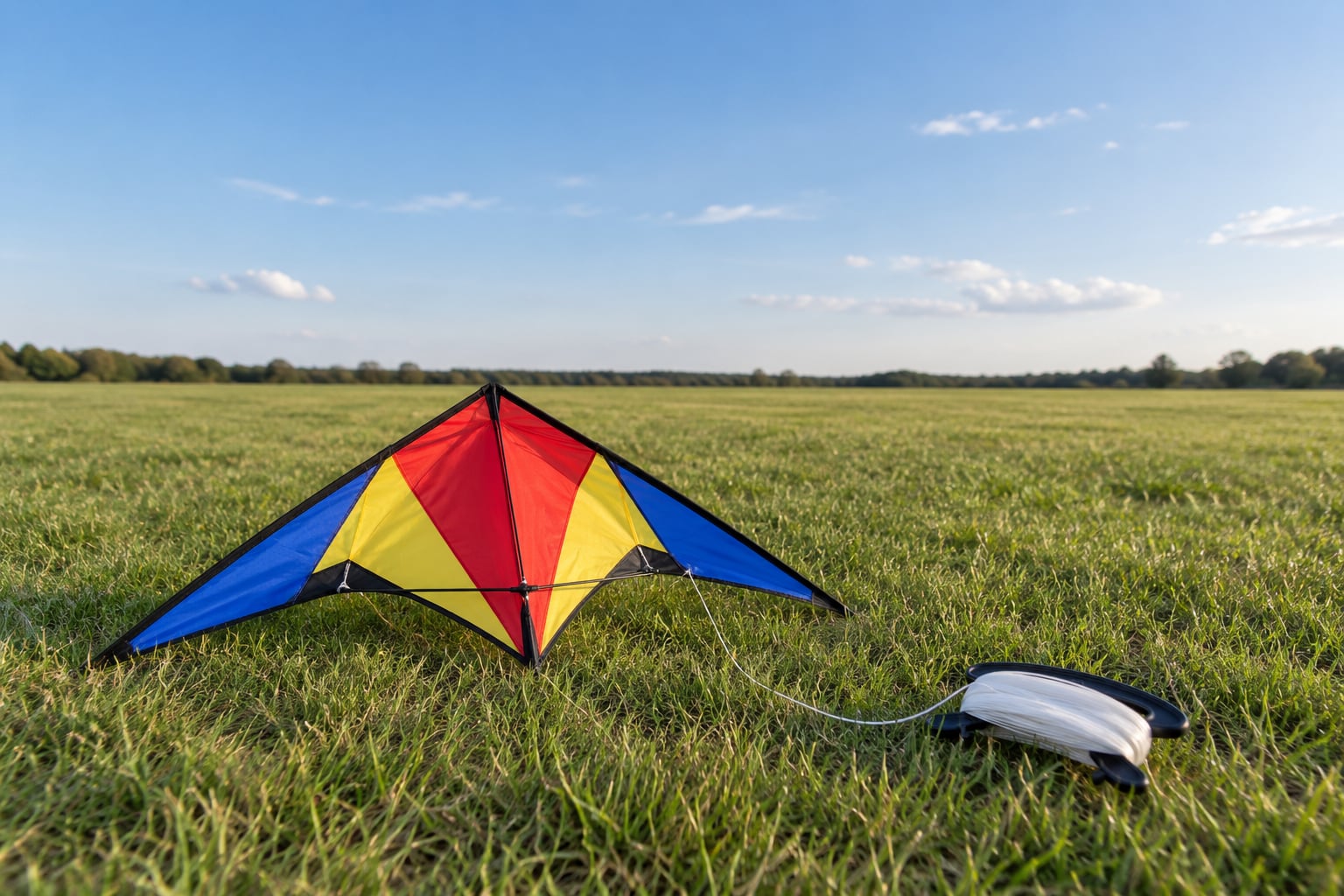
You can fly a kite with no wind, as long as you create the airflow yourself. Walk or run with the kite behind you, tow it upward, or let a helper pull it up a slope, and your own movement makes the “apparent wind” a kite needs to lift. Most of the work takes two people and about ten minutes.
The trick is that a kite never actually feels the breeze. It feels air moving past its sail, and that air can come from a fan, a wave, a passing car, or your own feet on grass. Once you understand that, a dead-calm afternoon stops being a lost afternoon.
Below are the five setups that work most reliably, ordered from easiest to the most involved. The first three cover roughly nine out of ten calm-day attempts.
Table of Contents
- 1What You Need
- 2Step-by-Step: How to Fly a Kite With No Wind
- 3How to Fly a Kite With No Wind by Running
- 4How to Fly a Kite With No Wind on a Slope
- 5How to Fly a Kite With No Wind With a Helper
- 6How to Fly a Kite With No Wind by Towing
- 7How to Fly a Kite With No Wind Near Waves and Traffic
- 8Common Mistakes
- 9Frequently Asked Questions
- 10Can you fly a kite with no wind at all?
- 11What is the best kite for calm, windless days?
- 12How much space do I need to fly a kite?
- 13Is it safe to use a car or a fan to make wind?
- 14Why does my kite keep falling when there is no wind?
- 15Can children fly kites safely when the wind is weak?
- 16Conclusion
What You Need
You need far less than a windy day does, because you are supplying the power yourself.
- A lightweight kite. A small delta, sled, or flat diamond under about a metre across is much easier to move through the air than a big framed kite.
- The right line. Thin, low-stretch braided line feels your motion better than thick stiff line, and it cuts through the air with less drag.
- Wide open space. A field, a beach at low tide, or a sloping park with no trees, roads, or power lines anywhere near the line path.
- A second person. Not optional for the first three methods, and still useful for the rest.
- Closed shoes and long trousers. The line can cut a burn across a bare palm in one bad second.
Before you start, check the bridle point, where the line attaches to the kite. Hold the kite by its spine with the nose pointed into the wind, let out about ten metres of line, and tug gently. If the nose dips or the kite wants to roll onto its back, move the bridle point down a little and test again.
Keep the line clear of your feet and never wrap it around your hands. If you are near water, stay back from the edge, because retrieving a kite from waves with a line in your hand is how most family outings end early.
Step-by-Step: How to Fly a Kite With No Wind
Every method below makes air move past the sail by moving something: your legs, a hillside, a helper’s arm, the tow line, or a wave. The kite is identical in all five.
How to Fly a Kite With No Wind by Running
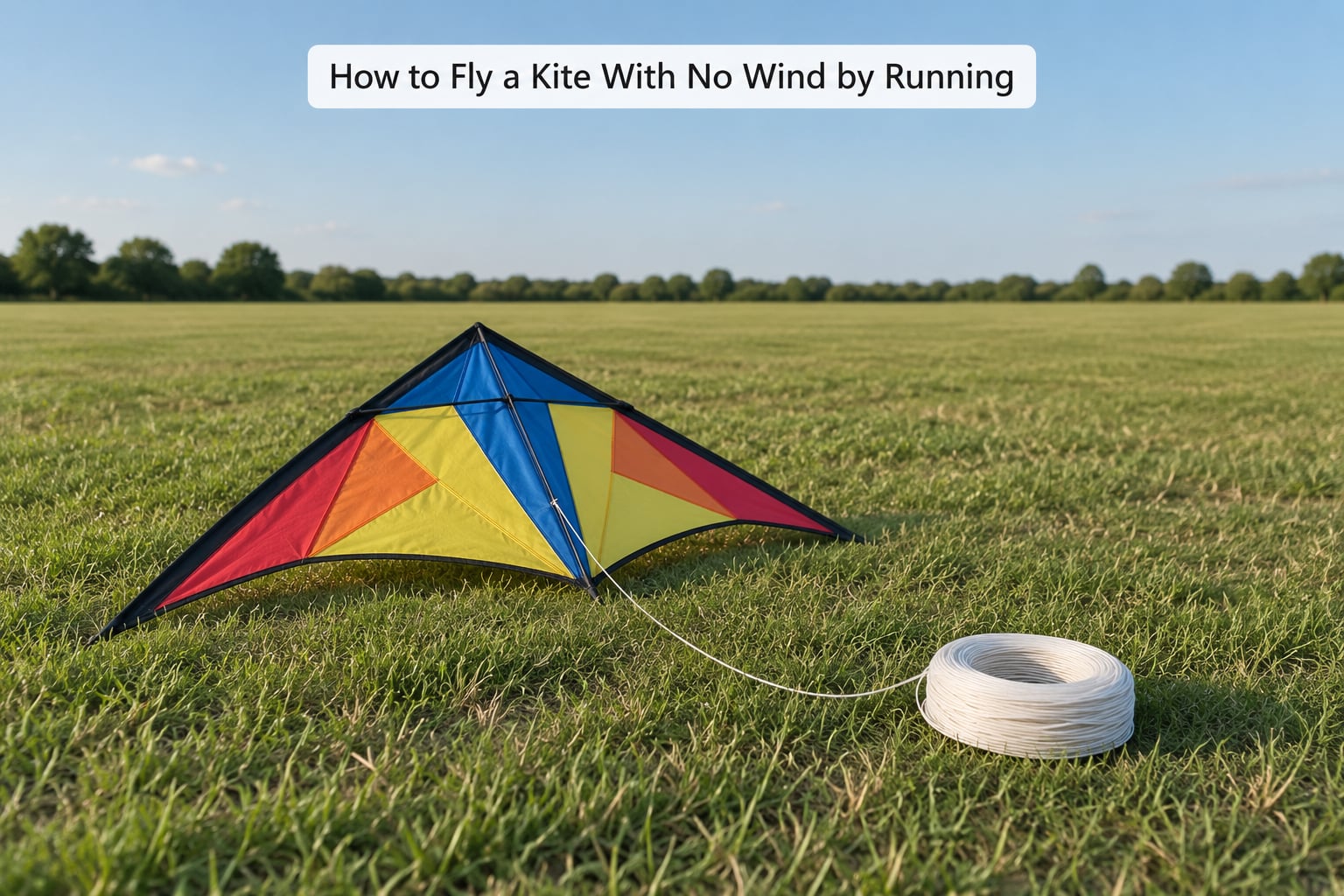
This is the classic trick and the one most families find first. Your helper stands behind you with the kite held at the bridle point, kite nose pointing at your back, line already paid out and slightly taut.
Walk first, not run. Walk backwards for five or six paces, feeling the line pull evenly. When the tug settles into a light steady tension, ask your helper to let go, then keep walking backwards at the same speed. The kite will slide out behind you and climb.
If it does not lift, shorten the line to about five metres and try again. Short lines respond faster to your body, and speed matters far more than distance.
How to Fly a Kite With No Wind on a Slope
A gentle hill gives you free airflow, since air moving uphill along the ground behaves like a steady breeze.
Stand partway up the slope and face downhill. Have your helper hold the kite out in front of you and slightly above your head, line taut, nose pointing into the slope. Walk downhill steadily while your helper lets go on your third step. Gravity does the rest: the kite accelerates away from you and settles into steady flight.
Once it is up, keep moving. Walk back up the hill and the airflow will weaken, so stay low on the slope and drift side to side to keep the same air on the sail.
How to Fly a Kite With No Wind With a Helper
For younger children, split the job in two instead of one person doing everything. One flyer walks and controls the line; the other runs ahead carrying the kite and creates most of the airflow.
Hand the line to the child, then walk backwards while the helper jogs away holding the kite by the bridle point, nose forward, line taut. When the helper drops it, both of you keep moving. The child learns line feel, and the helper supplies the power.
Swap roles after a few flights. Both halves of the skill matter, and most adults are surprised by how hard the line work is on their hands.
How to Fly a Kite With No Wind by Towing
For older children and teenagers, towing gets a heavier kite higher than running ever will. Tie the flying line to the end of a longer tow rope, then hold the tow rope while the kite flies normally above your head.
Walk into the wind and build speed. Once you feel the kite steady itself and the line begin to soften, run steadily forward, lifting your free hand to raise the tow point. That lifts your own body position and lets the kite settle higher overhead, into the smooth air well above ground level.
Lower the tow point, slow down, and let the kite settle back. Never sprint on uneven ground while a line is above you, and never tow past a road.
How to Fly a Kite With No Wind Near Waves and Traffic
Beach gusts give you free airflow in bursts. Waves work like an outdoor fan, sending a smooth pulse of air inland every eight seconds or so.
Stand at the water’s edge facing along the shore rather than straight out to sea, and time the launch for the moment a wave breaks behind you. Hold the kite up in the gust, let it go, then walk steadily forward as the gust dies so you do not sail past the power.
Roadside gusts are riskier, so treat them as a last resort. If you do use one, pull over fully, park on the verge, and fly on the far side of the car so passing vehicles add lift instead of dragging the kite into the road. Open your door wide on the side away from traffic, and watch mirrors rather than the sky.
Common Mistakes
The line goes slack. A slack line tells the kite nothing about your movement. Keep a light tension the whole time, walking backwards at a steady pace rather than stopping and starting.
You let go too early. If the helper releases before you are moving, the kite simply drops. Agree on a signal, then start that walk before the release.
You run toward obstacles. Running backwards with your eyes on the kite means walking into trees, fences, or a dog. Pick a landing direction first and have the helper watch it, not you.
The kite is too big. A large framed kite needs real power. In calm air, a small sail and light spars are what actually float.
The kite sinks tail-first or tumbles. That usually means too little airflow, and the fix is movement rather than adjustment. Walk faster, use a slope, or wait for a gust.
The line tangles. Tangling usually comes from winding on while the kite is still pulling, or from two people grabbing the same line. Wind in slowly, and only one person touches the line at a time.
Two more safety habits worth keeping: never fly in a thunderstorm, and check local rules, since some parks and airports restrict kite height or kite flying outright.
Frequently Asked Questions
Can you fly a kite with no wind at all?
Yes, but not by standing still. A kite needs air moving across its sail, and when the air is still you create it yourself by walking or running backwards, by pulling the kite up a slope, or by towing it. With a second person and ten calm minutes, most lightweight kites will hold steady flight. Expect it to sink when you stop moving.
What is the best kite for calm, windless days?
A small, light kite with a simple frame or a flat flexible sail is easiest. Small deltas and sleds respond to slow movement, while heavy framed kites and inflatable displays need far more power than a person can generate. Thin, low-stretch line also helps because it transmits your movement to the kite instead of absorbing it.
How much space do I need to fly a kite?
Allow roughly the length of your line in every direction, plus extra room on the side you walk backwards. For a five-metre line, that means a clear circle of about fifteen metres. Avoid trees, roads, power lines, and anywhere children might run. A beach at low tide or a wide sloping park works better than a flat field hemmed in by hedges.
Is it safe to use a car or a fan to make wind?
A large fan pointed at the kite works well indoors, provided it is stable, on a clear floor, and never near a child’s hands or face. A car is riskier: set up on the verge on the far side from traffic so the airflow pushes the kite away from the road, and never hold the line across the vehicle. Flying over moving traffic is not safe.
Why does my kite keep falling when there is no wind?
It is almost always a lack of airflow rather than a broken kite. Kites need to move forward steadily to keep the line tensioned and the sail fed with air, so stopping, dropping the line, or letting it slack brings it straight down. Try a faster walk, a short line, or a slope where gravity keeps feeding air past the sail.
Can children fly kites safely when the wind is weak?
Weak wind is generally calmer and safer than strong wind, because kites pull gently and drift slowly. Keep an adult within arm’s reach of younger children, use a short line, and have children wear shoes. The main risks are running backwards into obstacles and tangling the line, so clear the area first and pick a direction to run before launching.
Conclusion
Start with the running method on a still afternoon: a small kite, five metres of thin line, a wide clear field, and one helper. Walk backwards, keep the line taut, and let your legs supply the wind. Once that works, move to a slope or a beach, where the air comes for you.