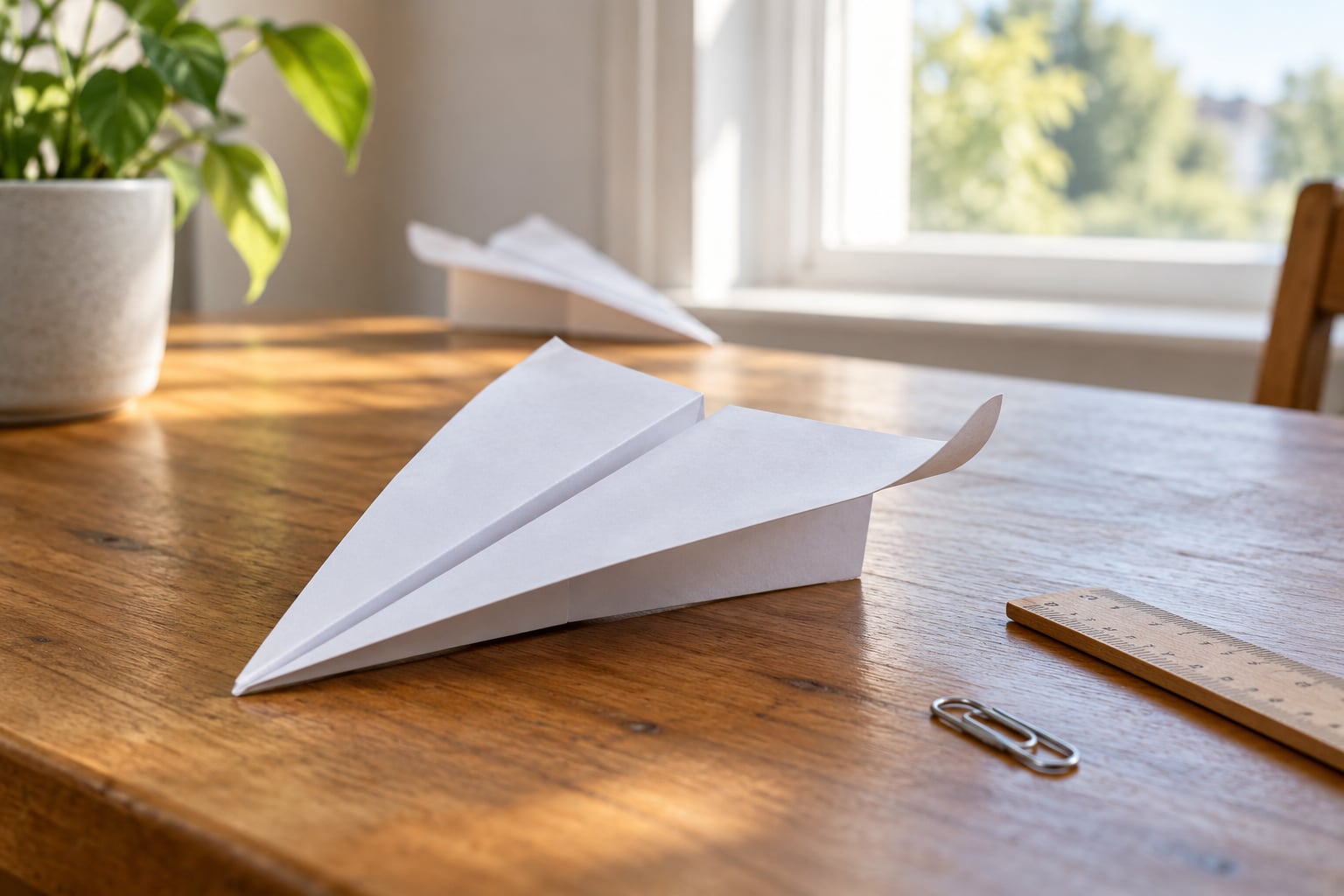
Most paper airplanes that dive are doing exactly what you told them to. You built a nose-heavy plane or you threw it downward, and gravity is now doing the rest. The good news is that a diving flight is one of the easiest problems to fix, and most fixes take under a minute with no tools.
This is written for parents, teachers and kids on the school steps. Every fix below is something you can bend, fold or throw differently, then test on the same patch of ground.
Table of Contents
- 1Why Does My Paper Airplane Dive?
- 2What Makes a Paper Airplane Climb, Glide, or Dive?
- 3Lift, Weight, and Balance
- 4Why Is a Paper Airplane Diving? Common Causes
- 5How Does Nose Weight Change the Flight?
- 6How to Fix a Paper Airplane That Dives
- 7Why Does My Paper Airplane Dive? Fold and Launch Adjustments
- 8How Can Kids Test Which Change Works?
- 9Why Does Your Paper Airplane Dive Even After These Fixes?
- 10Frequently Asked Questions
- 11Should a paper airplane nose dive when thrown?
- 12Why does my paper airplane spiral instead of glide?
- 13Does a paper clip make a paper airplane fly better?
- 14What is the best paper for a paper airplane?
- 15Why is my paper airplane faster but always turns?
Why Does My Paper Airplane Dive?
Why does my paper airplane dive? Because it is nose-heavy: the weight at the front puts the center of gravity ahead of the center of lift, so gravity pulls the nose down as soon as the plane slows. A bent-down trailing edge makes it worse. Bend the back edges of the wings slightly up, hold the nose level, and the dive usually stops within a few throws.
That is the short answer. If your plane sails beautifully when you set it on a shelf and drops from your hand but slams into the ground when you throw it, the fault is in the throw rather than the fold. If it dives even on the gentlest launch, the fold is the problem.
What Makes a Paper Airplane Climb, Glide, or Dive?
Four forces act on a paper airplane, and three of them are constantly arguing with the fourth.
- Lift is the upward push from air moving over the wings. No air moving past the wings, no lift.
- Weight is gravity pulling every gram of paper downward, and it always wins eventually.
- Thrust is your arm, and it only lasts about one second.
- Drag is the air slowing the plane down, mostly because the plane is a very rough little object.
Here is the part that surprises kids: speed is your friend at first. Throwing harder pushes more air past the wings, which makes more lift, which lets the plane fly longer even though drag is also higher. That is why a gentle toss makes a good plane drop and a hard throw sends it skipping across the yard.
There is a catch. Every plane has a speed limit for its wing angle, and once it slows past that point the wings stop making enough lift. The plane tips forward, loses speed, and falls. That sudden drop is called a stall, and it is the reason a plane sometimes seems fine for two seconds and then dies in midair.
Lift, Weight, and Balance
Every plane has a center of gravity, the balance point where you could rest it on your finger. It also has a center of lift, the spot where the wings push hardest, usually somewhere near the middle of the wing. When those two points line up, the plane trims itself and glides. When the center of gravity moves forward of the center of lift, the plane is nose-heavy and pitches down.
That is the whole reason a paperclip on the nose works. Adding weight moves the balance point forward, which sounds like it would make a dive worse, but stability is what it really buys you. The plane resists pitching, rolling and looping, so small folds and small wobbles stop mattering.
Two wing features help keep the plane level. Dihedral is the upward V shape where the wings meet the body, and it lets a tilted wing correct itself. Winglets are the small vertical fins at the wingtips, and they stop the plane from rolling sideways in a gust.
Why Is a Paper Airplane Diving? Common Causes
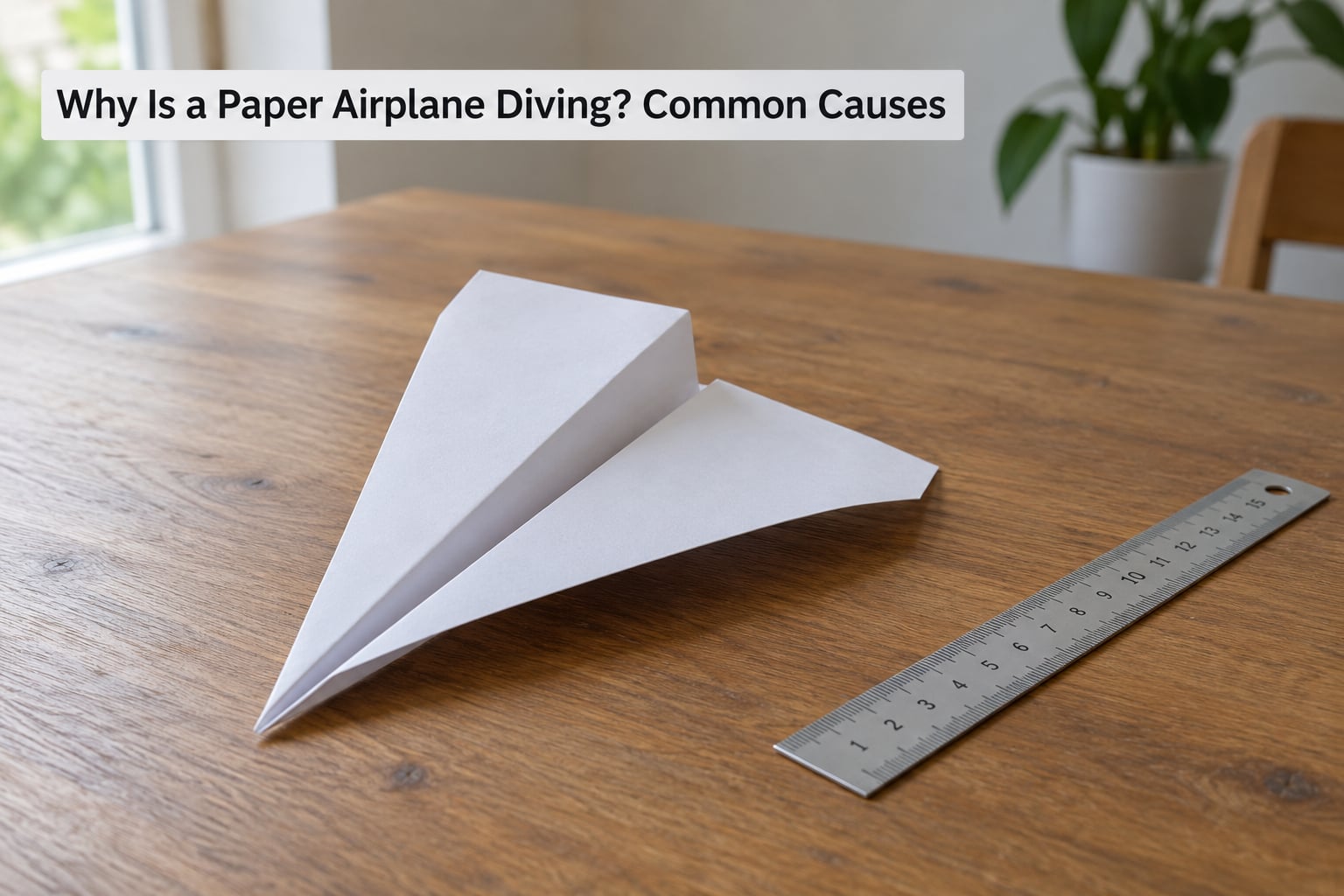
Match what the plane does to what is causing it. Most flights that go wrong fit one of these rows, and the fix is usually a single change rather than a refold.
| What the plane does | Likely cause | What to change |
|---|---|---|
| Dives straight down right after release | Nose angle points downward at launch | Aim the nose level or a few degrees up |
| Tips over and drops on every throw | Nose-heavy, center of gravity too far forward | Add a tiny nose clip or bend the trailing edges up |
| Flies about a second, then noses down | Trailing edges folded down, acting as a downward elevator | Curl the back edge of each wing gently upward |
| Spirals or circles to one side | Wings uneven, or a winglet folded in on one side | Measure both wings and re-fold the crooked side |
| Climbs, loops, then stalls | Thrown too hard, nose held too high | Soften the throw and lower the nose slightly |
| Hovers, wobbles, and drops in place | Too much drag or weak creases catching air | Sharpen the folds and slim the wingspan |
| Dives indoors, glides outside | Room air currents from doors, vents or people | Test in still air before changing the design |
How Does Nose Weight Change the Flight?
Nose weight is the pivot everyone forgets, and the rule is short: a little weight at the front stabilizes, a lot at the front dives, and weight at the back makes the plane stall or loop. Adult hobbyists treat a paperclip as a real measuring tool rather than a trick. You add a small weight, fly, then add or remove tiny amounts until the flight settles.
If you want to try it, bend a single paperclip into a shallow hook and slide it onto the nose, or tape a small washer-sized piece of card to the underside near the tip. Add it in tiny steps. Jump straight to heavy nose weight and you will build yourself a very efficient brick.
How to Fix a Paper Airplane That Dives
Work down this list in order. Each fix costs a few seconds, and most planes only need the first two.
- Point the nose level or a touch higher. Look along the top of the plane from behind. If the nose sits below the tail, raise it. This alone fixes a surprising share of dives.
- Bend the trailing edges up. Curl the back edge of each wing upward by a few millimeters, the same way you would curl the pages of a book. This is your elevator, and up means nose up.
- Straighten the wings. Lay the plane on a flat table. If a wing rocks or sits lower than the other, crease that side again until both wings touch down together.
- Move the balance point. Add a little weight at the nose, or move it back if the plane loops and stalls instead of gliding.
- Trim excess drag. Fewer flaps, tucked-in winglets, and a slimmer wingspan let the plane glide further without changing the wing angle at all.
- Refold with sharper creases. Run a ruler or the edge of a card firmly along every fold. Soft folds let the paper flex in flight, and a wing that changes shape mid-air usually dives.
Why Does My Paper Airplane Dive? Fold and Launch Adjustments
Launch advice online contradicts itself because different designs need different throws. One rule works for every paper airplane: start level, aim a few degrees up, and add speed rather than height.
- Grip by the body, not the nose. Hold the plane along the middle with your thumb under the keel. Pinching the nose tips it downward before it ever leaves your hand.
- Keep the nose level with the horizon. Then lift the front edge a little, roughly the angle of the hand to the wrist.
- Throw flat and smooth. A gentle push with a small wrist snap beats an overhand slam. Hard throws make the plane loop, stall, or spin.
- Release cleanly. Let go as your hand finishes moving forward. A plane dropped from a stationary hand has lost all its thrust.
Two flight styles tell you a lot. Experienced builders launch a new plane low and slow for the first few flights, and if it glides gently that way but dives on a fast throw, the design is fine and the throw is not. Test it from a chair height before you blame the paper.
How Can Kids Test Which Change Works?
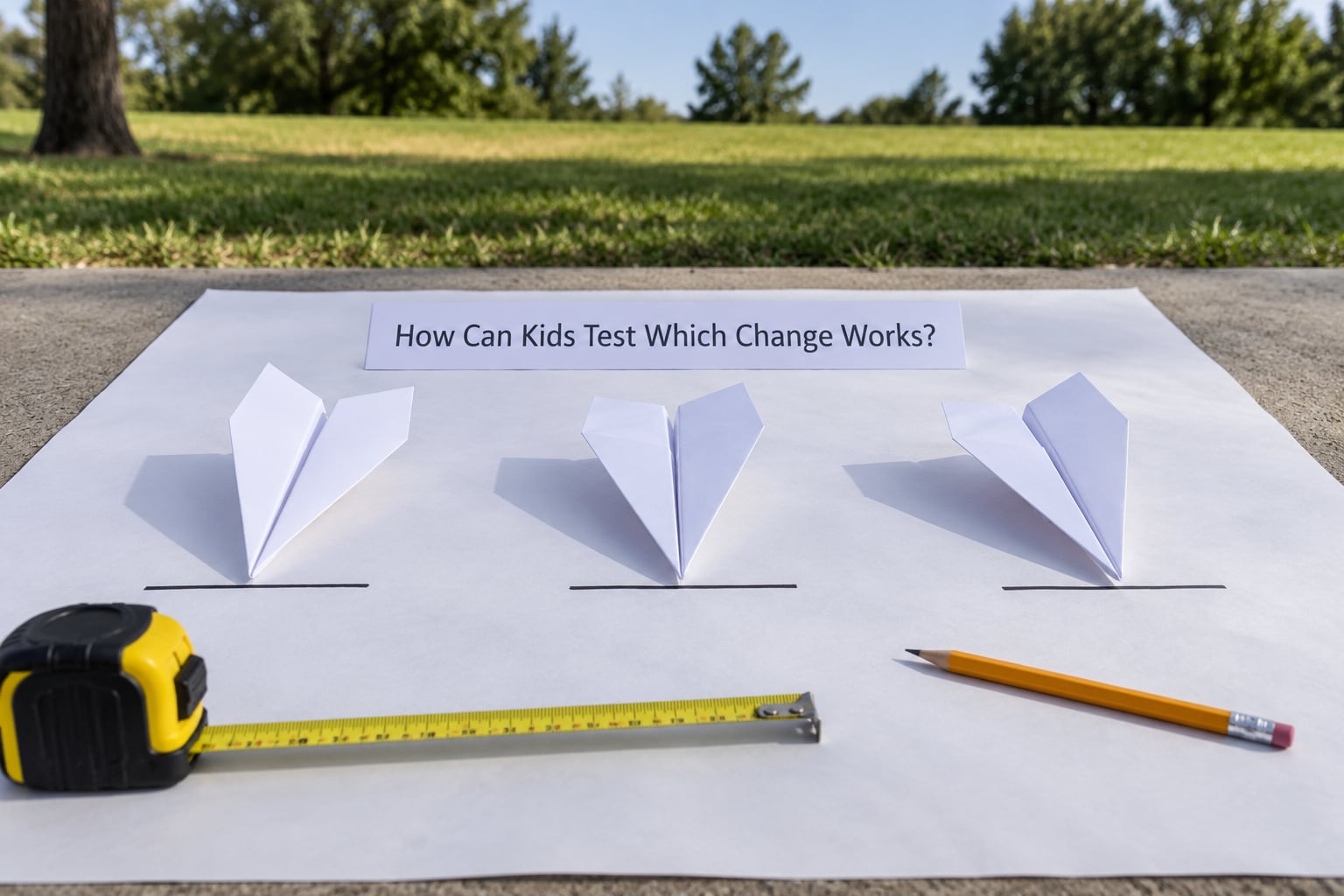
Turn the fixing into a proper experiment and kids stop guessing. The whole method takes ten minutes and needs a sheet of paper, a pencil and a tape measure or a step to count from.
- Fix the design. Fold one plane and leave it alone. Every other plane is an identical copy.
- Mark the launch spot. Draw a line and note the distance to a wall, fence or tree as your measuring mark.
- Throw each plane three times from the same spot. Use the same kind of throw each time and record the distance.
- Change one thing only. Bend the trailing edges on all three, then fly all three. Adding clips, changing wings and changing your throw at the same time tells you nothing.
- Average and compare. Three numbers per plane beat one lucky throw every time. The best version is usually the one with the longest average, not the single farthest flight.
Outdoors in open ground is the safest place to run this. Keep people behind the launch line and never throw toward a road, a window or a bird.
Why Does Your Paper Airplane Dive Even After These Fixes?
Some causes are invisible, and they explain the planes that still misbehave after every adjustment has been made carefully.
Paper grain. Machine-made paper has a direction, and a plane folded along the grain bends easily while the same fold across the grain resists and can spring back mid-flight.
Humidity. Damp paper is heavy and soft. It adds weight at unpredictable places and loses crease sharpness, so a plane that flew well in dry morning air can dive on a humid afternoon.
Wrinkles and handling. A pocket, a backpack and a crumpled sheet all leave the paper slightly out of shape, and that shape is what sets the flight attitude.
Inconsistent throws. A wrist flick at the start and a release at the finish is not the same throw twice. Most people underestimate how much the launch varies.
Obstacles and moving air. A wall, a tree or a light breeze can turn a straight glide into a spiral. Indoors, room currents from a door or a vent are frequently mistaken for a design fault.
And no single fold produces identical flights. Two planes from the same sheet, folded the same way, will behave differently, which is part of why the experiment above is worth running.
Frequently Asked Questions
Should a paper airplane nose dive when thrown?
No. A well-trimmed paper airplane should glide roughly level, with the nose level or slightly above the horizon. A nose dive means the plane is nose-heavy, the trailing edges are bent down, or you are throwing downward. Add a small nose weight, curl the back edges of the wings up, and release the plane level.
Why does my paper airplane spiral instead of glide?
A spiral almost always means uneven wings. One side sits lower, catches more air and drags the plane around, even when the plane looks symmetrical from above. Lay it on a flat table and check both wings touch down evenly, then re-fold the crooked side. Uneven winglets cause the same turn.
Does a paper clip make a paper airplane fly better?
Often yes, and it is a real technique rather than a hack. A small clip at the nose moves the center of gravity forward and stabilizes the plane against pitch, roll and loops. Add it in tiny steps, because too much forward weight makes the plane dive and weight at the back makes it stall.
What is the best paper for a paper airplane?
Standard 20lb to 24lb printer paper works well for gliders, and thin paper flies faster and further. Cardstock gives a slow, floaty glide but can feel heavy and add drag. Any paper should be fresh, flat and creased sharply, since damp or wrinkled paper holds its own shape badly.
Why is my paper airplane faster but always turns?
Speed usually makes a spiral worse because the uneven wing has more airflow to work with. It also means the plane may be flying too fast for its trimmed angle, so it stalls and drops into a turn. Slow the throw down first, then level the wings. If it still turns, the fold is the problem.
Start with the nose. Level it, curl the trailing edges of the wings up a few millimeters, and fly it level and low from the same spot three times. If it still dives, check the wings against a flat table before you refold anything.