A classroom party bingo game takes about fifteen minutes to set up and another fifteen to play. Pick a theme, choose a grid size that fits your age group, write one calling item per square, and shuffle those items onto a different card for every student. Print one card per child, mark the center free space, and read the items aloud one at a time until someone completes a line.
The whole thing costs about the same as a pack of stickers, and it does something most party games cannot: every child is looking at their own card, so nobody is standing on the sidelines waiting for a turn. That is why teachers reach for it again and again for holiday parties, end-of-year celebrations, and rainy-day indoor recess.
What takes a little planning is the word list and the card count. Get those two numbers right and the rest is mechanical. Here is how to make a bingo game for a classroom party from scratch, whether you have thirty minutes and a printer, or you would rather draw freehand on plain paper with a marker.
Table of Contents
- 1What You Need
- 2Step-by-Step: How to Make a Bingo Game for a Classroom Party
- 3Choose a Party Theme
- 4Make the Bingo Cards
- 5Create the Calling Cards
- 6Test the Game and Set Up the Party
- 7Common Mistakes
- 8Tips for Making the Game Easier
- 9Frequently Asked Questions
- 10How many squares should a kids bingo card have?
- 11What are the rules for playing bingo with kids?
- 12How can I create my own bingo cards for free?
- 13Where can I print bingo cards for free?
- 14How do I create a bingo template in Microsoft Word?
- 15How long does a bingo game take with young children?
- 16Conclusion
What You Need
You do not need much. A ream of plain printer paper, a marker or two, and about twenty minutes of quiet time covers everything for a class of thirty. Add scissors and a paper cutter if you want clean edges, and laminating pouches only if you plan to reuse the same cards all year.
| Item | How much | Low-cost swap |
|---|---|---|
| Card stock or plain printer paper | 35 sheets for 30 students (one per child, 5 spares) | Recycled plain paper from the copier tray |
| Marker or pencil per student | 1 each | One communal cup of pencils |
| Calling item list | 24 items for a 3×3 grid, 48 for a 5×5 grid | Draw pictures on index cards instead of writing words |
| Scissors or paper cutter | 1 per adult | Fold and tear along a pencil line |
| Prizes | 3 to 6 small ones, plus 3 participation stickers | Stickers, pencils, or a turn at the front for the music choice |
If you plan to print, look at your grid size first, because it decides how many words you write and how many cards fit on a page. The next section covers that math.
Step-by-Step: How to Make a Bingo Game for a Classroom Party
This is the whole process in eight steps. Skim it once, then come back to the detail sections underneath.
- Pick a theme that fits the party, such as a holiday, a birthday, or a subject you are reviewing.
- Choose a grid size for your age group: 3×3 for kindergarten and first grade, 4×4 for grades 2 and 3, 5×5 for grade 4 and up.
- Write one calling item per square, counting extra so you have spares: about 24 items for a 3×3 grid and about 48 for a 5×5 grid.
- Build the cards with a free center square, placing the same items in a different order on every card.
- Print and cut, two cards per page in black and white if you want to save ink, with a card per student plus five spares.
- Make the calling cards from your item list, one item per card, and keep the matching answer key.
- Teach the rules for two minutes, including which winning patterns count.
- Play for about ten to fifteen minutes, then hand out prizes and move on to the next party activity.
Choose a Party Theme
The theme decides your word list, so choose it before you touch the grid. A theme gives you pictures you can already point at, which matters more for younger children than any clever rule set.
For a winter party, a list might include mitten, hot cocoa, sled, snowflake, scarf, frost, icicle, and skate, padded out to 24 or 48 entries with variations. For a birthday party, use cake, candle, present, balloon, hat, song, and name cards for the birthday child. For an end-of-year party, summer words work well: flip-flop, sprinkler, watermelon, sunscreen, campfire, and similar.
Do not include a word twice, and do not use words that sound similar. Two near-matches like hat and cap will produce arguments every time you call one. If you need more items than you have ideas, ask the class to suggest ten on a sticky note before the party, then choose the best ones.
Make the Bingo Cards
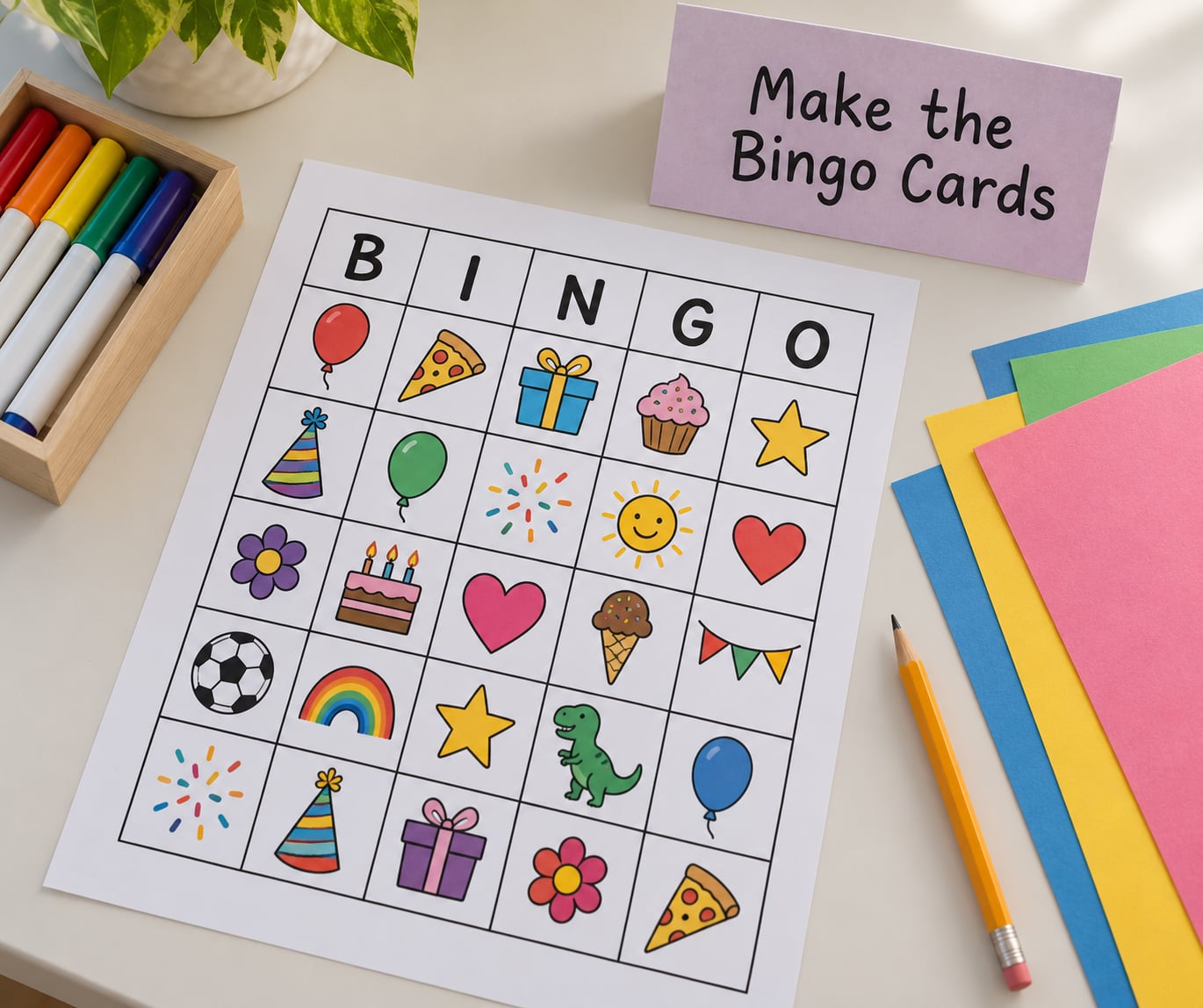
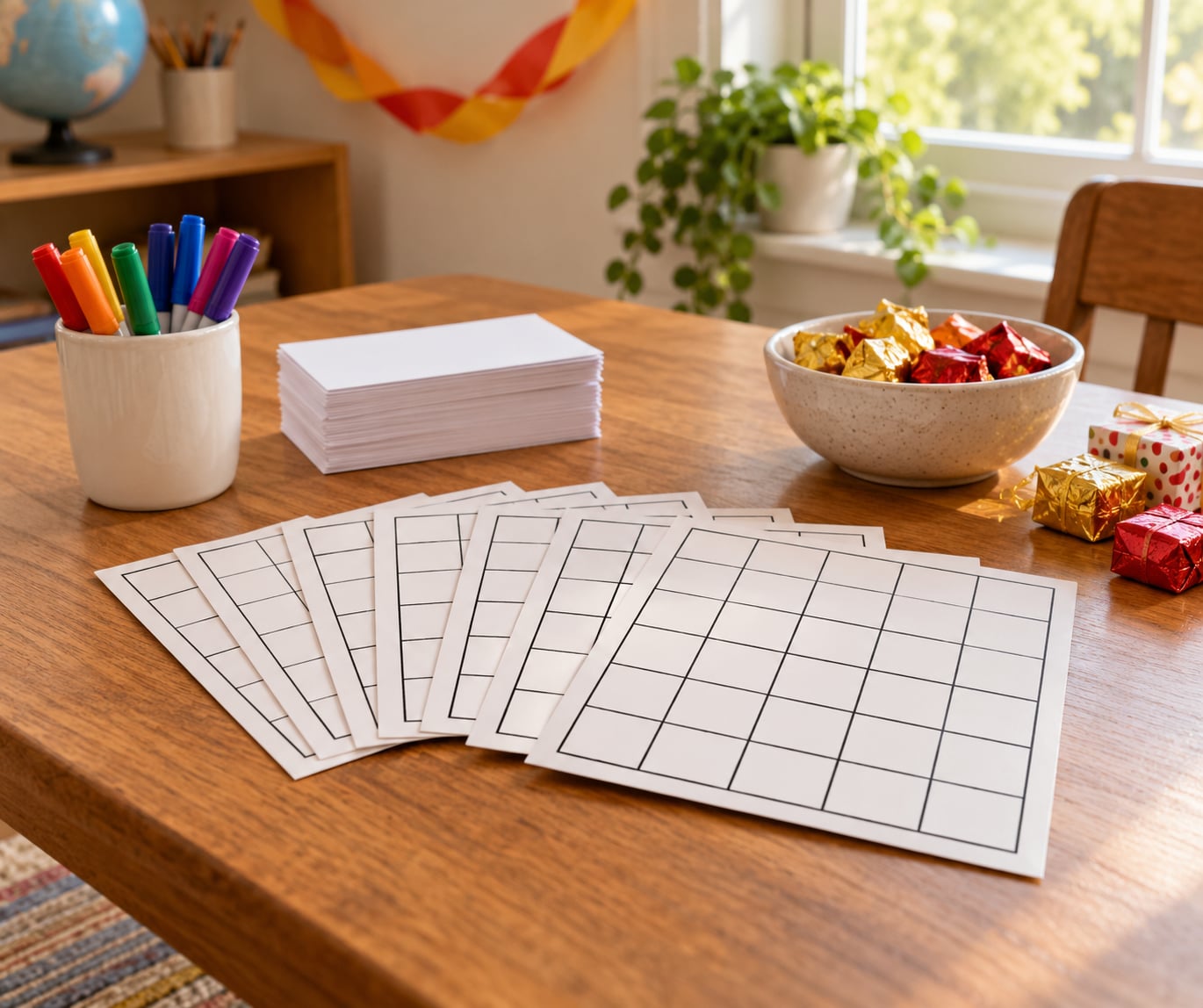
Every card gets the same 24 items, but in a different order. That shuffle is the part people skip, and it is the part that matters most. If all thirty children hold the same layout, the first person to finish wins and everybody else has nothing to do.
Lay out a grid with even squares, use a thick marker or a ruler and pen so lines stay straight, and mark the center square free. Younger children need pictures rather than words, so draw or paste simple shapes in the squares instead of writing. Keep the design identical across every card and vary only the arrangement of items.
Printing in black and white and two cards per page keeps a class of thirty to about fifteen sheets of paper. Print one page of your theme as a key for yourself, then a few extra cards in case a sheet feeds through crooked. Cutting along a pencil line with a tear works fine if you have no scissors.
If you would rather not print at all, a free online bingo card generator will randomize the layout for you and hand back printable or on-screen cards. A spreadsheet works too: type the items in one column, then copy the range onto each card and let a formula shuffle it.
Create the Calling Cards
Your calling cards should match the items on the cards exactly, one item per card. Cut index cards, write one item per card in large letters, and keep the answer key with the unused items in a stack so you can see at a glance whether you still need to call.
Shuffle the calling cards before the game starts. If they stay in list order, the call sequence becomes predictable and someone who was paying attention will know exactly which square is coming next.
Read each item slowly, say it twice, and hold the card up so students who cannot read yet can match the picture or the first sound. For a picture theme, describe the item instead of reading a word, since older siblings and volunteers running the game should be able to call from the same set.
Test the Game and Set Up the Party
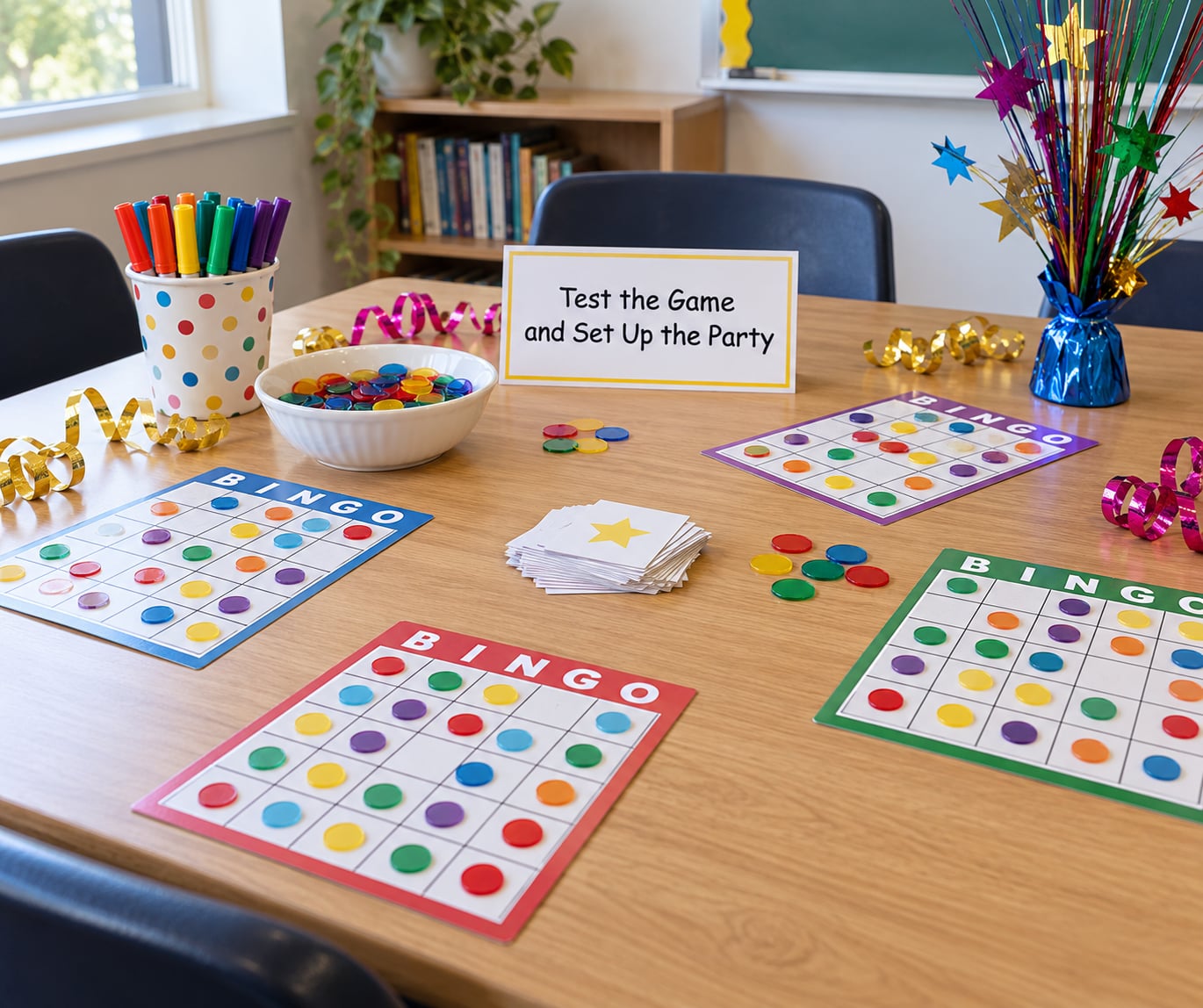
Run one round yourself the night before. You are checking three things: whether the items fit the space, whether two children sharing a card would be impossible, and roughly how many calls a win takes. Ten to fifteen calls is a good finish for a party, because it keeps the game short enough for the agenda.
Set students in pairs or small groups at tables with one card per child. Give every child their own marker, and decide the winning pattern before you start: a full row, column, diagonal, the four corners, or the entire card. Loosest to tightest is the fun order for a party, since the four corners finish first.
Plan for several winners at once. In a class of thirty, expect three or four children to finish in the same round, so hand out stickers or participation prizes to everyone who gets a line and save a real prize for a full card. Three small prizes and a pile of stickers is plenty, and it prevents the disappointed faces that show up when one child takes everything.
Common Mistakes
Every card is identical. This is the mistake that ruins a game. Build at least six different layouts and rotate them, or use a generator or spreadsheet shuffle. If two children hold the same card, have one of them mark the partner’s board while they call.
Printing in color on card stock. Twenty-five pages of color ink is a lot for something kids will hand back. Black and white on plain paper, two per page, prints in minutes and works better for drawing on anyway.
The word list is too hard. Kindergarteners will stall on long words and older children will finish before you call half the list. Match the grid to the grade band, and use pictures below first grade.
Near-duplicate words. Hat and cap cause disputes. Pick one word per idea, and swap any pair that sounds alike for a different idea.
The game runs long. A full card with 48 items can take twenty minutes or more. Cap the game at fifteen minutes of calling, switch to four corners as the winning pattern, or call only half your list and award the closest lines.
Nobody plays. A quiet card game in a party setting loses to just about anything louder. Give students a card before the party starts, explain the prizes, and try the no-print movement version where they walk the room.
Tips for Making the Game Easier
- Younger children: use a 3×3 grid, pictures only, and four corners as the winning pattern. Nine squares finish in a handful of calls, which suits short attention spans.
- Larger classes: play in teams of four with one card per team and one caller. It removes the shortage of cards and gets quieter students talking.
- Children who cannot read yet: print one large grid on card stock and let a pair mark it together, or add a small picture beside each word.
- Multilingual learners: keep the calling cards in both languages, or use pictures, so every student can match what they hear.
- Mixed reading levels: make two card versions, one with pictures and short words and one with full words, and hand them out at random.
- No printer at all: draw one large grid on butcher paper, tape it to the wall, and have teams place counters. It becomes a whole-class game.
- Rainy-day or movement version: put a movement prompt in each square, such as jump, clap, or find a blue shoe, and play with no cards at all.
- Review version: use math facts, sight words, or antonyms as the items and the game doubles as practice.
Frequently Asked Questions
How many squares should a kids bingo card have?
Match the grid to the age group. A 3×3 grid with 9 squares works for kindergarten and first grade, 4×4 with 16 squares suits grades 2 and 3, and 5×5 with 25 squares fits grade 4 and up. Plan roughly 24 calling items for a 3×3 grid and about 48 for a 5×5 grid so you have spares and can finish before the game drags on.
What are the rules for playing bingo with kids?
Give each child a card and a marker. Read one calling item at a time and let players mark matching squares. The middle square is free and always counts as already marked. The first player to complete a row, column, diagonal, or the four corners calls BINGO and wins. Stop after about fifteen minutes of calling so the game fits inside a party slot.
How can I create my own bingo cards for free?
Use a free online bingo card generator, which randomizes the items so no two cards match and lets you print or play on screen. A spreadsheet is the other free route: type the items in one column, then copy the range to each card and let a formula shuffle them. Drawing the grid by hand with a marker on plain paper works too, and takes about a minute per card.
Where can I print bingo cards for free?
Most free generators let you print straight from the browser page with no account. Your school copier also prints a plain black and white page, so building a simple grid in Word, Google Slides, or a spreadsheet and printing two cards per sheet works well. Print one card per student plus about five spares, which is 35 sheets for a class of 30.
How do I create a bingo template in Microsoft Word?
Open a blank document, use the table tool to draw a grid, then set its borders to visible. Type one item per cell and keep the center cell marked free. Copy the finished grid and paste it onto a new page for each student, rearranging the items each time so the cards differ. Google Slides and Excel work the same way, and Excel is handy for shuffling a long list automatically.
How long does a bingo game take with young children?
Budget fifteen minutes of play, plus about three minutes for the rules and hand out. Younger children finish a 3×3 card in ten to fifteen calls, so a 5×5 card with a full-card winning pattern can run long. Stop the calling at fifteen minutes, award the closest lines a sticker, and move on to the next activity before the room gets restless.
Conclusion
Start with the word list. Write down the party theme, list twenty-four or forty-eight items that all look different, and check that none of them sound alike. Everything after that is printing, cutting, and ten minutes of calling.
Test one round before the party, hand out prizes generously, and the game will do the rest.