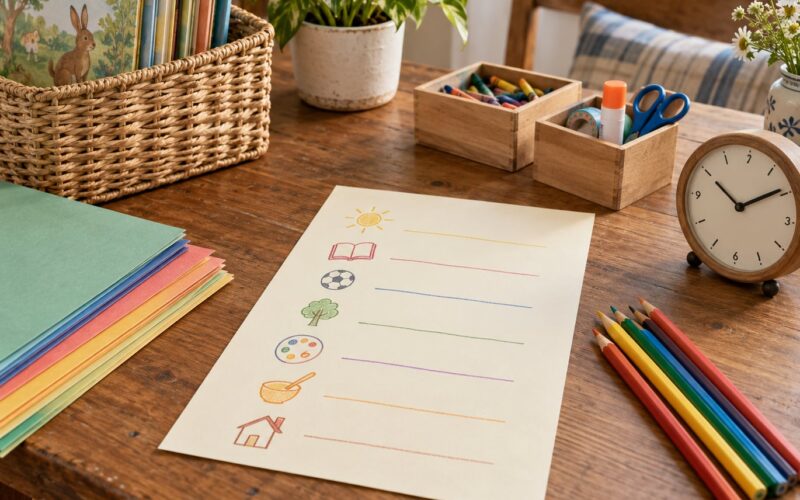
A summer bucket list is a written set of experiences your family wants to complete before the school year starts again, and the trick to how to make a summer bucket list with kids is that your children do most of the choosing. You write down every idea without judging any of them, narrow the pile to the ones that actually fit your summer, and put those on a calendar everyone can see.
The whole process takes about 30 minutes. Here is the short version before the details: gather ideas from everyone, turn the fuzzy ones into specific activities, let the kids pick their priorities, add a flexible batch of easy ideas, then schedule and review it.
A shared list does something quietly useful. It turns the familiar “I’m bored” complaint into “what should we do next,” and it makes sure the small seasonal moments — the ice cream stand that only opens in July, the outdoor movie, the u-pick farm down the road — actually happen instead of sliding past a busy August.
Table of Contents
- 1What You Need
- 2How to Make a Summer Bucket List with Kids
- 3Step 1: Gather Ideas from Everyone
- 4Step 2: Turn Ideas into Clear Activities
- 5Step 3: Let Children Choose and Prioritize
- 6Step 4: Add Flexible Activity Ideas
- 7Step 5: Schedule the List and Review It
- 8Common Mistakes
- 9Frequently Asked Questions
- 10How many items should be on a summer bucket list?
- 11Should I make a separate bucket list for each child?
- 12What if we cannot afford paid summer activities?
- 13How do I keep the list moving on rainy days?
- 14What do I do with items we never got to?
- 15Conclusion
What You Need
You need less than you would expect. None of it is specific to summer, and none of it costs anything.
- Something to write on. A big sheet of paper taped to the fridge, a page in a shared notes app, or a printed list that lives in a binder.
- Something to write with. Pens, and markers if your kids are under six.
- Sticky notes or index cards, if you have them. These turn a wall of ideas into a physical list that moves.
- A calendar the kids can see. A wall calendar, a dry-erase month planner, or a big sheet of paper with the days as columns.
- A way for everyone to add ideas. A voice memo thread, a notes app, a jar by the door where people drop scraps of paper. This matters for the person who is not in the room when you brainstorm.
If you would rather not write anything from scratch, a free printable checklist works just as well as long as you let your kids fill in the blanks. A list with empty squares at the bottom gets used far more often than a beautiful one that is already full when you print it.
How to Make a Summer Bucket List with Kids
Step 1: Gather Ideas from Everyone
Set one date and write it down, because a list that starts “when we get around to it” never starts. The end of May or the first weekend in June is early enough that the summer is still ahead of you and late enough that the school year is fresh in everyone’s mind.
On that day, get every voice in the room. Grown-ups go first, quickly, then the kids. A good prompt gets better answers than “what do you want to do this summer”:
- What do you want to learn this summer?
- What do you want to make or build?
- Where do you want to go, even just your own street?
- Who do you want to help or spend time with?
- What do you want to do outside, every single day if you could?
Two rules keep this from turning into an argument. Nobody can veto an idea in the first ten minutes, and every idea gets written down before you discuss any of them. With a 2-year-old and a 12-year-old in the room, expect a lot of duplicates and be glad to hear them — “play at the park” three times means that is a real priority for the youngest one.
Write fast and do not edit yet. A toddler’s “swimming” and an adult’s “learn to stand up paddleboard” both go on the master list at this stage.
Step 2: Turn Ideas into Clear Activities
Broad ideas are warm but useless. “Do something fun” cannot go on a calendar. Take each idea and add a place, a format, or a finish line.
- “Go to the park” becomes “spend a whole afternoon at the playground with the big slides on Cedar Street.”
- “Make art” becomes “paint a sidewalk chalk mural on the front path.”
- “Cook something” becomes “make lemonade from scratch and set up a stand.”
- “See a movie” becomes “watch one on the driveway sheet with blankets after dark.”
As you rewrite, cross off the things you already do most weekends. A list of ordinary Tuesdays will get abandoned by week two. Save your list for the things that are slightly out of the ordinary, because those are the entries that still feel special in August.
Step 3: Let Children Choose and Prioritize
This is the step that decides whether the list works. Sort everything into three piles: must-do this summer, family choices, and nice-to-haves if there is time.
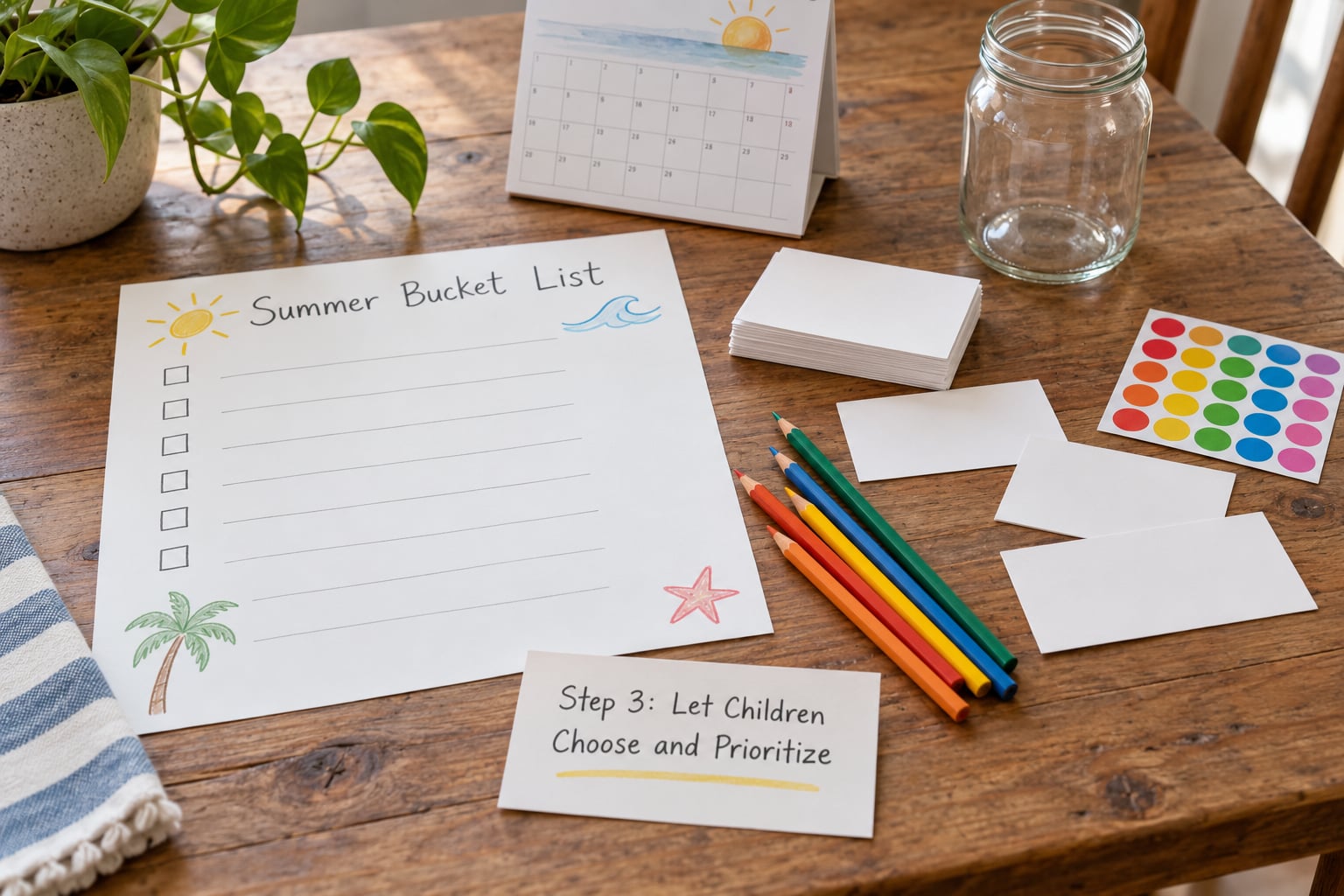
Ask each child to choose their own three priorities from the must-do pile. Grown-ups get the same number. Then check for coverage: at least one entry that came from each family member, and at least one thing that gets the kids out of the house.
Sticker rankings work well with younger children who cannot yet weigh options, and they take about five minutes. Older kids like being asked directly, and they are often the ones who add the idea that ends up being the best one on the list.
Aim for somewhere between 25 and 40 items for a list covering a full summer. The actual usable stretch is about ten weeks, so a hundred items is a wish list, not a plan. Numbering the entries helps too — 32 sounds like a summer, 100 sounds like homework.
Step 4: Add Flexible Activity Ideas
Leave room in the list for the day when nothing goes to plan. These are the ones that take ten minutes, need no booking, and cost nothing, and they are the ideas you will actually reach for in the fourth week.
- Have a water balloon fight in the yard or an alley.
- Run a backyard scavenger hunt with five things to find.
- Collect five different leaves or five kinds of seed and look them up.
- Visit the library and let everyone pick two books each.
- Eat a whole picnic on a blanket, even in the living room.
- Build something together out of cardboard boxes.
- Ride bikes to the farthest interesting thing in your neighborhood.
- Lie on the grass after dark and name three constellations.
- Bake something nobody has made before this summer.
Add ten or fifteen of these yourself so a rained-out Saturday has somewhere to go. Parents on parenting forums talk about the boredom anxiety more than anything else, and a list of ten-minute fallbacks does more for it than any amount of planning.
If you have family members in different age bands, share one master list and give each stage its own column. A toddler’s column is mostly water and mess, a tween’s column is mostly friends and independence, and a few shared entries — a family cookout, a movie night, a day trip — keep everyone pointing at the same list.
Step 5: Schedule the List and Review It
Put roughly three entries on the calendar per week, not one per day. Space is what makes this work: a family with a full sports calendar and two working parents cannot absorb a daily list, and the entries that never fit are the ones that quietly sour the whole thing.
Mark weather-dependent entries with a small symbol, and pick one day each week as the family vote day. Ten minutes on Sunday deciding what happens this week turns a list into plans and gives kids a say in the order.
Check things off as you go, visibly, in whatever form the list lives. Crossed-off items are most of the motivation; a list nobody can see getting shorter is easy to forget about. Do a quick review at the end of each month and, when you find entries that will not fit, move them to a carry-forward list rather than deleting them. A list that survives a year is a tradition, not a to-do list.
You will not finish every item. Almost nobody does, and that is the point — the leftovers become next summer’s first page.
Common Mistakes
Overfilling the list. A hundred entries in ten weeks turns a treat into a report card. Fix it by cutting the master list down to 25 or 40, and keep everything else somewhere visible so nothing feels thrown away.
Choosing activities that are too ambitious for your week. Entries that need a car, a reservation, or a six-hour block will all land on the same three Saturdays. Fix it by writing each entry as a time commitment: ten minutes, half a day, or needs planning ahead. Then spread the big ones out.
Leaving entries vague. “Be outside more” is a feeling, not an activity. Fix it by adding a place and a finish line to anything that starts with “do” or “have fun.”
Filling the list with things you have to pay for. Families write lists full of zoos, water parks and amusement parks because those are the ideas that come to mind first, and money is the constraint most often named on parent forums. Fix it by deciding your ceiling before you brainstorm and giving free entries equal billing — the driveway movie and the chalk mural count the same as the paid one.
Leaving no room to be spontaneous. A fully scheduled summer is one more obligation, which kills the reason you made the list. Keep half the entries unplaced. Some of the best things on a summer list were never on it.
One more worth naming: making the list for your kids instead of with them. They will check it far more often if at least a few entries are theirs, and you will learn what they actually want to do instead of what you assume.
Frequently Asked Questions
How many items should be on a summer bucket list?
For most families, 25 to 40 items is the sweet spot for a full summer. The usable stretch is roughly ten weeks, so three or four entries a week feels achievable and still leaves room for the weather. Write a longer master list if you like, then circle the smaller number you intend to finish. A hundred-item list feels like homework and ends up abandoned.
Should I make a separate bucket list for each child?
Use one shared master list, then give each age band its own column of picks. That way siblings of very different ages still point at the same sheet, and a two-year-old and a twelve-year-old are not handed identical lists. Give each child three priorities of their own so everyone has something they chose, and keep a few family-wide entries like a cookout or a day trip for everyone.
What if we cannot afford paid summer activities?
Decide your spending limit before you brainstorm, then ask everyone for ideas that cost nothing. A huge share of the best summer bucket list ideas need only water, cardboard, sidewalk chalk, a blanket and whatever is already in the kitchen. Free entries are also easier to repeat, and repeating them is what fills the weeks when nothing else happens.
How do I keep the list moving on rainy days?
Add ten to fifteen short entries before summer starts: ten-minute games, baking, building, drawing, a library run or a treasure hunt in the living room. Keep them on a separate small card so you can grab one without flipping through the full list. Pick one fixed review day each week, and a rainy day is a good day to do the review and plan the next one.
What do I do with items we never got to?
Move them to a carry-forward list instead of crossing them out. Some entries were bad timing rather than bad ideas, and next summer starts with a page you already wrote. Keeping the leftovers also removes the guilt, because the list was never a report card. Review the leftovers at the end of the summer and delete only the ones nobody wants anymore.
Conclusion
Making a summer bucket list with kids is one brainstorming session, a sorting pass, and a calendar. Gather every idea without judging any of them, rewrite the fuzzy ones so they can actually be done, let the kids pick their own priorities, add a batch of cheap no-prep entries for slow days, and place about three a week on a calendar everyone can see.
Start small today. Write down five ideas your child gives you, let each person pick one, and do one of them this week. Once the first few boxes get checked off, adding the rest is easy.