A screen-free weekend works when you plan it like any other weekend, not as a test of family willpower. Set the rules before Friday, pick one anchor activity for each half-day, and keep a small bench of ready-to-go ideas for the gaps. Thirty minutes of prep on Thursday night is usually enough.
Families who search how to plan a screen free weekend with kids usually assume they need to invent three full days from nothing. They end up improvising at 4pm Saturday, tired, and the tablet appears on its own. The fix is boring and unglamorous: a loose schedule, materials already in boxes, and rules the kids helped write.
Table of Contents
- 1What You Need
- 2How to plan a screen free weekend with kids: a simple checklist
- 3Step-by-Step
- 41. Choose one weekend focus
- 52. Build a flexible daily rhythm
- 63. Prepare the materials in advance
- 74. Plan activities for different energy levels
- 8For toddlers, ages 2 to 4
- 9For school-age kids, 5 to 8
- 10For tweens, 9 to 12
- 11For mixed-age families
- 125. Include free-choice and downtime
- 136. Set screen boundaries before the weekend
- 147. Review and adjust each day
- 15Common Mistakes
- 16Tips for Making the Weekend Easier
- 17Frequently Asked Questions
- 18How long should a screen-free weekend be?
- 19How old is too young for a screen-free weekend?
- 20What do you do when kids say they are bored?
- 21What is the 7 7 7 rule for kids?
- 22Is it realistic to be fully screen-free for a whole weekend?
- 23What activities work indoors when the weather is bad?
What You Need
You need less than you think. A piece of paper for the schedule, whatever craft and outdoor supplies you already own, and one honest conversation about the screen rules. Everything else is optional.
How to plan a screen free weekend with kids: a simple checklist
Work through this on Thursday evening and the weekend basically plans itself:
- One piece of paper per day, with four or five time blocks written loosely
- Three anchor activities total, one per half-day, chosen by your kids
- Supplies sorted into boxes or bags so nothing has to be hunted for
- Meals decided for Saturday, with at least one the kids cook or help cook
- One outdoor option and one indoor backup, decided in advance
- A go-bag of paper, pencils, books and stickers that travels with you
- Screen rules written down in your own words, with the exceptions written next to them
- Bedtime kept the same as a school night, or the weekend unravels
Step-by-Step
1. Choose one weekend focus
Pick a broad theme for the weekend: creativity, nature, cooking, building, or exploring your neighborhood. One theme makes the weekend feel like it belongs together instead of drifting.
Let the kids choose the theme from three options. Parents describe themed days working far better than a grab-bag, because the theme answers the hard question for them: what do we do next?
A theme is not a schedule. “Building” can mean a blanket fort on Friday, a cardboard car on Saturday, and compost or milk-carton construction on Sunday. Kids get to decide which.
2. Build a flexible daily rhythm
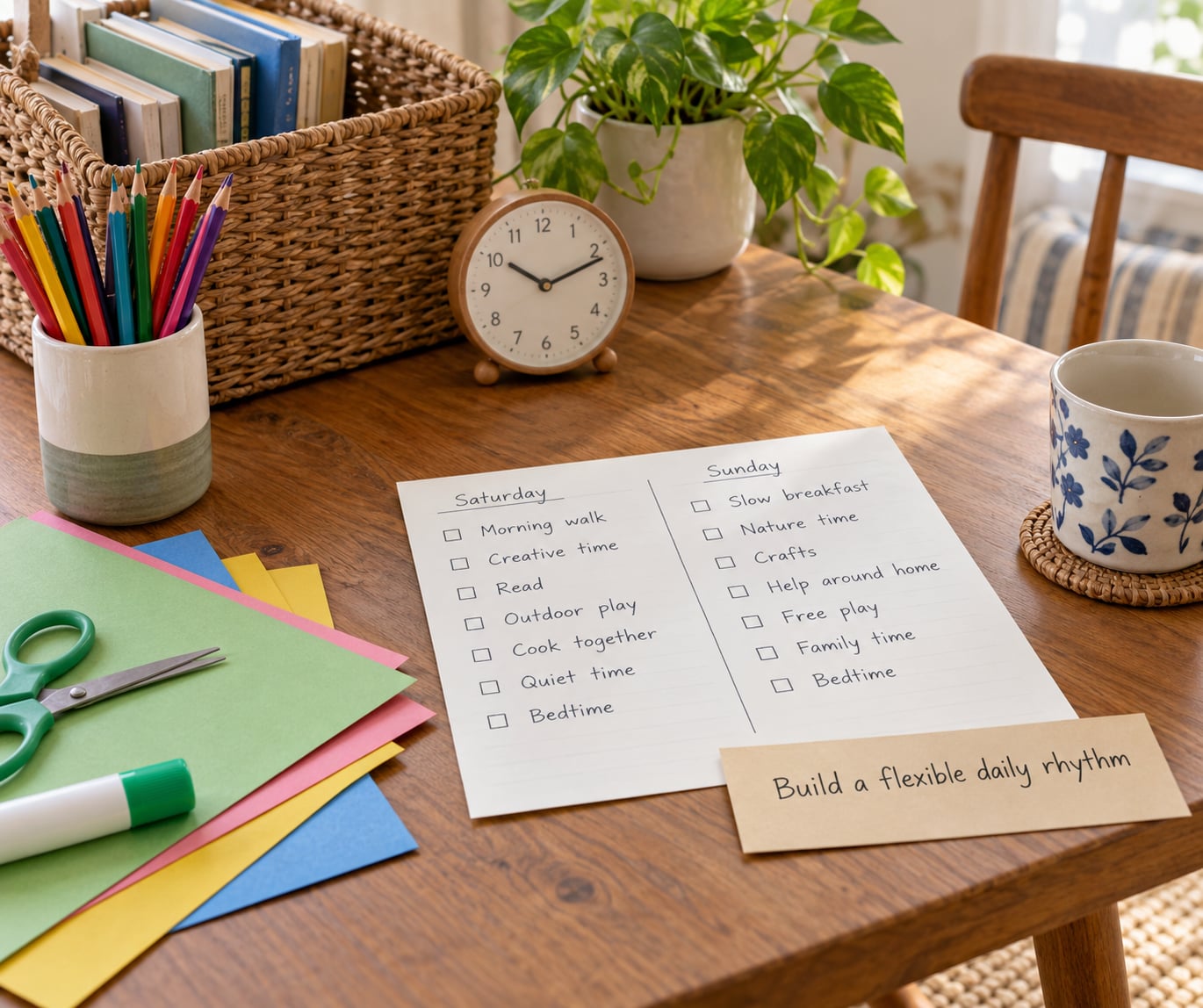
Use time blocks, not a minute-by-minute itinerary. A block plan survives a slow morning; a minute-by-minute plan collapses at the first hiccup and everybody feels like they failed.
A rhythm that holds up well:
- Morning, high energy: the day’s anchor activity, ideally outdoors
- Midday, restless: movement, chores, or a trip to a park
- Afternoon, fading: something with a clear finish line, like baking or building
- Evening, slow: dinner, a board game, reading aloud, bath, bed
A common baseline among parents is roughly 30 minutes of reading, 30 minutes of creative or hobby time, and an hour outdoors each day. Copying a rhythm like that works better than inventing your own each night.
3. Prepare the materials in advance
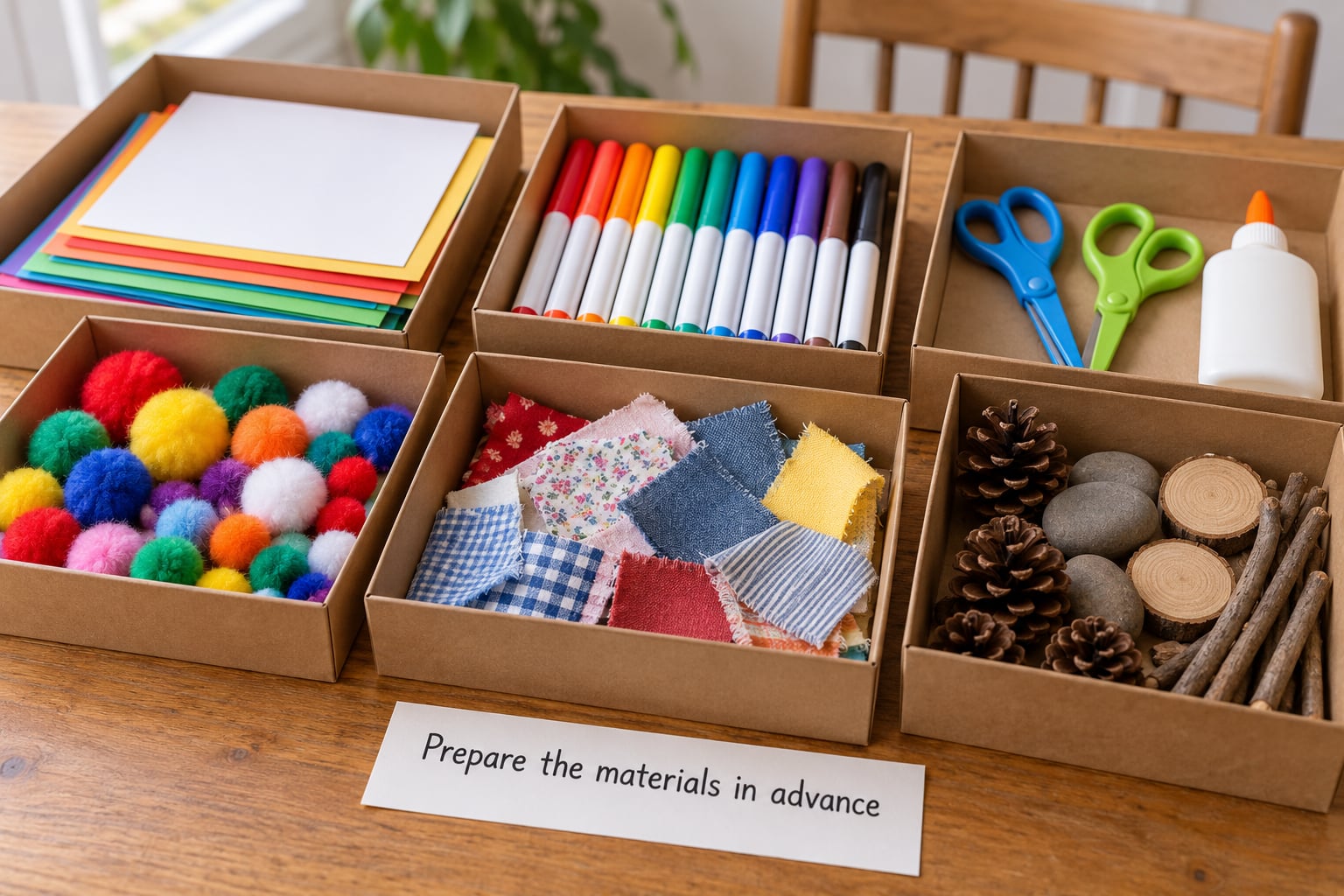
Sort supplies into ready-to-use kits rather than one communal bin. A craft box that has to be restocked mid-project is a craft box nobody opens.
Paper, washable markers, child-safe scissors, glue sticks, tape, pom-poms, fabric scraps, cardboard, and whatever natural materials you have gathered. The whole thing costs almost nothing if you raid the recycling bin, which is why I skip a separate shopping trip entirely.
Then set up stations. One table for drawing and cutting, one spot for building, a basket of books in the living room. Stations let two kids work on different things without negotiating over the same supplies.
4. Plan activities for different energy levels
Match the activity to the hour, not just the age. A three-year-old and a ten-year-old can share a nature walk but almost nothing else, and that is fine.
For toddlers, ages 2 to 4
Big movements, simple wins: sticker peeling at a table, filling a bin with rice and toys, sidewalk chalk, a short walk to the corner and back. Keep sessions to ten or fifteen minutes. If something works, do it again immediately rather than moving on.
For school-age kids, 5 to 8
Make something. Cardboard forts, painting rocks, a scavenger hunt around the block, baking something where they handle the measuring. This age group wants a finished product more than a fun hour.
For tweens, 9 to 12
Challenge them. Let them plan one block of the weekend themselves, including the meal. Cooking something that needs an oven, building a bigger structure, a photography walk with a disposable camera, or a puzzle that takes real concentration.
For mixed-age families
Look for activities with a job for everyone: the toddler stirs while the older one measures, the little one carries the collection basket while the tween reads the list. If it cannot be split into roles, run two activities at once and alternate.
5. Include free-choice and downtime
Leave gaps on purpose. A screen-free weekend packed with enrichment is just another schedule, and kids notice the difference.
Reserve at least two blocks a day for whatever they want, including nothing. Parents of autistic kids often pair one structured activity with a quiet block of drawing or colouring, because an over-filled day ends in overwhelm rather than calm.
Put your own rest in the plan too. Rotating playdates work well through the weekend: the kids burn energy somewhere else while the adult gets an actual break. That is scheduling, not laziness.
6. Set screen boundaries before the weekend
Agree the rules out loud, ideally with the kids in the room, and write them where everyone can see them. A weekend worked out in advance gets far less resistance than one announced Friday night.
Most families asking how to plan a screen free weekend with kids worry about the announcement, not the activities. Say it plainly once, on Thursday, and leave it there.
Be specific about the exceptions. School messages, a video call with grandparents, a doctor, and music while cooking are usually fine. Write those down so nobody has to negotiate them at the moment they want a screen.
When a kid resists, stay boring. “The rules were made together on Thursday, and they still stand” ends a negotiation faster than a long explanation, which reads as an opening for one.
Model it yourself. Adults who quietly check their phone through the weekend give children permission to do the same. Put your phone in a basket during meals and in the go-bag when you leave the house.
7. Review and adjust each day
Spend five minutes at the end of each day asking one question: what worked and what drained everyone? Change tomorrow’s plan based on the answer.
The 4pm Saturday collapse is normal rather than a sign the plan is wrong. When energy bottoms out, swap the scheduled activity for something with a low threshold: a bath, a snack on the porch, twenty minutes of drawing with the radio on. The weekend still counts.
If the whole day went sideways, that is data, not failure. Kids will tell you honestly what they want next time, and asking beats guessing.
Common Mistakes
Overscheduling is the big one. Twenty screen-free activities in two days is a harder sell than a screen, and kids learn to hate the idea. Plan two anchors per day and leave the rest open.
Forgetting supplies kills more weekends than resistance does. If the glue is in the basement and the paper is in the closet, the tablet wins by default. Prep on Thursday.
Assuming everyone wants the same thing is a mistake in mixed-age homes. A tween handed a toddler’s craft kit will reject the entire weekend on principle. Give each child one block they chose themselves.
Promising perfection sets everyone up. Nobody runs a flawless screen-free weekend, and kids who are told they will fail usually fail on purpose. Frame it as a family experiment, not a challenge with a scoreboard.
Removing screens abruptly without warning gets pushback. Tell kids days ahead. The surprise is what creates the argument, not the rule itself.
Skipping your own downtime is the mistake exhausted parents regret. Put a rest block in the plan like any other activity, or you will reach for your own screen by Saturday lunch.
Tips for Making the Weekend Easier
Put the schedule somewhere visible, on the fridge or a door, so kids can check it without asking you. Written plans reduce the number of times you have to say no.
Keep two backup activities sealed and unopened for the moment the plan fails. Turning a walk into a bingo card buys a surprising amount of time with no screen involved.
Let kids rotate ownership. One child plans Saturday morning, another picks the Saturday bake. Ownership is what makes the plan feel like theirs rather than imposed.
Keep one device reachable for genuine emergencies and put it in another room. Full bans with no exception get negotiated, and negotiated rules get tested.
Do less than you planned. A weekend with one genuinely good hour beats a weekend where three adults were exhausted by Sunday evening.
Frequently Asked Questions
How long should a screen-free weekend be?
Two full days is the usual sweet spot. Longer rarely works because families get tense and every hour starts feeling like a test. A single Saturday is plenty to prove the idea and much easier for kids who are used to gaming with friends. If you want to try more, start with the weekend and extend to weekday afternoons once the rhythm feels normal.
How old is too young for a screen-free weekend?
Any age works, because the point is not the ban. With toddlers ages 2 to 4 you are really just replacing background TV with movement, sensory play and outdoor time, and they will not miss what they were not using anyway. Under 18 months the American Academy of Pediatrics advises avoiding screen media other than video calls, so a no-screen weekend lines up with guidance rather than fighting it.
What do you do when kids say they are bored?
Expect boredom, especially in the first hour, and do not rush to solve it. Boredom is the exact thing a screen-free weekend is meant to practice, and most kids settle into independent play after 30 to 60 minutes. Offer a small choice between two ready kits, then step back. Filling every gap yourself teaches the opposite lesson.
What is the 7 7 7 rule for kids?
It is a widely used daily balance guideline of roughly seven hours of sleep, seven hours of movement and seven hours of screen content for school-age children and teens. It is a rule of thumb rather than an official recommendation. The sleep half matters most in a screen-free weekend, because keeping an ordinary bedtime is what stops the disruption from carrying into Monday.
Is it realistic to be fully screen-free for a whole weekend?
Fully is hard, and a negotiated approach often survives longer. Many families treat the weekend as a shared family movie night with no individual devices, which keeps the social part and drops the constant negotiation. Whichever version you pick, decide the exception list in advance with your kids. Deciding together on Thursday beats renegotiating at four o’clock on Saturday.
What activities work indoors when the weather is bad?
Fort building, baking, a cardboard construction project, drawing stations, a treasure hunt through the rooms of the house, and dress-up or puppet play all hold up indoors. Set up two stations on Thursday so the weather never forces an improvised decision. A go-bag of paper, pencils and books keeps an activity available when you are waiting at the doctor’s office or in line somewhere.
If you have never tried how to plan a screen free weekend with kids before, start with one weekend. Thursday: three anchors, one supply box, rules written down and agreed by everyone. Saturday: one anchor in the morning, one in the afternoon, and a normal bedtime. That is the whole plan.