The best answer to what to do with kids on a rainy day indoors is to give them something they build, move through, or make together rather than another thing to watch. Most days call for two or three activities back to back, one to burn energy, one to use their hands, and one that is quiet enough to keep everyone sane.
Every idea below uses things most homes already have, states who it suits and how long it takes to set up, and works without buying a single supply. The activities are numbered so you can jump straight to one that fits the age and the energy in the room.
Table of Contents
- 1What to Do With Kids on a Rainy Day Indoors: At a Glance
- 21. Make a Paper Rainy-Day Craft
- 32. Set Up a Coloring-Page Basket
- 4What to do with kids on a rainy day indoors when you have five spare minutes
- 53. Create a Tape-Resist Painting
- 64. Build a Cardboard City
- 75. Play I Spy or a Rainy-Day Treasure Hunt
- 86. Make a Stop-Motion Movie
- 97. Have a Family Dance-Party Olympics
- 108. Bake and Decorate Easy Rainy-Day Treats
- 119. Create a Mini Indoor Scavenger Hunt
- 1210. Fold Origami Animals and Shapes
- 1311. Start a Floor Fort
- 1412. Make a Memory Matching Game
- 1513. Put On a Make-Believe Adventure
- 1614. Make Simple Play-Dough Creations
- 1715. Hold a Family Pajama and Portrait Hour
- 18Frequently Asked Questions
- 19What are cheap things to do with kids on a rainy day indoors?
- 20What indoor activities work well for toddlers on a rainy day?
- 21How can I keep children busy indoors without screens?
- 22What can kids make at home with simple craft supplies?
- 23Do I need to plan every activity for a rainy day?
- 24Start With One Easy Idea
What to Do With Kids on a Rainy Day Indoors: At a Glance
| Activity | Best ages | Setup | Screen-free | Main supplies |
|---|---|---|---|---|
| Paper raindrop garland | 3-8 | 10 min | Yes | Paper, glue stick, string |
| Coloring-page basket | 2-8 | 5 min | Yes | Printables, crayons, basket |
| Tape-resist painting | 3-10 | 10 min | Yes | Painter’s tape, cardstock, paint |
| Cardboard city | 4-10 | 20 min | Yes | Boxes, marker, paper |
| I Spy treasure hunt | 4-10 | 10 min | Yes | Clue cards, small prize |
| Stop-motion movie | 7-14 | 15 min | Yes | Phone, clay, toy figures |
| Dance-party Olympics | 3-10 | 10 min | Yes | Music, open floor space |
| Bake and decorate treats | 3-12 | 20 min | Yes | Biscuits, icing, fruit |
| Indoor scavenger hunt | 3-9 | 5 min | Yes | Checklist, pen |
| Origami animals | 6-14 | 0 min | Yes | Square paper |
| Floor fort | 3-10 | 15 min | Yes | Blankets, chairs, cushions |
| Memory matching game | 2-8 | 20 min | Yes | Cardboard, drawings |
| Make-believe adventure | 3-9 | 10 min | Yes | Cups, boxes, dress-up clothes |
| Play-dough creations | 2-8 | 15 min | Yes | Flour, salt, water, oil |
| Pajama and portrait hour | 4-14 | 5 min | Yes | Paper, pencils, books |
All fifteen are screen-free, which matters more than most lists admit. Parents on Reddit keep naming the same reliable handful, obstacle courses, forts, scavenger hunts and cooking together, and they keep saying the same thing about the rest: good ideas get used up in fifteen minutes.
1. Make a Paper Rainy-Day Craft
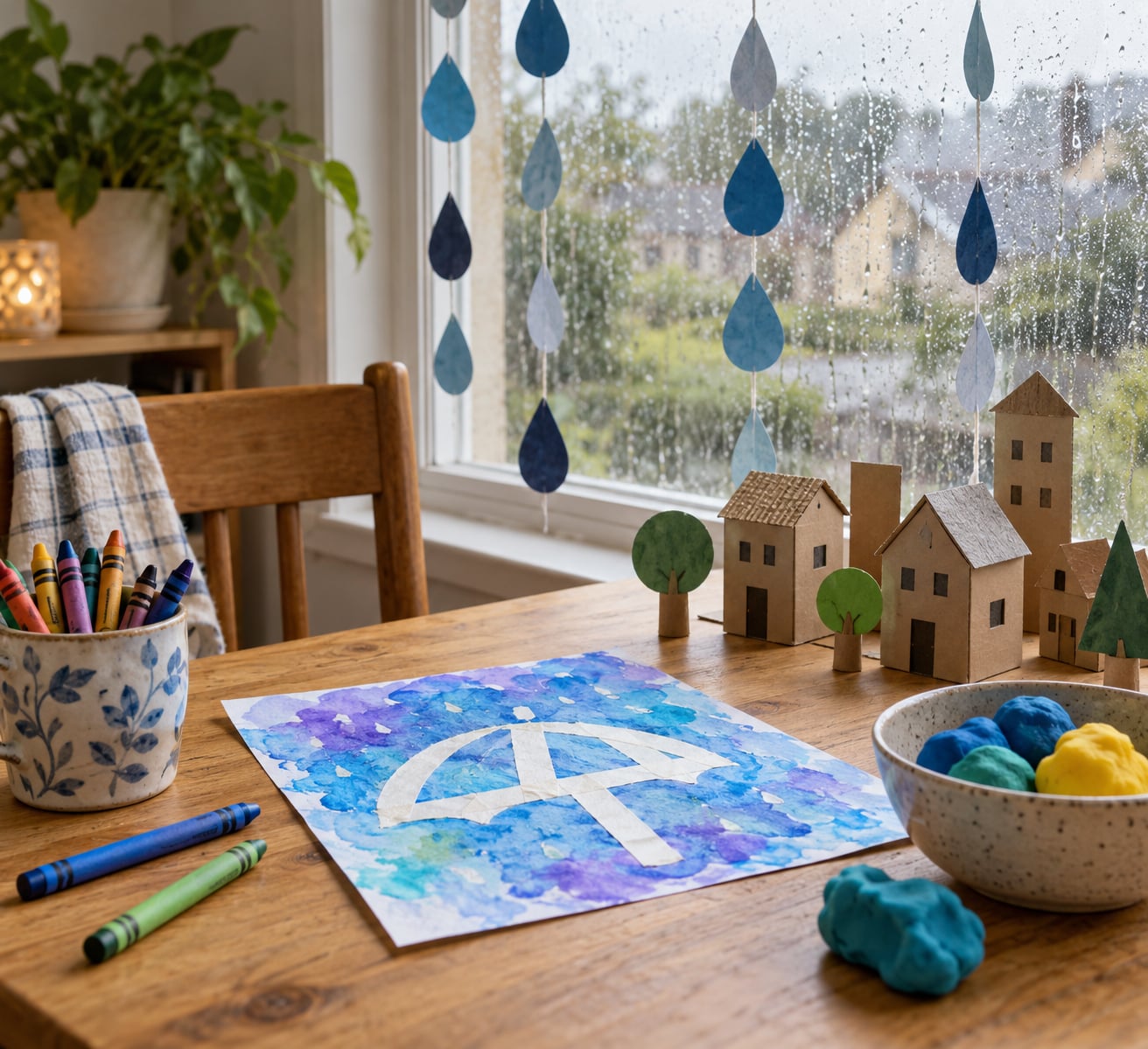
A hanging paper garland gives a grey window some shape and gives children something that keeps moving. It suits ages three to eight and takes about ten minutes before the glue needs to set.
Cut raindrop shapes from white or pale blue paper. Older children can cut their own; younger ones tear pieces and you trim the edges for them. Fold each drop in half, run a line of glue along the fold, and press it closed so the drop has a little depth.
For the clouds, roll a strip of paper into a loose tube for the body and add two circles for the puffs. Thread the drops and clouds onto a length of string with a dab of glue under each one, then hang the line across a window or above the table. It looks best when the drops hang at different lengths.
A recycled envelope or the blank side of a grocery bag works fine for the paper, and a glue stick is easier to clean up than liquid glue. Lay the pieces out on a tray overnight so nothing sticks to the floor in the morning.
2. Set Up a Coloring-Page Basket
What to do with kids on a rainy day indoors when you have five spare minutes
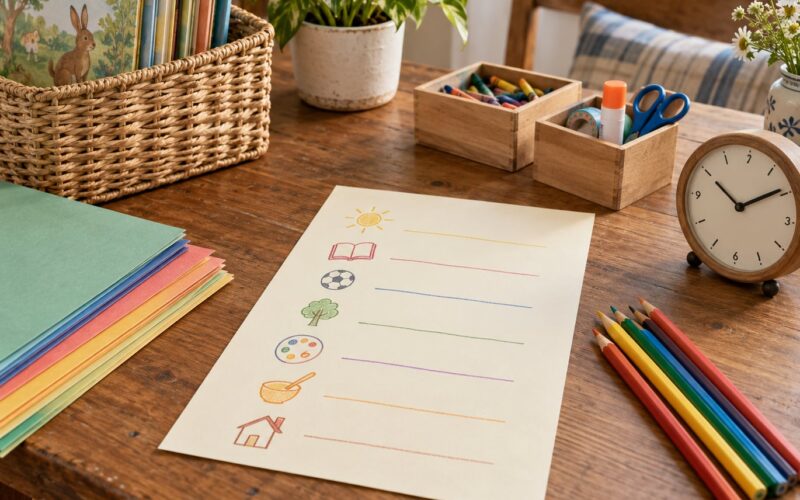
A basket of coloring pages by theme is the fastest answer when you have no plan at all. It suits ages two to eight and needs nothing beyond a basket, crayons and a stack of sheets.
Sort the sheets into three folders: wide shapes and single objects for the under-threes, themed scenes for preschoolers, and detailed pictures or lettering for school-age children who want a challenge. Punch a hole in each corner, thread the groups onto three key rings, and stand them in a basket by the sofa.
A themed basket works better than a random pile. A weather basket with raindrops, boots and umbrellas does something clever for a grey day: it gives the weather a shape instead of leaving the window as the only thing to look at.
For a quiet-time version, put six pages in a folder with a set of coloured pencils and hand it over at a table instead of the floor. Ninety quiet minutes buys you an awful lot.
3. Create a Tape-Resist Painting
Tape-resist painting gives clean, sharp lines that children cannot manage with a brush alone, so the results look far better than their expectations. The appeal is in the reveal: painting over the tape is ordinary, and pulling it off is magic.
Stick strips of painter’s tape across thick cardstock in any pattern, pressing each one down with a fingernail so paint cannot leak underneath. Children then brush or sponge colour over the whole sheet. Thin paint goes on best, and a sponge avoids the long streaks a brush leaves.
Let the sheet dry flat before lifting the tape, which takes a few hours rather than minutes. Pull each strip back slowly and at an angle. The lines underneath stay white, which is exactly the effect you hoped for when you started.
Ages three to ten do well with this. Younger children can place the tape themselves, which is half the fun, and older children can plan a design first and turn it into a mask, a rocket skin or a wrapping paper sheet.
4. Build a Cardboard City
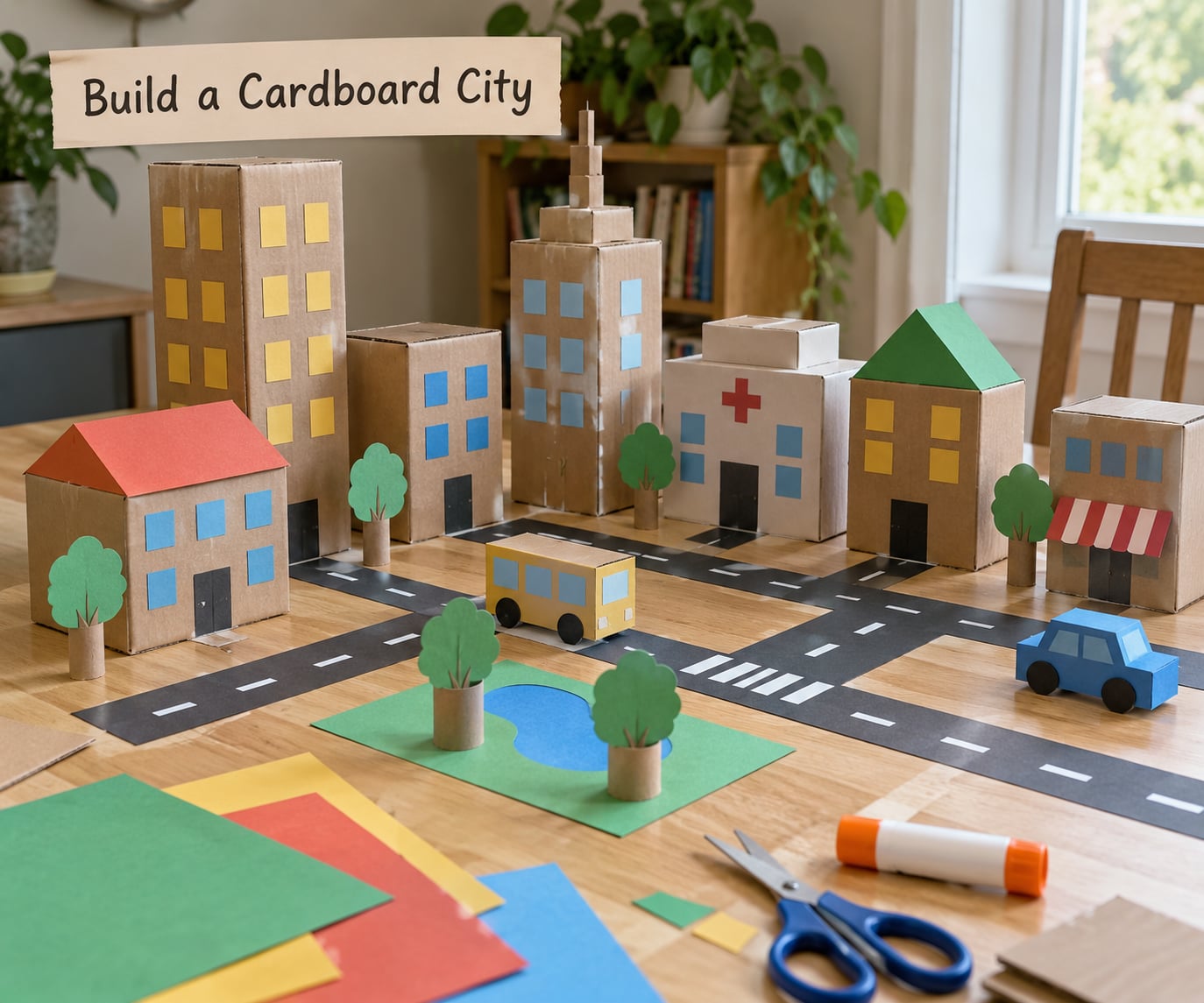
A cardboard city turns a stack of delivery boxes into a town, and it suits ages four to ten. Setup is twenty minutes if you cut the pieces yourself, less if the children do the cutting and you clear the floor first.
Start with a plan on the floor. Draw a road grid on a large sheet of paper, decide which box becomes a shop, a garage and a tower, and tape the roads down before anything gets built. Cutting a window into each box with a craft knife takes a minute a box, but it is what turns a stack of cartons into a place with a story.
One child can run the whole city as a solo world. With two or more, give each child a district so nobody fights over the same building, and let them add a bakery, a station and a park. Add toy cars, small figures or folded paper people so the town has traffic.
The city survives until the children decide it should not, which is usually a day or two. That is fine, because the box is the best toy in the house all over again afterward.
5. Play I Spy or a Rainy-Day Treasure Hunt
A clue-based treasure hunt works without hiding treats in every room, which is what makes most indoor hunts exhausting to set up. Five written clues and one hiding spot take about ten minutes and suit ages four to ten.
Write clues that describe what is on the way rather than what the treasure looks like: something round that you sit on, something cold in the kitchen, something that holds water. Each clue should have a definite answer and a definite next direction, otherwise a five-year-old will circle the same room for ten minutes.
Write pictures as well as words for the under-fives, and cut one word out of each clue for children who cannot read yet. With several children, stagger the start by a minute or two, or send them in pairs so one clue is not read aloud to everyone.
A simple example that works every time: the clues walk through the kitchen and end behind the cereal box on the top shelf, with a sticker or a small chocolate egg as the prize. Set the hiding spot before the clues go out, not after, or you will forget where you put it.
6. Make a Stop-Motion Movie
A stop-motion film is the one rainy-day idea here that produces something no other activity does: a finished movie at the end of it. It suits ages seven to fourteen and takes fifteen minutes to set up before the filming begins.
Prop the phone against a stack of books so it cannot move, tap the screen to lock focus and exposure, and turn off any timer that would darken each frame. Move the figure a small amount, take a photo, move it again. Consistency matters far more than perfection.
Most people film at ten to fifteen frames per second and then play the stills back at that speed, which gives the familiar jerky motion. A short film of sixty to a hundred frames takes about a minute to play and roughly an hour to shoot, so keep the cast small.
For a three-character example, use a lump of plasticine dinosaur, a folded paper boat and a toy astronaut. Put them on a desk with a folded piece of blue card behind it, and give each character a job before filming starts. Kids who find the patience for the shooting tend to want to make a second one immediately.
7. Have a Family Dance-Party Olympics
A dance-party Olympics burns the energy that builds up indoors by lunchtime, and it works for ages three to ten. Ten minutes of setup buys about thirty minutes of movement, noise and laughter.
Pick four events: a dancing contest, a balance walk along a tape line on the floor, a hopping course from cushion to cushion, and a singing round. Give each event a score out of five and write the scores on the back of a placemat, because a whiteboard feels too much like a competition to some children.
Clear the space first. Push back the furniture, remove the low coffee table, take the rug up if the children will be hopping, and move anything breakable to a high shelf. Ballet-style movement is fine in a hallway; jumping is not, next to glass or a radiator.
For a thirty-minute version, spend five minutes on each event, five minutes cooling down with water and fruit, and finish with a slow song and a lie-down on the cushions. The lying-down part is not optional in most households. Let adults join in, too, or the event becomes a spectator sport and ends early.
8. Bake and Decorate Easy Rainy-Day Treats
Baking together covers cooking, maths and decorating in one go, which is why it holds a child’s attention longer than most crafts do. Plan for forty-five minutes from starting to eating, with twenty minutes of that being prep by an adult. It suits ages three to twelve with the right jobs assigned.
Good options are decorated biscuits, pancakes with a fruit-and-yogurt topping station, or small yogurt cups layered with fruit and crushed cereal. Give each child one job they can finish alone: stirring, tearing, spooning, placing a berry. Leave the oven and any sharp tools to an adult.
Check for allergies and intolerances before you start, and keep separate bowls and utensils if more than one child is at the table. Wash hands before handling anything, and remember that raw egg mixture needs cooking through, so no licking of the bowl. Use a fresh whisked egg for French toast rather than pre-shredded anything meant to be raw.
Turn it into the activity rather than the baking: put the icing, the sprinkles and the fruit in bowls on the counter and let decorating be the whole event. The pancakes get eaten, the plates get left in the sink, and nobody minds.
9. Create a Mini Indoor Scavenger Hunt
An indoor scavenger hunt costs nothing and works in any house because it uses objects that are already there. It suits ages three to nine and takes five minutes to write.
Start with categories rather than named objects: something blue, something rough, something round, something that makes a noise when you shake it, something smaller than a cookie. A paper list with a box next to each line is all you need.
Set difficulty by age. Toddlers hunt for four broad categories with one example each, so nobody is asked to find something nobody owns. Preschoolers get six categories with drawings. School-age children get a hunt with a twist, where one line reads something another child has to bring back.
Keep the rules clear. Shoes off in bedrooms, no climbing on furniture, nothing from the bathroom or the kitchen counter, and nothing sharp. Nobody carries an object back to the kitchen, whatever the hunt says to find.
Then turn the leftover categories into the next activity. Two things that were texture-matched or colour-matched make a free sorting game for the ten minutes after.
10. Fold Origami Animals and Shapes
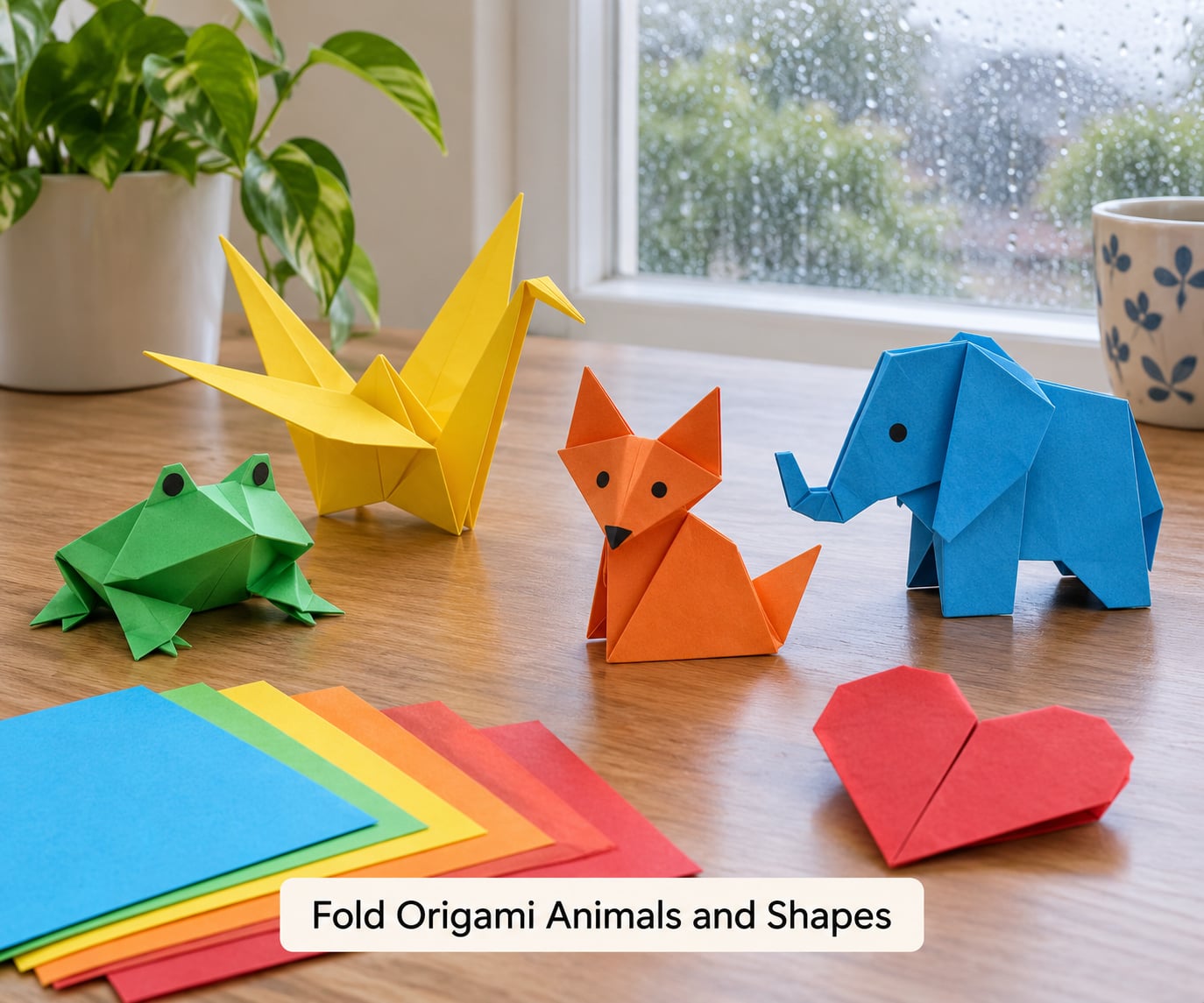
Origami is the best idea on this list for a bad-weather day because it needs no preparation at all, no space and no cleanup. It suits ages six to fourteen and costs nothing beyond paper. Children under five can do paper folding games, but they will not follow an origami sequence.
Start with a boat, because it takes four folds and finishes in about a minute. Then a paper hat, which is one fold and gives an instant result. The classic bird takes longer, around fifteen folds, and is a good second project for children who found the boat too easy.
Folding works on fine motor skills in a way that colouring does not, because every fold has to be accurate and in order. It is quiet enough that a child can do it while someone else reads aloud nearby, and the results pile up on the table, which feels productive after a morning of nothing.
Use square paper, and printer paper works well well enough. Give younger children a lighter weight sheet; a stiff card or a sheet of copy paper that has been used once bends more forgivingly and folds more easily.
11. Start a Floor Fort
A fort is the fallback every parent already knows, which is why it is on this list. It suits ages three to ten and takes about fifteen minutes, most of which is arguing about where it goes.
Choose the spot before you start. A corner near a window works well because the light is good and there is one way in, but keep the structure clear of radiators, heaters and any doorway. Never climb or drape anything on top of a wardrobe, a cabinet or a tall shelf.
Stand two chairs a short distance apart, drape a large blanket over them, and weigh the floor edges with cushions so nobody can pull it down over their own head. Blankets over furniture on wheels can move, so pull those chairs away from the wheels or lock them first.
Keep a gap at the entrance for air and keep the inside cool. A fort that is a snug is a hit; a fort that is stuffy gets abandoned in twenty minutes, which is the usual complaint about this activity. String a small torch inside for a flashlight and the place gains a year of life.
Add a cushion floor, a blanket wall, and one item that belongs inside: a book, a snack plate, a stuffed animal. Then leave it standing for a day, because taking it down within the hour defeats the point.
12. Make a Memory Matching Game
A homemade matching game lasts for years and costs one sheet of card. Preparation is about twenty minutes and the game itself suits ages two to eight, with the difficulty set by how many pairs you use.
Cut twelve identical rectangles from stiff card, half of them, and draw or paste six pairs of simple pictures: a cup and a saucer, a sock and a shoe, a spoon and a bowl. Old greeting cards work well because they already have pictures, and so do illustrations cut from a magazine.
For under-threes, use six cards, three pairs, and pictures that are obviously different from each other. At three or four, move to twelve cards. Once six pairs are mastered, add pairs that belong together in a less obvious way, like a comb and a brush.
Glue the cards on thick card so they do not flex, and laminate them if you have sleeves. A flipped card that bends up and hides its own picture frustrates small children more than losing a turn does.
Time a round with a kitchen timer and keep it low for the first game, so the focus stays on looking rather than on winning. The same deck works for a matching game in the car or at a table at a party.
13. Put On a Make-Believe Adventure
Make-believe needs props rather than supplies, and cups, boxes, spoons and a set of clothes that does not fit usually cover it. It suits ages three to nine and takes about ten minutes to set up. This is the answer for the afternoon when the rain still has not let up and the crafts are used up.
A kitchen cafe works with no purchases: a menu card, cups, a small pot, plastic plates and a tray for the order. A space journey needs a cardboard box with a lid and four buttons, plus a torch for a thruster. A puppet theater needs a sheet over a chair and a paper bag or sock with eyes. A detective case needs an envelope and one odd clue hidden somewhere obvious.
Give each child a role rather than a task, and let the roles change. A child who has written the ending of the cafe twice in ten minutes will last far longer than one who has been asked to hand out three made-up sandwiches on order.
For an example storyline, the cafe regulars arrive, order something impossible like a striped milkshake, and the kitchen has to invent it before the storm ends. Give the children one problem and let them solve it. An activity with a problem in it holds attention longer than an open-ended one.
If you can join in, join in. Adults running this game last considerably longer than adults watching it.
14. Make Simple Play-Dough Creations
Play dough runs for an hour and then needs a covered container, which is one of the reasons it is worth the fifteen minutes. It suits ages two to eight and can be made from kitchen staples rather than purchased.
Mix two cups of plain flour with half a cup of table salt, then add a cup of warm water and a tablespoon of vegetable oil. Stir it with a spoon until it is too thick for the spoon, then finish by hand. Add food colouring a few drops at a time, which is far easier than trying to fix the colour afterwards.
Store it in a sealed container at room temperature and replace it every few days. Do not put it in the fridge, because condensation makes it sticky. Allow two days for drying if the children want to make ornaments that hang, or use paper shapes for anything that will not survive a drop.
Edible colouring keeps it safe for small children who still put things in their mouths. Anything else is fine once the children are past that stage, and colouring it with a washable felt pen before baking on a low heat dries out the colour permanently.
A three-item challenge stops the mass-production problem: exactly one flower, one animal and one pretend food. Limited scope means the three items are finished, which is the part children forget about.
15. Hold a Family Pajama and Portrait Hour
A pajama hour is the wind-down activity that works on a day that has gone wrong, and it needs about five minutes of organisation. It suits ages four to fourteen and it can run in the last hour before bed.
Split the hour into three parts. Ten minutes reading aloud, twenty minutes drawing, and the rest free in the pajamas with dim lighting and the last snack of the day. The drawing is the part to hold on to.
Everyone draws one portrait of one other person in the room and no one is allowed to look at their own face while doing it. Children find this hilarious and adults find it surprisingly good. Then put the portraits on one page, add the date, and let everyone sign it.
The keepsake does not have to be a good likeness to work. A set of five badly drawn portraits on one sheet, kept in a drawer or slipped into a frame, becomes the thing your family still has in ten years.
For a wider age spread, the younger children draw while the older ones write a one-sentence caption beside them. Teenagers usually refuse the whole thing, and drawing a portrait of them anyway gets you the good one for the frame.
Frequently Asked Questions
What are cheap things to do with kids on a rainy day indoors?
Most of them are free. Drawing on the back of old envelopes, a scavenger hunt, a treasure hunt with written clues, a dance contest, a fort built from two chairs and a blanket, and a puppet show behind a sheet all use things you already own. If you want to spend nothing at all, check the ideas above that list paper, cardboard and kitchen staples as the main supplies.
What indoor activities work well for toddlers on a rainy day?
Tears paper, a laundry basket of balls, colouring large simple shapes on a big sheet of paper, a play-dough recipe you make while they watch, and a treasure hunt where every clue has a picture on it. Keep the session short, five to ten minutes each, and move on when it stops working rather than trying to finish the activity. Most published lists start at age five, which is why toddler days fall through the cracks.
How can I keep children busy indoors without screens?
Rotate between one high-energy activity and one quiet one, rather than running quiet activities all morning. A scavenger hunt followed by a coloring-page basket holds far longer than two coloring sessions. Set out two or three materials at a time instead of the whole cupboard, and give the high-energy one a start line, an end line and a timer, which turns aimless movement into a game with a shape to it.
What can kids make at home with simple craft supplies?
Paper raindrops and cloud garlands, tape-resist paintings, cardboard cities, homemade play dough, paper hats and origami boats, homemade memory cards, and decorated biscuits all need paper, glue, tape, scissors, paint and kitchen staples. The list of ideas for what to do with kids on a rainy day indoors above lists the exact materials for each one so you can check the cupboard before the rain starts.
Do I need to plan every activity for a rainy day?
No. About four of the fifteen ideas here need no preparation at all: origami, I Spy, the dance party and the scavenger hunt all start the moment you decide to do them. Planning helps most when you have five hours, two children of different ages and heavy rain all day. If you have an hour and one child, decide on the spot and accept that half an idea is better than a good plan you never started.
Start With One Easy Idea
Pick one activity now and stop reading. If the children are wound up, start with the dance-party Olympics or the floor fort; if they are already quiet, start with origami or the memory game. If you have an hour and a weather forecast that says the rain is not stopping, choose the one that uses the fewest materials, because that is the version you will still be able to finish at four o’clock.
Still stuck on what to do with kids on a rainy day indoors? Scan the at-a-glance table above and pick the row that matches the age in the room, then give it twenty minutes before deciding whether to stay or move on.