If homemade slime keeps getting hard, the answer is almost always one of two things: water left the batch, or too much activator tied the polymer chains together too fast. Slime is glue-based, and glue-based mixtures lose moisture through any surface you leave open. Once the water is gone, the slime sets from squishy to stiff in a few hours. Diagnosis before repair is the whole trick here, because the two problems need opposite first moves.
I have made more batches of this stuff than I care to admit, and almost every “my slime turned to rock” moment traced back to one jar with the lid resting on instead of screwed on, or one enthusiastic pour of activator that I thought would fix stickiness. Updated for 2026, here is how to tell which problem you have and what actually works.
Table of Contents
- 1Why Does Homemade Slime Get Hard?
- 21. Water evaporating through an open surface
- 32. Too much activator, or activator added twice
- 43. Cold storage or cold weather
- 54. Glue that is not PVA
- 65. Add-ins that drink the water
- 7Common Causes of Hard or Sticky Slime
- 8How to Tell Whether Your Slime Is Dry, Sticky, or Gelled
- 9How to Soften Homemade Slime
- 10For PVA slime with borax or contact solution
- 11For saline slime made with contact lens solution
- 12For cornstarch slime
- 13For slime made with a white PVA craft glue
- 14For slime bought in a tub
- 15Which Liquid Should You Add to Slime?
- 16How to Keep Slime Soft and Stretchy
- 17When Should You Make a New Batch Instead of Fixing Slime?
- 18Frequently Asked Questions
- 19Why does my slime get hard overnight?
- 20Can I soften hardened slime with water?
- 21How do I fix slime that is too sticky?
- 22Why does my slime turn into a hard ball?
- 23How long can homemade slime be stored?
- 24Conclusion
Why Does Homemade Slime Get Hard?
Homemade slime gets hard for five reasons: the water in it evaporates, too much activator over-cross-links the glue, cold temperature stiffens it, the glue is not true PVA, or heavy add-ins like clay and cornstarch absorb the moisture it needs. The tell is what the slime feels like, and each feel points to a different fix.
Most guides skip the part that matters most here. Air drying and over-activation both end in a stiff slime, and their repairs are opposites. Dried-out slime needs water. Over-activated slime needs more glue and less activator, and adding water alone will only give you sticky, weepy slime.
1. Water evaporating through an open surface
This is the cause behind most “it was perfect last night” stories. Polyvinyl acetate, the plastic in school glue, holds its stretch only while there is water between the polymer chains. Expose that surface to air and the water leaves. The slime tightens, gets rubbery, then goes stiff.
Tell-tale signs: the surface feels slightly matte rather than glossy, the slime is smaller than it was last week, and it pulls apart in short rips instead of long slow stretches.
2. Too much activator, or activator added twice
Borax, contact solution and liquid starch all supply borate ions that bridge the PVA chains together. Extra activator means more bridges, a tighter network, and a slime that snaps instead of stretches. People add a second dose trying to solve stickiness, then the batch goes hard and they assume the water went.
Tell-tale signs: the slime feels dense and doughy rather than dry, it tears cleanly like rubber, and it no longer picks up stickiness from a fingertip. Experienced slime makers put it plainly: too much activator gives rubbery slime, and not enough leaves it sticky.
3. Cold storage or cold weather
Temperature changes the texture before any water is lost. A batch kept in a fridge, a garage, or a car overnight in winter will come back stiff. Warm it back up and a surprising share of “dead” slimes turn out to be perfectly fine.
4. Glue that is not PVA
Some craft glues and some glue sticks are not water-based PVA at all. They stretch for a while and then seize into a rubbery lump, because nothing in them cross-links properly. If your slime went strange within days of mixing and the recipe was correct, the glue is the suspect.
5. Add-ins that drink the water
Clay, Model Magic, cornstarch, flour and instant snow all absorb liquid from the batch. Combine heavy add-ins with an already-stiff base and the result hardens fast. Flour is the one I would avoid as a thickener for exactly this reason, and the same pattern shows up constantly in clay-heavy “cloud” slime, which goes stiff within days.
Common Causes of Hard or Sticky Slime
Read your batch against these signs before you add anything. Guessing is what turns a fixable slime into a waste-bin slime.
- Stiff but not rubbery, surface matte: evaporation. Fix with warm water and kneading.
- Rubbery, snaps cleanly, tears rather than stretches: over-activated. Fix with more PVA glue, no more activator.
- Sticky and watery at the same time: under-activated or diluted. Fix with a small amount of activator, added slowly.
- Water pooling at the bottom of the jar: the polymer and water have separated. Fix by kneading hard, or make a new batch if it will not rejoin.
- Stiff and cold to the touch only: temperature. Warm it in your hands for several minutes first.
- Stiff within days of mixing, no storage issues: wrong glue or too much add-in. Fixing is unreliable here.
How to Tell Whether Your Slime Is Dry, Sticky, or Gelled
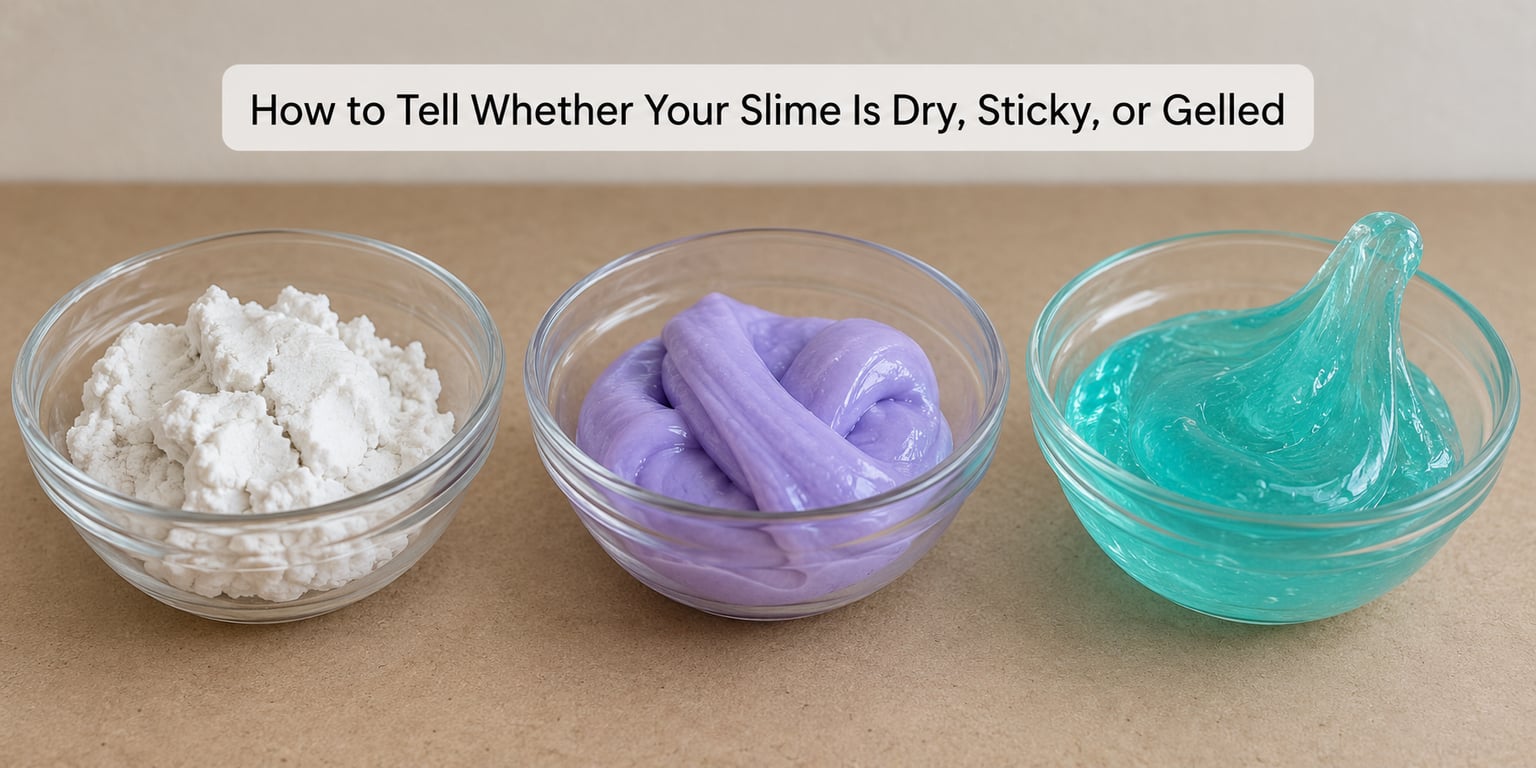
Pull a small piece slowly. Dry slime fights you and then gives, sticky slime stretches and clings to your hand, gelled slime snaps.
| What it feels like | What it does when you pull | Most likely cause | First move |
|---|---|---|---|
| Dry and matte | Stretches a little, then rips short | Water evaporated | Add warm water a drop at a time |
| Dense and rubbery | Snaps back fast, tears clean | Too much activator | Add a spoonful of PVA glue |
| Wet and clingy | Stretches long and grabs hands | Under-activated or diluted | Add activator a little at a time |
| Hard with a liquid layer under it | Breaks apart, cannot be made whole | Separation | Knead several minutes, then reassess |
| Firm but pliable | Stretches slowly, returns to shape | Cold storage | Warm it in your hands |
| Cloudy and firm | Stretches, slightly grainy | Over-mixed or too many add-ins | Add a drop of water, knead gently |
How to Soften Homemade Slime
Always start with the smallest possible amount and knead it in fully before deciding whether to add more. Ten seconds of kneading changes more than a big pour of liquid, and a spoon too much undoes your work.
For PVA slime with borax or contact solution
Put the slime in a bowl, add warm water one drop at a time, and knead with your palm. Not cold water, not hot. It should go from stiff to soft within a few minutes of kneading. If it turns sticky and wet, you went too far, so add a little more glue and work it through.
For saline slime made with contact lens solution
Same approach, gentler. Warm water, drop by drop, with slow folding rather than slapping. These batches are usually only over-activated, because the activator is in the glue base itself, so give them a few minutes before adding anything else.
For cornstarch slime
No extra water. This batch is already at maximum liquid capacity, so water makes it glue soup. Add a small amount of the cornstarch mixture back and knead until the paste comes together.
For slime made with a white PVA craft glue
Warm water first, then a spoonful of the same glue if it is over-activated. Keep ratios consistent. A bottle you already own works far better than a new one mid-batch, since PVA content varies between brands.
For slime bought in a tub
Store-bought slime has more plasticizer in it than homemade batches, so it holds together longer but also resists water. Warm water and kneading is still step one. If nothing moves after a few minutes, a slime softener product made for that brand works better than anything from your kitchen drawer.
Which Liquid Should You Add to Slime?
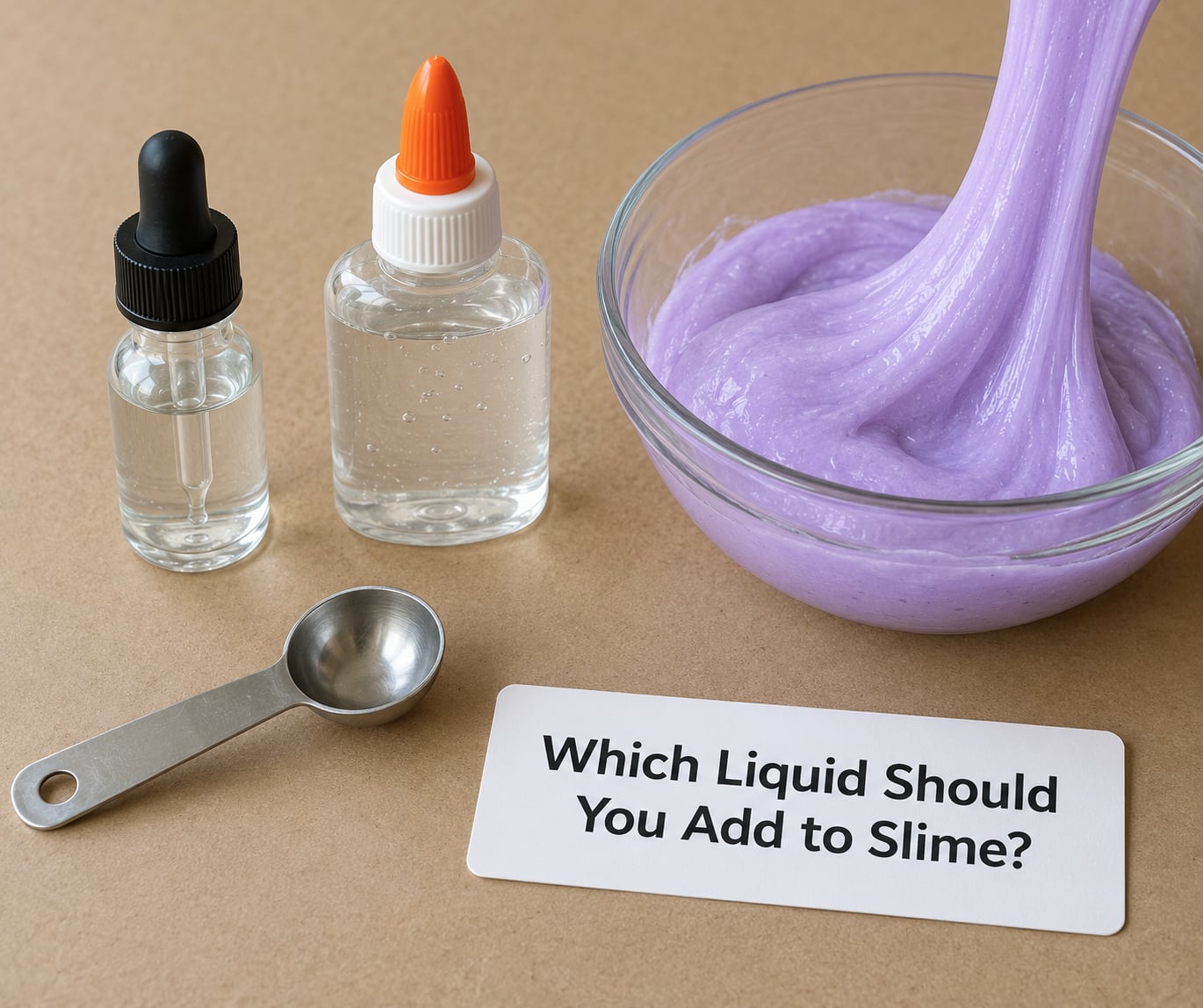
The right liquid depends entirely on what went wrong. Use this table before you open a bottle.
| Liquid | Use it when | How much | Never combine with |
|---|---|---|---|
| Warm water | Slime is dry, matte, slightly stiff | Drops at a time, 5 to 10 total | Over-activated slime, cornstarch slime |
| PVA school glue | Slime is rubbery, dense, or over-activated | One to two tablespoons | Fresh activator in the same session |
| Saline or contact solution | Glue-based slime that is sticky and slack | A teaspoon, added slowly | Already-thick batches, hot water |
| Activator (borax solution or liquid starch) | Slime is too runny to hold a shape | A teaspoon at a time | Anything already stiff or rubbery |
| Glycerin or lotion | Slime is stretchy but dry and tight | A teaspoon | Rock-hard or already rubbery slime |
That glycerin line matters more than it looks. Softener adds body rather than water, so a batch that has already gone rubbery and hard will end up completely solid if you add more. Lotion helps a dry but still-stretchy batch, and does nothing useful to a stiff one.
How to Keep Slime Soft and Stretchy
Storage decides how long a batch survives, and it is a thirty-second habit rather than a recipe change.
- Screw the lid on fully. A jar resting on its rim loses water overnight.
- Keep the container airtight and out of direct sun, away from radiators and car dashboards.
- Hold it at room temperature. Fridge storage is fine for a few days, but a chilled batch stiffens and needs warming before play.
- Wash hands before and after. Food residue and oil accelerate slime breakdown faster than you would expect.
- Keep play sessions to 10 or 15 minutes, then return the slime to its jar. Continuous handling is what pushes batches to failure.
- Label the jar with the mixing date so you know whether a stiff texture means cold, age, or over-activation.
Expect to mix a fresh batch every few weeks with regular use. Slime is a short-lived material, and treating it as one makes the hard days far less frustrating.
When Should You Make a New Batch Instead of Fixing Slime?
Some batches are finished, and a fresh jar takes fifteen minutes. Start over rather than trying to rescue these.
- Visible mold: white, green or black fuzzy spots, anywhere in the batch. Do not knead it and do not sniff it closely.
- A sour or chemical smell that is not present in a fresh batch.
- Water that will not reincorporate: after several minutes of kneading the liquid still sits at the bottom and the solid refuses to join it.
- A rock-hard batch: if warm water and kneading produce no give at all after ten minutes, the polymer has set past the point of return. A quarter teaspoon of borax added by mistake is the usual reason, and the water fix will not work.
- Slime that smells and feels wrong after a hot car or a freezer stint.
Safety note for adults: handling borax and contact solution is an adult job. Slime is not food, keep it away from children under five, and if anyone ingests activator solution, contact Poison Control in the United States on 1-800-222-1222.
Frequently Asked Questions
Why does my slime get hard overnight?
Usually three things: the lid was resting on the jar instead of sealed, the batch sat in a cold room or car overnight, or someone handled it before bed and left residue on the surface. Overnight hardening is almost always moisture loss, so warm water and kneading fixes it. Warm it in your hands first if it feels cold, then add warm water a drop at a time.
Can I soften hardened slime with water?
Yes, if the slime is dry and matte rather than rubbery. Warm water works well, added one drop at a time with slow kneading. It fails on slime that was over-activated, because water makes that batch sticky without softening it. Give it a full five minutes of kneading before adding more, and stop as soon as it feels stretchy again.
How do I fix slime that is too sticky?
Add activator, not water. Pour a teaspoon of borax solution, contact solution or liquid starch into the bowl, then knead until it pulls away from your palm. Add it in small amounts, because over-activating sticky slime turns the problem into hard slime in seconds. If it is only slightly tacky, more kneading on its own often clears it.
Why does my slime turn into a hard ball?
A hard ball usually means too much activator, or a batch that dried out and then got kneaded hard. Borate ions over-cross-link the PVA chains and the slime seizes into a dense lump. Warm water rescues it only if some softness remains. Once it is genuinely rock hard, start a new batch and use less activator next time.
How long can homemade slime be stored?
Sealed at room temperature and played with for 10 to 15 minutes a day, a batch usually lasts two to four weeks before it needs replacing. Continuous handling shortens that sharply. Store it airtight, away from sun and heat, and wash hands before play. Chill it for short periods if you need it to last longer, then let it warm up before use.
Conclusion
Start by naming the problem, not by reaching for a bottle. Decide whether the slime is dry, sticky, or over-gelled, then add the smallest suitable amount of the correct liquid and knead it in slowly. If a rock-hard batch refuses to soften after ten minutes, mix a new one.