Tie dye fades after washing for one of two very different reasons: the dye never bonded to the fabric and rinses straight out, or the dye was the wrong type for that fiber and has nothing durable to hold onto. Every wash just reveals a decision that was already made at the dyeing table.
That distinction matters, because the two problems need opposite fixes. A shirt that loses most of its color in the first three washes has a bonding problem, and no wash routine will bring the color back. A shirt that looked perfect on day one and has slowly dulled over a year of wear has a different issue, and the fix is mostly about what happens next.
A little color leaving on the first wash or two is normal. Fiber-reactive dye baths always hold leftover dye, and watching a little of that rinse away is not the same as watching the shirt go pale.
Table of Contents
- 1What Causes Tie-Dye to Fade After Washing?
- 2How Fiber Type Changes Fading
- 3Why Does Tie Dye Fade After Washing? The Dyeing Process
- 4Which Washing Habits Make Fading Worse?
- 5How to Wash Tie-Dye So the Colors Last Longer
- 6Can You Make Faded Tie-Dye Bright Again?
- 7Simple Tie-Dye Troubleshooting Guide
- 8Frequently Asked Questions
- 9Is tie dye supposed to fade naturally?
- 10Does cold water actually stop tie dye from fading?
- 11Do vinegar or salt set tie-dye color?
- 12How long should I wait before washing a freshly tie-dyed shirt?
- 13Can I wash tie-dye shirts together with other laundry?
- 14Conclusion: Start With a Gentler First Wash
What Causes Tie-Dye to Fade After Washing?
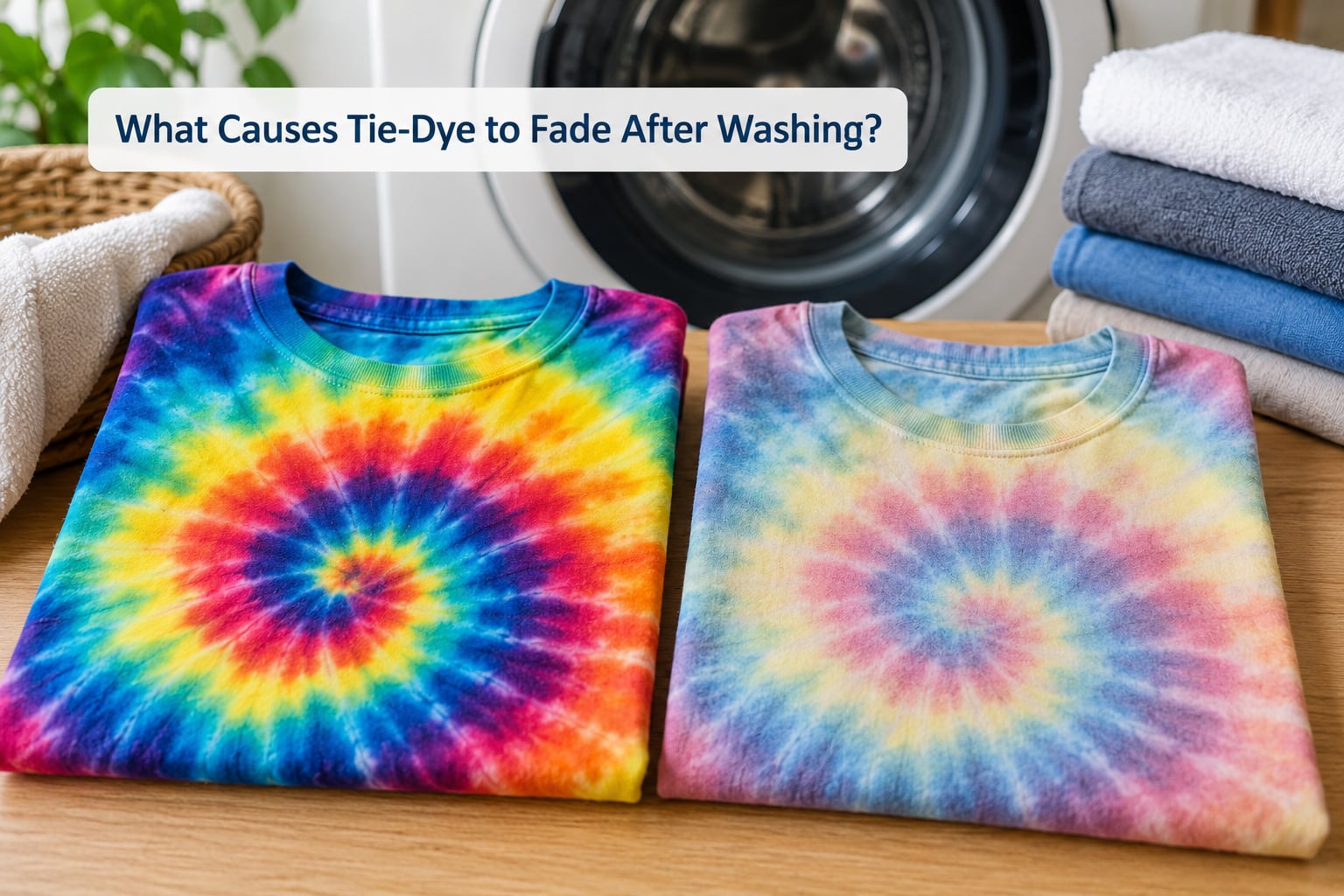
Here are the causes in rough order of how much damage they do.
- Dye that never bonded. The color sits in the fabric instead of being fixed to it, so it leaves in the first rinses and washes. This is what an exhausted dye bath leaves behind on a finished shirt.
- The wrong dye class for the fiber. All-purpose dye on cotton, or fiber-reactive dye on polyester, cannot form a lasting bond with that fiber. The color looks good for a while, then leaves slowly.
- Heat during washing. Hot water loosens dye that has not fully set and wakes up any that is still sitting on the surface.
- Harsh detergent and bleach. Strong alkaline detergents and any chlorine bleach attack the fiber and the dye molecule itself.
- Soaking, overloading and friction. Long soaks, tight loads and items rubbing together keep dye suspended and pull loose color off the surface.
- Sunlight and wear. UV light breaks dye molecules down, and abrasion at cuffs, collars and waistbands thins the color where the garment rubs.
Number one and number two are decided before the shirt ever reaches the washer. Everything after that is either protecting a bond that exists or failing to create one.
How Fiber Type Changes Fading
Fiber-reactive dye, the type sold as Procion MX or in Tulip One-Step kits, works by chemically reacting with cellulose. That makes it a permanent option for cotton, rayon, Tencel, linen and hemp, and a waste of money on anything synthetic.
| Fiber | How it holds dye | Fade risk at home |
|---|---|---|
| Cotton | Takes fiber-reactive dye strongly | Low once fully cured; softener residue blocks the bond |
| Rayon and Tencel | Very absorbent, bonds well | Low, but the wet fabric is fragile in the wash |
| Silk | Needs acid or fiber-reactive dye | Moderate; hot water is risky |
| Polyester | Needs a disperse dye and high heat | High with the wrong dye; the color sits on the surface |
| Cotton-poly blends | Partial bonding only | Moderate, and the two fibers may shift colors differently |
That last row causes a specific surprise: a 50/50 blend takes color on the cotton half and much less on the polyester half, so the shirt can look flat and uneven once it dries. Silk and wool do not like soda ash and want their own dye families instead.
Why Does Tie Dye Fade After Washing? The Dyeing Process
Think of permanent color as a chemical handshake between the dye and the fiber, and this is why tie dye fades when something in that handshake is missing.
Fiber-reactive dye needs three things to complete the bond: moisture, warmth and time. Soda ash, also called sodium carbonate, raises the pH of the bath so the reaction can start. A common recipe is one tablespoon of soda ash per cup of water, soaked into the damp fabric for 15 to 30 minutes before the dye goes on.
After dyeing, the shirt should stay warm and damp for roughly 6 to 24 hours, ideally above about 70 degrees Fahrenheit. Plastic-wrapped and kept in a warm spot, that is what the dye needs to finish reacting. Rinsing early, letting the fabric dry out, or working in a cold room all leave more dye unfixed, and that unfixed dye is what washes out later.
All-purpose dye, sold under names like Rit, works differently. It does not bond to cellulose at room temperature at all, so on cotton it can only ever be a surface stain. That is fine for a craft night. It will never survive regular washing on cotton.
Disperse dye is the opposite case, used for polyester and other synthetics and needing heat to set. Put it on cotton and you get pale results; put fiber-reactive dye on polyester and you get the same problem in reverse.
Rinsing matters too. Rinse in cool water first, then warm, then cold, changing the water until it runs nearly clear. Everything that comes out in that water was never bonded. If you skip the rinses and dump the shirt in the washer, the machine water turns into a bath of loose dye that settles back onto everything inside it.
One more pre-dye step gets overlooked: fabric softener and sizing form a film on cotton that dye cannot get through. Wash the blank shirt with detergent only, no softener, and no dryer, before you tie it.
Which Washing Habits Make Fading Worse?
- Hot water. The single biggest wash-time mistake, and the same water that shrinks cotton while it fades it.
- Heavy detergent and bleach. Chlorine bleach strips dye permanently. Oxygen bleach is gentler but still not friendly to color.
- Fabric softener in the wash. It coats the fibers and dulls color over time, the same film that blocked the dye in the first place.
- Frequent washing. Every cycle is one more chance for abrasion and dye loss. Once or twice a week is plenty.
- Overloading. A full drum means more rubbing, and dark items can transfer loose color onto pale ones.
- Machine drying on heat. The heat cycle repeats the damage that hot water does.
- Sun drying on the line. UV fading is slow and permanent, and bright rooms cause it faster than people expect.
- Washing new tie-dye with everything else. Even a well-set shirt can pick up loose dye in that first load.
How to Wash Tie-Dye So the Colors Last Longer
The first wash matters more than any wash that follows it. Give it its own short cycle with nothing else in the machine.
- Let the dye finish first. Wait out the cure time your dye instructions call for, usually 6 to 24 hours, keeping the fabric warm and damp.
- Rinse by hand in cool water. Keep the water running until it is nearly clear. Change the temperature from cool to warm to cool as you go.
- Wash the shirt alone. Cold water, gentle or delicate cycle, a small amount of mild detergent, no softener and no bleach.
- Check for dye in the water. If the water runs blue on the second rinse, that is normal. Do that rinse again.
- Air dry, or dry flat out of direct sun. Skip the machine dryer for the first several washes.
- Wash it inside out from here on. The inside face takes the friction instead of the color.
For rayon and Tencel, use a mesh bag and the gentlest cycle, since the wet fibers snag easily. For silk, skip the machine and hand wash cool with a detergent made for delicate fabrics. Polyester dyed with a proper disperse dye can usually take a warm wash, since the color is locked inside the fiber rather than sitting on it.
If the shirt is for a kid, the same rules work, just expect to repeat them. Group projects fail mostly because cold dye baths and skipped cure times let loose dye run between shirts.
Can You Make Faded Tie-Dye Bright Again?
Honestly, usually not. Household dye will not reattach to a fiber it has already lost color to, and no commercial product brings a genuinely faded shade back to its original depth.
What does work is covering it. Overdyeing a faded cotton shirt with fresh fiber-reactive dye lays new color on top, and the two shades mix into something different from the original but usually livelier than what you had. Just plan for a new palette rather than trying to reproduce the old one.
Bleaching first, then dyeing, gives you a clean white canvas. Keep the soak to 15 or 20 minutes and rinse thoroughly, because bleach left in the fabric will eat both the new dye and the fibers. Users often neutralize a bleach soak afterward with sodium thiosulfate, sold as Bleach Stop.
Fixatives like Retayne are worth knowing about. They catch dye that has not bonded and hold it in place, which helps on cotton that was under-dyed, but they cannot rescue a shirt dyed with the wrong chemistry. Synthrapol works at the other end of the process, washing out excess dye before it ever reaches the fabric.
Sometimes the better answer is to wear it. A soft faded shirt beats a stiff overdye every time.
Simple Tie-Dye Troubleshooting Guide
| Symptom | Likely cause | What to do |
|---|---|---|
| Water runs dark blue on the first wash | Unbonded dye still in the fabric | Rinse again until clear, then wash separately in cold water |
| Most of the color gone after one or two washes | No soda ash, or a cool or short cure | Expect no recovery; overdye the shirt |
| Bright at first, duller every month | All-purpose dye on cotton, or abrasion and sweat at cuffs | Wash inside out, cold, and rotate with other shirts |
| Colors blurred into each other | Rinsed too early, then washed with other laundry | Separate loads from now on and extend cure time next time |
| Black turned purple, or yellow barely took | Dye mixed with too much water, or dye bath already exhausted | Use concentrated dye in a fresh small bath |
| Color dulls in a sunny room | UV exposure over time | Store folded away from windows and direct light |
| Shirt felt fine, then shrunk | Hot water or machine drying | Cold water and air dry from the start |
Frequently Asked Questions
Is tie dye supposed to fade naturally?
A small amount of color leaving in the first few washes is normal and expected, because every dye bath holds leftover dye that never bonded. Gradual dulling over months of wear is also normal, driven by UV light, sweat and abrasion at cuffs and collars. Losing most of the color in one wash is not normal, and it points to a bonding problem rather than natural wear.
Does cold water actually stop tie dye from fading?
Cold water slows fading, and it is the single most useful habit after dyeing. Heat speeds up dye loss and also shrinks cotton, so a cold wash protects both the color and the size of the garment. Cold water alone will not rescue a shirt whose dye was never fixed, because the wash only reveals the bonding failure that already happened.
Do vinegar or salt set tie-dye color?
No. Salt and vinegar do not set fiber-reactive dye on cotton, and the idea that they do is one of the most persistent myths in the craft. Vinegar only belongs in acid dye baths for wool and silk. What actually sets the color is soda ash, warmth, moisture and a full cure time of 6 to 24 hours before rinsing.
How long should I wait before washing a freshly tie-dyed shirt?
Wait at least 6 hours and up to 24 if you can, keeping the fabric warm and damp the whole time. The dye reaction needs moisture, warmth and time to finish bonding to the fiber. Washing sooner pulls out dye that has not finished reacting. There is no downside to leaving it longer, since the reaction does not expire once it is under way.
Can I wash tie-dye shirts together with other laundry?
Not for the first few washes. Dye that has not bonded will migrate in the machine and settle on everything in the load, which fades your tie-dye and stains the other clothes at the same time. Wash new tie-dye alone in cold water, gentle cycle, mild detergent and no softener. Once the color stops coming out in the water, you can group it with similar shades.
Conclusion: Start With a Gentler First Wash
Why does tie dye fade after washing? Either the dye never bonded to the fiber, or it was the wrong dye for that fiber, and the wash only confirms what the dyeing table decided.
So start where it counts. Let the shirt finish its cure time in a warm, damp, wrapped state, rinse it by hand in cool water until that water runs clear, then wash it alone in cold water with mild detergent and air dry it out of direct sun. That single sequence prevents more fading than any product you can buy afterward.