The easiest way to explain primary and secondary colors to kids is to put three paint colors on the table and let them combine two at a time. Primary colors are red, yellow and blue. Secondary colors are orange, green and purple, and each one is made by mixing exactly two primary colors together.
Children usually remember the pairs after their own hands have made them, not after hearing them. So the whole job is setting up a small, controlled mixing experiment and letting your child do the mixing. This guide covers what to say, what to put out, and how to check that the idea actually landed.
Table of Contents
- 1What Are Primary and Secondary Colors?
- 2How to Explain Primary and Secondary Colors to Kids
- 3Words you can say out loud
- 4The five-step sequence that works
- 5How to check they understood
- 6Primary Colors: The Starting Colors
- 7Secondary Colors: Colors Made by Mixing
- 8How to Demonstrate Color Mixing
- 9Easy Activities for Teaching Colors to Children
- 10Simple Questions to Ask Kids About Colors
- 11Frequently Asked Questions
- 12What are the primary colors and what do they represent for kids?
- 13What are the secondary colors?
- 14How do I teach primary and secondary colors step by step?
- 15What are the 7 primary colors in order?
- 16What are some fun ways to teach colors to preschoolers?
- 17At what age should I teach my child primary colors?
- 18Conclusion
What Are Primary and Secondary Colors?
Primary colors are the three colors that cannot be created by mixing other colors together. In paint, they are red, yellow and blue. If you mix them, you can never get back to a single pure red, a single pure yellow or a single pure blue.
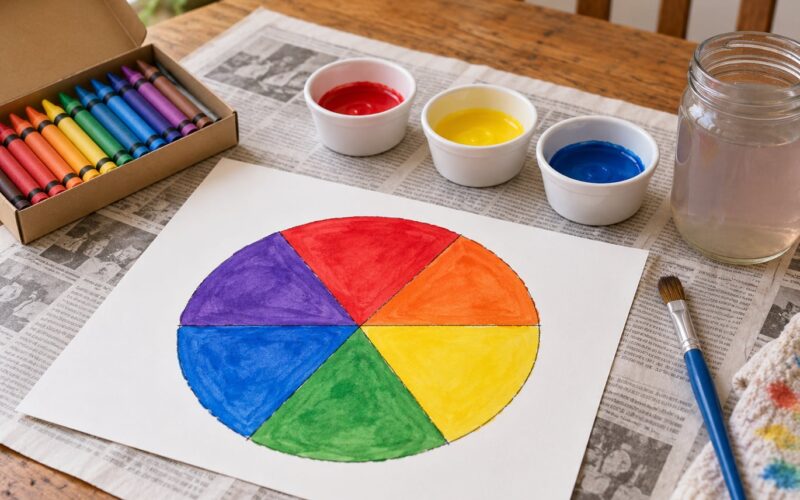
Secondary colors are the three colors you get when you combine two primary colors in equal parts. Each secondary color sits between its two parents on the color wheel, which is why people sometimes describe the wheel as a pizza cut into six slices.
| Mix these two primary colors | You get this secondary color |
|---|---|
| Red + yellow | Orange |
| Blue + yellow | Green |
| Red + blue | Purple |
A gentle next step, once the three pairs are solid, is the tertiary colors. Those come from mixing one primary with one secondary, which is where names like red-orange and blue-green come from. Most children do not need them before age six.
How to Explain Primary and Secondary Colors to Kids
Say it in under a minute, then hand over the paint. Below is a short script you can copy almost word for word, followed by the sequence that makes it stick.
Words you can say out loud
“These three colors are called primary colors: red, yellow and blue. They are the starting colors. You cannot make them by mixing other colors together.”
“Now I am going to mix two of them. Red and yellow make orange. Red and blue make purple. Blue and yellow make green. Those three new colors are called secondary colors, because we made them ourselves by mixing.”
“Every color on this wheel came from one of those three starting colors.”
The five-step sequence that works
1. Name first. Point to red, yellow and blue on their own and say the names. Ask your child to point to each one rather than repeat the word.
2. Mix two only. Put one dab of red and one dab of yellow side by side. Let your child push them together with a finger or brush. Say the result out loud: “red and yellow made orange.”
3. Predict before you pour. Before each new pair, ask what your child thinks will happen. Being wrong is useful here, as long as you both watch what really happens.
4. Connect it to the real world. Hold up an orange and a banana. Orange was made from red and yellow. A leaf was made from blue and yellow.
5. Review the day after. While they wash up, ask which two colors made purple. One question at bath time is enough; this is not a test.
How to check they understood
Ask your child to mix blue and yellow and tell you the name of the color that appeared. If they mix correctly but hesitate on the word, that is normal and the understanding is already there. Only worry if they put all three colors into one pile.
Primary Colors: The Starting Colors
Red, yellow and blue are the traditional primary colors for children’s painting, and they are the only three colors you need for every activity in this guide. Teachers who hand a preschool class more than three colors usually lose the lesson to overwhelm, so three is a deliberate limit rather than a shortcut.
Point to colors your child already owns. A red fire truck, a yellow banana, a blue raincoat. Naming a familiar object does more work than naming a swatch, because the word attaches to something they have touched and played with.
One thing worth knowing: for painting, three primaries are correct. Light is different. With light, the primaries are red, green and blue, which is why a rainbow has seven colors while a paint palette still starts with three.
Secondary Colors: Colors Made by Mixing
Secondary colors are orange, green and purple. Each one takes exactly two primary colors in equal parts, and each one is named for what it looks like next to the colors around it.
Orange is red mixed with yellow. More yellow pushes it toward a sunny yellow-orange; more red pushes it toward a rusty red-orange.
Green is blue mixed with yellow. A little blue gives you the leaf green most children picture when they hear the word.
Purple is red mixed with blue. More blue makes it closer to the blue people often call violet, and more red makes a deep plum color.
Real paint rarely gives the exact textbook shade. That is fine, and worth saying out loud: “we used too much blue, so ours is a bluish purple.” That sentence teaches proportion, which is a bigger idea than the color name.
How to Demonstrate Color Mixing
This is the activity that carries the whole lesson. Set aside about twenty minutes, put a tablecloth down, and accept that one shirt may not survive it.
Materials: washable tempera or finger paint in red, yellow and blue only, one paper plate or palette per child, a shallow tray or an ice cube tray, paper, and an old toothbrush or wide brush. Watercolor cakes work too, though they are fussier for small hands.
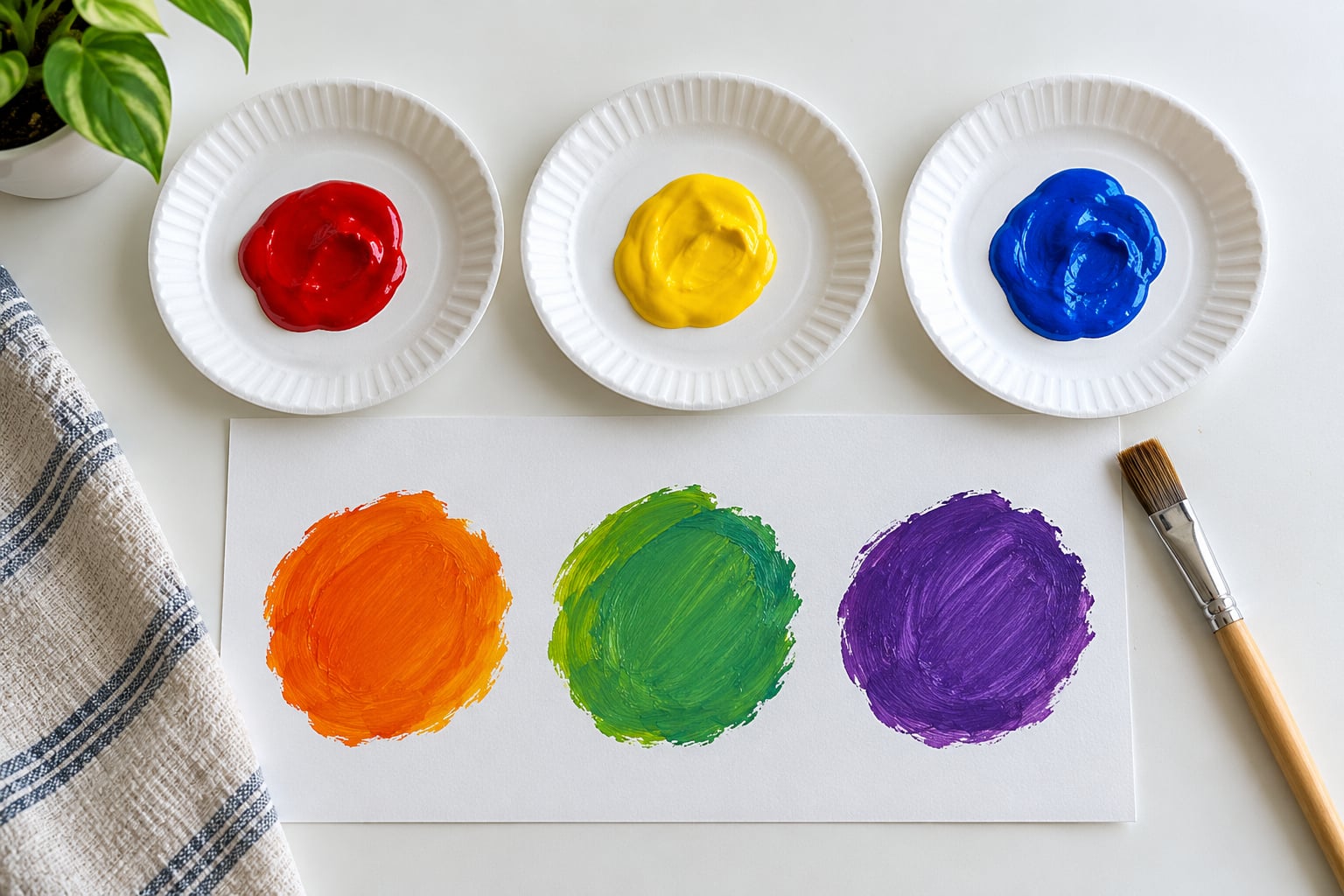
1. Squeeze one dab of each primary color into three wells of a plate, or into three sections of an ice cube tray. Small amounts are the whole trick. A quarter-sized dab gives plenty of mixing room and almost no cleanup.
2. Ask your child to touch a finger to red, then to yellow, then to stir them together in the middle of the plate.
3. Pause and let them name it. Then have them touch two fingers to the new color and point to something at home that matches it.
4. Rinse hands or brushes, refill the wells, and repeat for blue plus yellow, then red plus blue.
5. Finish by lining up all three finished colors so your child can see the full set of six together.
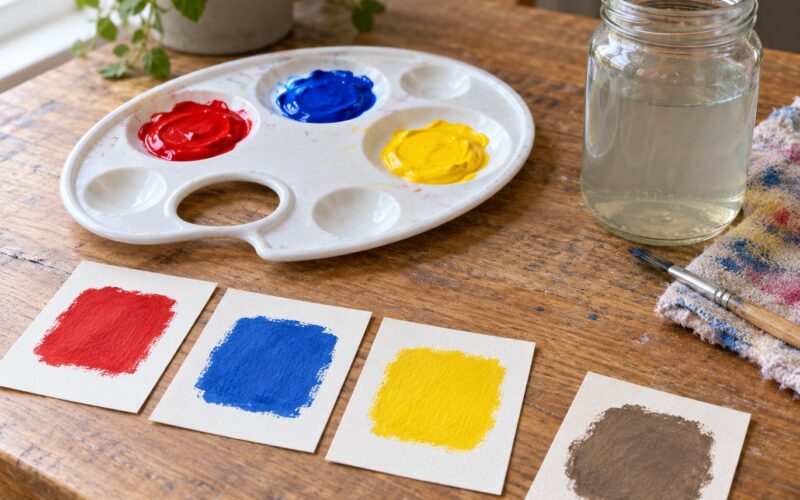
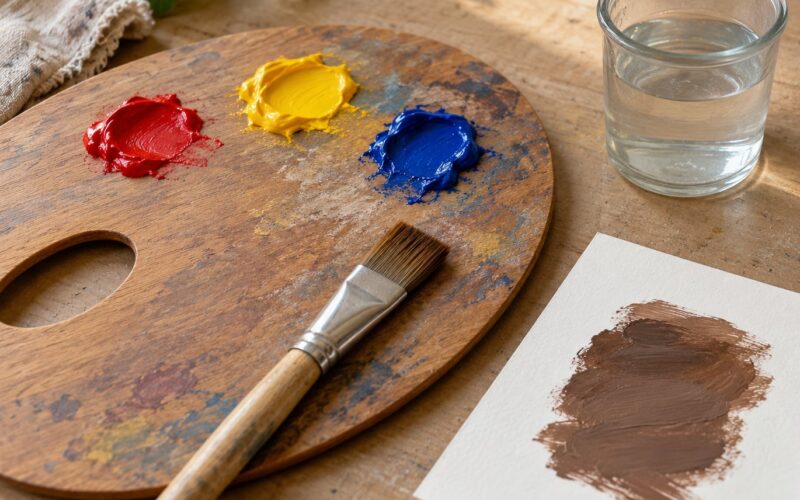
Expect brown. Kids with no reason not to will eventually mash all three at once and make mud, and that stage is normal rather than a failure. Put the third color away before it happens and say why: “today we only mix two, so the new color shows up.”
Easy Activities for Teaching Colors to Children
Each of these reinforces the same three pairs in a different way, so pick two or three rather than attempting all six.
Paint palette pairs. Materials: tempera paint, plates, paper. Goal: memorizing the recipes. This is the core activity above, run as a matching game: paint all three secondaries, cover them, then have your child recreate each one from the two primaries underneath.
Shaving cream bag. Materials: a resealable freezer bag, shaving foam, red, yellow and blue food coloring, scissors. Goal: cause and effect with no mess. Squeeze three drops of different colors into the foam, seal the bag, and let your child squish it from outside. The colors bleed together slowly, so the before-and-after is easy to see.
Ice cube tray color swap. Materials: an ice cube tray, warm water, red, yellow and blue food coloring, a spoon. Goal: controlled amounts. Freeze tinted ice cubes, then let your child move them from one cup of warm water to another and watch the water change color.
Color hunt and sort. Materials: a paper bag or basket, something to draw with. Goal: vocabulary and recognition. Send your child to collect one red thing, one yellow thing and one blue thing, then to find one orange, green or purple object. No paint, no cleanup.
Crayon rubbings. Materials: crayons, plain paper, a coin. Goal: fine motor control plus naming. Draw a thick outline of a simple circle in red, then trace over it in yellow. Rub a coin over both and the child gets a new color that is not there.
No-supply version. Materials: nothing but paper. Goal: the idea with zero setup. Draw six circles on one sheet, color three of them red, yellow and blue, and draw arrows from each pair to an empty circle. Your child fills in the answers.
Simple Questions to Ask Kids About Colors
Questions move a child past memorizing. Work down this list rather than asking everything at once, and stop while it is still fun.
Ask your child to point to the three primary colors on a page, a toy box or the room itself. This checks recognition without requiring speech.
Ask which two colors made the orange on their plate. Keep the answer in a sentence: “I made this orange from red and yellow.”
Ask what they think will happen before they mix, then compare the guess with the result.
Ask them to find something orange and something purple in the house, then explain what those two have in common on the color wheel.
Ask which colors are warm and which are cool. Red, orange and yellow are warm; blue, green and purple are cool. This is a gentle next step that costs nothing to teach.
Ask them to mix all three on purpose and explain why the result turned brown. Letting them destroy the rule on purpose makes them far more willing to follow it the rest of the time.
Frequently Asked Questions
What are the primary colors and what do they represent for kids?
The primary colors in paint are red, yellow and blue. They are called primary because they are the starting colors: you cannot create a pure red, yellow or blue by mixing anything else together. In light, the primaries are red, green and blue instead, which is why a rainbow has seven colors while a paint palette starts with three.
What are the secondary colors?
The secondary colors are orange, green and purple. Each one is made by mixing two primary colors in equal parts: red plus yellow makes orange, blue plus yellow makes green, and red plus blue makes purple. Real paint rarely hits the exact textbook shade, so expect small shifts depending on how much of each color your child adds.
How do I teach primary and secondary colors step by step?
Name red, yellow and blue first and have your child point to each one. Then put one dab of two colors side by side and let your child mix them with a finger or brush, saying the recipe out loud as the new color appears. Repeat for the other two pairs, connect each result to a familiar object, and review one recipe later the same day. Keep it to twenty minutes.
What are the 7 primary colors in order?
A rainbow has seven colors in the order red, orange, yellow, green, blue, indigo and violet, sometimes shortened to ROYGBIV. Those are not seven primary colors. In art, primaries stay at three: red, yellow and blue for paint, and red, green and blue for light. Rainbow order is a memory trick for the spectrum, not a mixing recipe.
What are some fun ways to teach colors to preschoolers?
Paint pair matching works best because the child rebuilds each secondary color from its two primaries. A sealed bag of shaving cream with drops of food coloring gives the same lesson without a single cleanup. An ice cube tray controls how much paint goes out, and a color hunt or crayon rubbing keeps the day moving when the paint dries up.
At what age should I teach my child primary colors?
Toddlers between two and three usually recognize and name red, yellow and blue reliably, so that is a fine time to start. Three to four year olds can handle the mixing itself and will surprise you with what they predict. By five or six most children can mix a pair on request. Under two, simply naming colors during daily play is plenty.
Conclusion
Start with three colors and nothing else. Put a dab of red and a dab of yellow in front of your child, say the recipe out loud, and let them push the two together and discover orange. Do it once more for green and once for purple, and you have taught primary and secondary colors in about twenty minutes.
Add the extra activities, the questions and the color wheel only after those three recipes feel automatic. Updated for 2026, this approach works from a two-year-old naming a fire truck to a kindergartner explaining why their purple came out bluish.