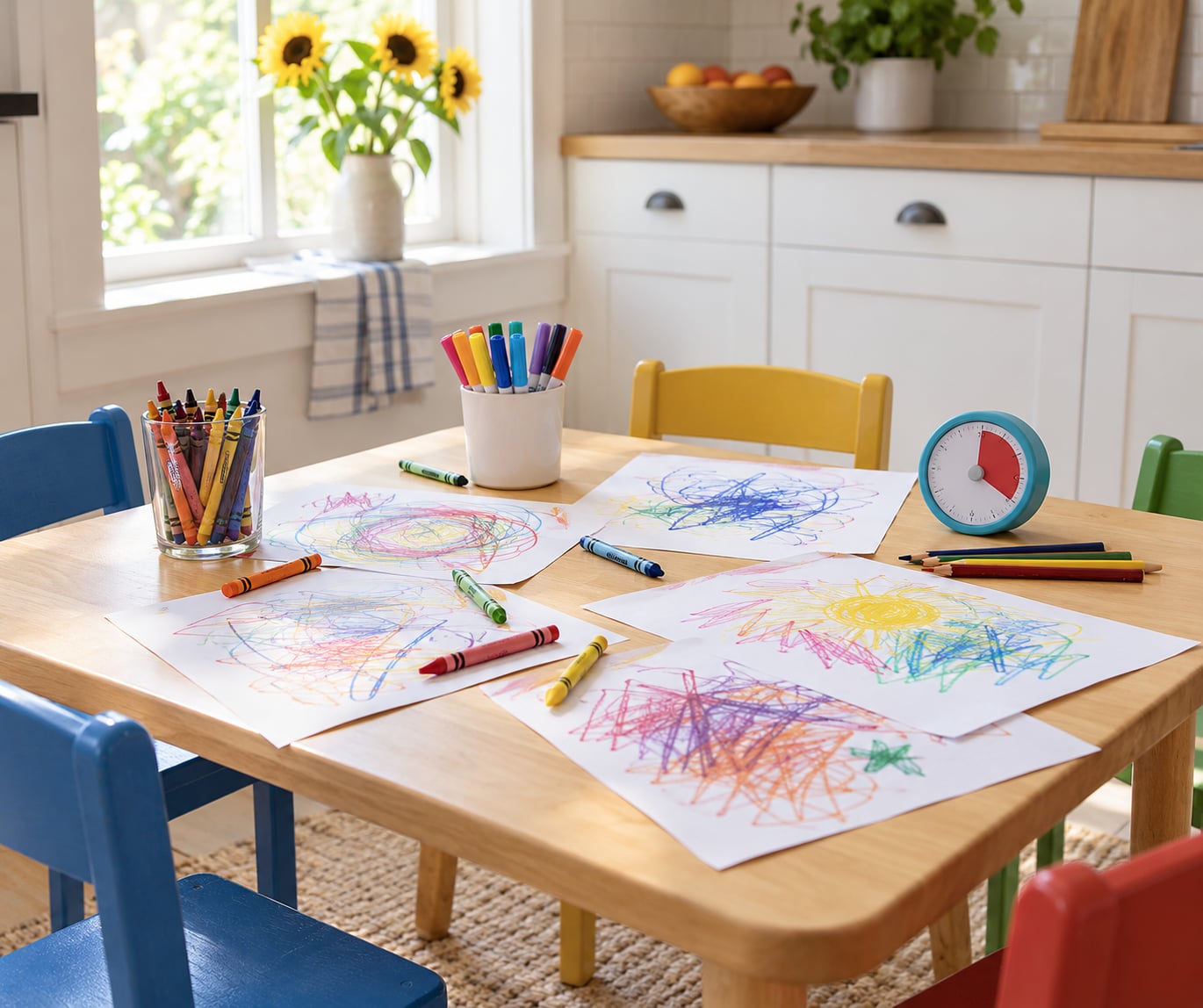
To do a doodle challenge with kids, set up a small space with paper and pens, give one prompt, set a short time limit, and let your child turn that prompt into anything they want. No drawing skill is required. The whole thing takes about ten minutes of setup and 10 to 20 minutes of drawing.
The structure matters more than the prompt. Without a starting line and a finish line, free drawing drifts into staring at a blank page, and that is where most children quit in the first ninety seconds. With one prompt and one timer, the same page becomes a small puzzle.
I keep a basket by the kitchen window with six crayons, a handful of washable markers, a stack of printer paper and a small timer. It takes no planning, costs almost nothing and covers the two moments I most need something: a wet Tuesday afternoon and the gap before dinner when everyone is arguing about whose turn it is.
What follows is the version that works for us most often. Adjust the time limit for your child’s age and you have a screen-free activity that works for toddlers, primary-schoolers and tweens from the same six steps.
Table of Contents
- 1What You Need for a Doodle Challenge With Kids
- 2Step-by-Step: How to Do a Doodle Challenge With Kids
- 3Step 1: Choose a Theme or Drawing Prompt
- 4Step 2: Set a Comfortable Time Limit
- 5Step 3: Make the First Marks Without Worrying About the Result
- 6Step 4: Build the Doodle Into a Picture
- 7Step 5: Add Details and Color
- 8Step 6: Share the Drawings and Reflect
- 9Common Mistakes
- 10Frequently Asked Questions
- 11How long should a doodle challenge last for kids?
- 12What age is appropriate for a doodle challenge?
- 13Do children need special art supplies to do a doodle challenge?
- 14What if my child does not know what to draw?
- 15How can I make the challenge more difficult for older children?
- 16Can a doodle challenge work without a timer or any preparation?
- 17Where to Start Tonight
What You Need for a Doodle Challenge With Kids
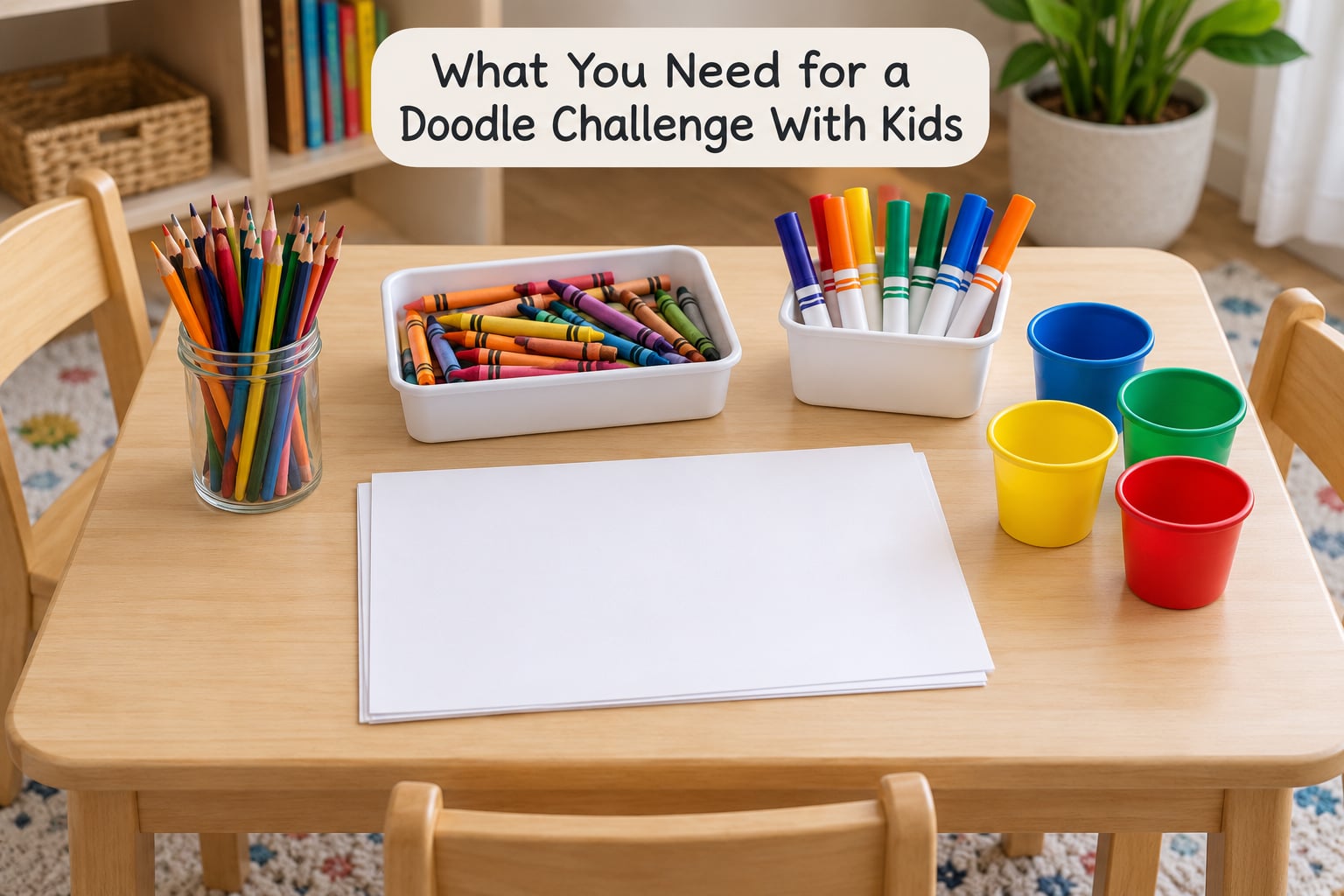
You need less than most people expect. Everything on this list is either already in a drawer or costs very little.
- Paper. Plain printer paper works. Cardstock or a sketchbook feels more special and takes marker without bending. For a long challenge, tape four sheets together so the drawing has room to grow.
- Something to draw with. Pencils and a fine-tip pen for lines and patterns, washable markers for bold shapes, crayons for filling in large areas.
- A timer. A kitchen timer, a phone or a song that runs about the right length. Kids respond better to a visible countdown than to you calling out the time.
- Prompts. A short list you write on slips of paper, a jar you draw from, or a page of ideas from this article. Five prompts is plenty for one sitting.
- Something to protect the table. A placemat, a sheet of newspaper, a large cookie sheet or a cheap tablecloth. Markers bleed through paper and stain wood.
Keep spare paper nearby. A page that gets ruined by one aggressive marker stroke is the fastest way to end a challenge early, and most children will not risk a second sheet unless you put out two.
Substitutions are fine. A paper bag cut flat works like a sketchbook. A potato half dipped in paint gives toddlers a stamp instead of a line. For travel or a waiting room, a napkin and a wax crayon in a coat pocket is the whole kit.
One honest note about supplies: keep the set small on purpose. A full art box invites kids to sort, test and reorganize instead of drawing, and you will lose ten minutes to the setup.
Step-by-Step: How to Do a Doodle Challenge With Kids
Step 1: Choose a Theme or Drawing Prompt
Pick one prompt for the whole session. A broad theme like animals gives kids room; a narrow instruction like draw a house gives them a starting shape. Most children do better with a loose brief than a detailed one.
Prompts that work well are short and slightly strange: a creature that lives in a teacup, a machine that only makes soup, the view from a window on a bus, a house for a snail. The oddness is what gets them going, because there is no image in their head to copy and fail to match.
If someone finishes early, hand them a second prompt rather than a longer time limit. A five-year-old who is done in three minutes gets more drawing to do, not a longer stretch of the same page.
Step 2: Set a Comfortable Time Limit
Choose the limit by age, not by ambition. Two to four years old usually manage five to eight minutes. Five to seven year olds do their best work in about ten. Eight and up can hold fifteen to twenty, and older children often prefer to set their own.
Say the time limit out loud before anyone starts, and say what happens at the end of it. “When the timer goes off you finish your line, then we look at all the pages together” sets a much better expectation than “draw for ten minutes”.
Write the limit at the top of the paper if you like. Children who can see it stop asking how long is left, which removes the most common interruption of the whole activity.
Step 3: Make the First Marks Without Worrying About the Result
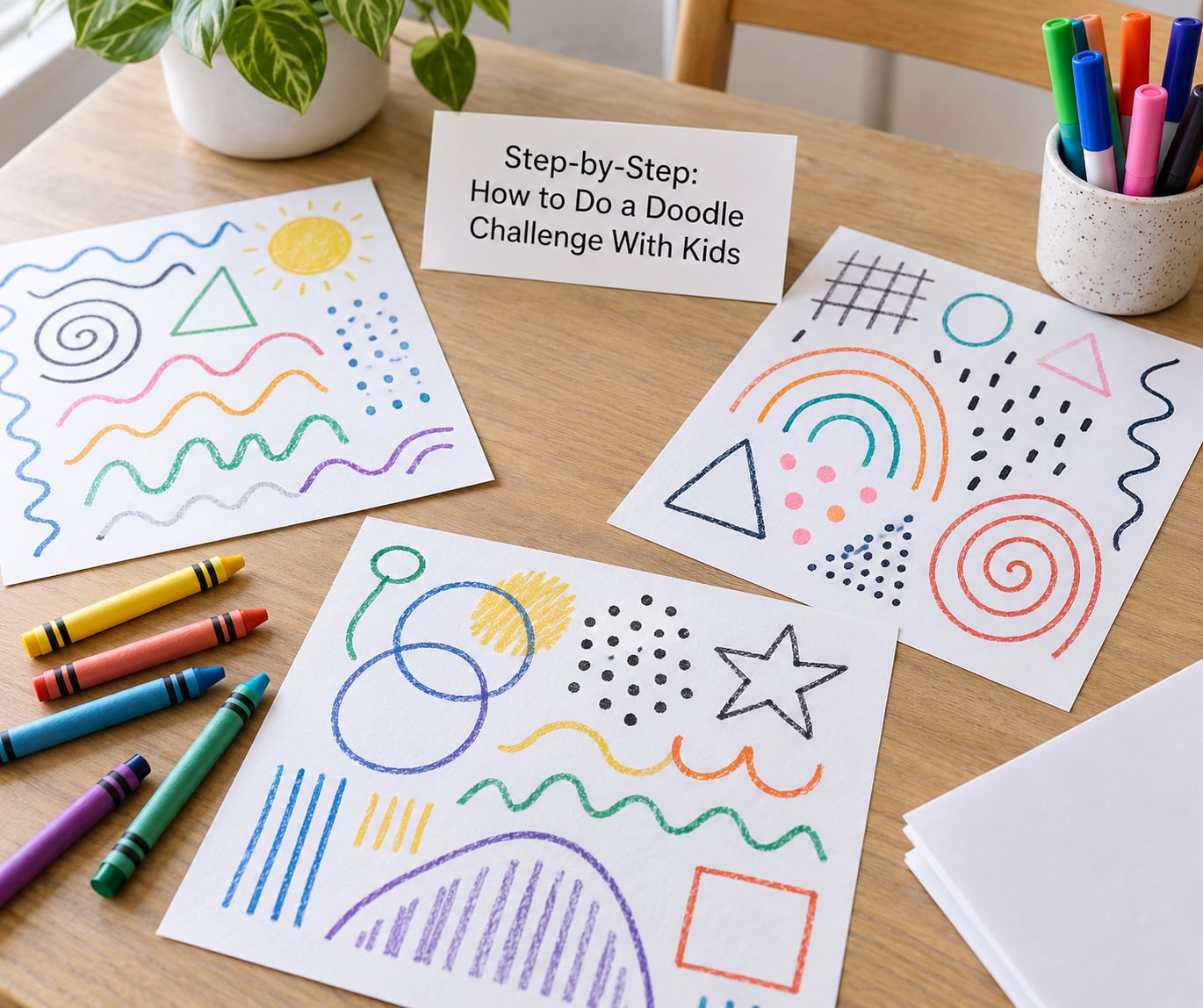
The first ninety seconds decide whether a challenge works. Start with marks that cannot be wrong: scribbles in one direction, then across them, then spirals, dots or wiggly lines until the page feels busy.
This warm-up is the whole trick. Once there are lines everywhere, a child sees texture and patterns rather than an empty page, and every new shape they add looks like it belongs to something already there.
Do the first mark with them, on your own paper, right beside theirs. Adults tend to give advice that lands as criticism, and a minute of drawing alongside you usually gets a better result than a sentence of coaching.
Step 4: Build the Doodle Into a Picture
Now tell them to find something in their marks: a fish, a face, a castle, a bug. Most children can see three or four possibilities immediately, and once they pick one, they own it.
Three techniques work at every age. Draw new shapes around the busy areas to frame the picture. Fill the quiet areas with a repeated pattern such as dots, scales or zigzags. Or leave it abstract and move on, because an abstract page is still a valid result.
If someone says they cannot find anything in their scribbles, cross the lines with a ruler or another pencil. Long straight lines over a scribble produce a car, a boat or a house shape in about ten seconds, and the discovery is theirs.
Step 5: Add Details and Color
Details are what turn a doodle into a finished page: eyes on the creature, a pattern inside each shape, a background around the edges, a shadow under the object. Ask for one detail per shape rather than telling them to finish, since the instruction to finish never works.
For color, pick one of three rules before you start. One color only, which looks striking and cuts decision time. Two colors, one for shapes and one for the background. Or full color, where the only rule is that the page has no white space larger than a hand at the end.
Older children who layer pencil, then pen, then marker get a much better result and stay absorbed for the full time. Warn them that the last marker layer has to be quick, since wet ink smudges for about half a minute.
Step 6: Share the Drawings and Reflect
Lay the pages out together, in date order or in a line across the table. Ten seconds of quiet looking, then one question each: what did you start with, what did you change your mind about, what was the hardest part.
Two rules keep this pleasant. Ask about the process, never about whether it is good. And let the child decide whether the page stays on display, which is what you want anyway, because the pages become a record rather than homework.
If two or more children are taking part, you can score it. One point for using the whole page, one for a repeated pattern, one for a detail you could not see from across the room. Nobody wins overall, and it usually produces an immediate rematch.
Want it to last longer than one session? Put one prompt on a calendar grid, one box per day, and let a single page hold the whole week. A sticker or a small mark in each finished box does more for momentum than any encouragement from you.
Common Mistakes
Giving an open prompt like go draw something. That is a test with no instructions attached, and blank-page freeze is the usual result. Give a concrete noun, an action or a slightly ridiculous situation, and the page fills itself.
Correcting technique mid-drawing. A comment about grip, proportions or where the horizon should sit gets heard as a verdict. Kids who lost confidence in art at school tend to freeze the moment an adult evaluates the work, so keep your notes about the process, not the result.
Letting siblings copy each other. Two children drawing side by side will match each other’s style within a minute. Seat them apart, or set a shared prompt they both draw from at the same time rather than looking at each other’s pages.
Handing over the whole art box. Ten minutes of sorting markers and testing pens is a fine activity, just not this one. Put three markers and two crayons on the table and put the rest away.
Ending the timer before they finish. A hard stop mid-picture feels like a punishment. Give a two-minute warning, and let anyone still working use a scrap sheet to practise while the others start sharing.
Starting on a bare table with good markers. One stained tabletop ends the habit faster than one failed page. Protect the surface first, and put a rubbish bin within reach so nobody has to ask to throw a crumpled sheet away.
Starting too big. “Make an entire comic page” stalls a seven-year-old in under a minute. Small finished pages build the habit; ambitious ones end it.
Frequently Asked Questions
How long should a doodle challenge last for kids?
Match the limit to the age. Two to four year olds usually manage five to eight minutes, five to seven year olds about ten, and children aged eight and up can hold fifteen to twenty. Announce the time and the finish line before anyone starts, and give a two-minute warning rather than stopping them mid-picture.
What age is appropriate for a doodle challenge?
Any age works, because a doodle challenge needs no drawing skill. With toddlers it becomes scribble patterns and stamps, with primary-schoolers it becomes pictures built from marks, and with older children it turns into composition, pattern filling and layering pencil with pen and marker. The prompt changes with age, not the activity.
Do children need special art supplies to do a doodle challenge?
No. Paper and something to draw with is the full requirement, which is why drawing challenges for kids at home work so easily. A pencil and a rubber work for a first round, and crayons or washable markers make the second round more fun. Keep the set to three markers and two crayons so setup stays fast.
What if my child does not know what to draw?
Do not ask what to draw. Ask a smaller question instead: draw a shape you like, fill the page with one kind of line, or draw a thing that could only exist in a dream. Starting with a shape or a pattern removes the blank-page problem, and children almost always turn those marks into something on their own.
How can I make the challenge more difficult for older children?
Add constraints rather than adding pages. Ask them to fill the page with a single repeated pattern, to use only three shapes, to add a second character and a background, or to tell a story across three connected panels. Two-player formats such as back-and-forth drawing, where each person adds to the same page, raise the difficulty for everyone.
Can a doodle challenge work without a timer or any preparation?
Yes. Skip the timer and just say you will stop when the song ends, or when everyone puts their pen down. Preparation can be as small as tearing five sheets out of a notepad and dropping four crayons on the table. A challenge that starts in under a minute is the one most likely to happen again.
Where to Start Tonight
To do a doodle challenge with kids, start with one prompt, one page per child and ten minutes on the timer. Write the prompt on the page, protect the table, and let them scribble first. Everything else in this guide is an adjustment you make after you have done that once.